Spring
April 15, 2015 § 26 Comments

“Unlatch the door to the canary’s cage, indeed, rip the little door from its jamb.” – Billy Collins
The evening is soft now. Dinner is over and I have come out to the back step to watch the bay and witness the arrival of spring. Mid-April is decidedly confident, like a starlet with an abundance of dogwood and cherry blossoms, and oh, those azaleas and the way the wisteria is already snaking through the trees. It would be so easy to stay right here and watch the day end. I don’t want to put anyone to bed or sweep the crumbs from the floor or wash the pan. Then the mocking bird flies out of last year’s tomato plants, its striped wings as sharp as its message is clear. I should go back inside. I should finish the chores. But inside, I hear the boys laughing, not bickering yet, so I sit a bit longer with my palms turned up, feeling spring in my hands until the cry of a jay makes me wince. He is so loud and insistent he competes with the artillery on the other side of the water, and I try to remember we have to let all the birdsong in if we are going to hear any of it.
This morning I walked with a friend, and we passed a group of Marines practicing some kind of martial arts, one kneeling behind the other within a border of sand bags, an elbow in camouflage hugging a neck. They were gentle in their demonstration of this fierce art, and I felt the effect this particular way they train has on my heart. They are careful even as they are practicing the quick skill of killing.
Somehow, overnight, a dogwood tree has turned white in my neighbor’s back yard, right in front of the water, the bay that is now calm and waveless, the whitecaps somehow turning into blossoms in front of my eyes. And this is why spring is so painful to me: all this unfurling and opening. All this softness and ease. Here, the sun says, fooling you. Just sit with me and I’ll be gentle and easy on your skin.
The other day I was sitting outside of the elementary school, waiting for Oliver to come out and wave his lunch box at me. He hates the bus and he says it’s too loud for him to read his book on the way home. We are so alike we don’t always get along, but this I can understand. As I sat on the concrete waiting, I saw a Marine who came to the yoga classes I used to teach and we waved to each other, but in that awkward way. As Henry got closer, he questioned me about my shoulder.
“Are you doing yoga again ma’am?” Henry asked and I told him I’m getting back into it and what about him? Another Marine passed with his two daughters, both of the girls in hot pink, which would make you blink: that contrast between a shaved head and a princess gown, the unlikeliness of softness against the scratch of this world.
Suddenly I miss teaching so much it hurts the way all of this unfolding hurts. The way unfurling yourself to the sun feels, the way your skin peeled off after that bike ride you took on the 101 twenty years ago and the way he put his palm on the back of your burned shoulder blade, right at the place where your heart meets your spine. “Can I help?” you asked then as you stood in his kitchen, watching him spin avocados into guacamole. He smiled at you. “Just charm me,” he had said, while that smile crept in like a criminal.
I told Henry to check out the free classes on YouTube. “Search for ‘Power Yoga’,” I told him. “You’ll find good stuff there.”
“Aw,” he said, “There’s no one like you.” But I know he is charming me because he keeps on walking, his head down and a smile sneaking into his cheeks. Heart and backbone, each holding each other up even as they are completely incompatible. Spring is so misguided, thinking it’s safe to come out, believing it’s acceptable to live for only a moment, that the month of April could ever be enough. I wonder if there is a difference between the Marines with elbows in choke holds and the ones in the yoga classes I used to teach, their shoulders and spines beginning to soften into a twist. And I think there is no difference in gentleness, no matter what pose, the way they all seem to circle around when it’s over and light cigarettes as if they were incense.
Autumn and winter are so comfortable, all clove and wool, mitten and fireplace. I am not sure I can handle this though: the smell of cooked meat wafting through the screen door, which isn’t who I thought I would be. I thought I would be sprouts and hummus, veggie burgers and broccoli, but since Scott has gone we have tacos on Monday nights, after a free yoga class for the teachers while the boys build Legos in the back of the classroom. All these opposites colliding like the osprey who flew overhead last night, clutching the fish in its talons. “You can’t be vegetarian when your husband is deployed,” my neighbor told me while the sun beat down last June. “It’s just too tiring.” And I am disappointed in myself that this has turned out to be correct. I am disappointed I am not as gentle as I wanted to be this year, that I didn’t train the dog to heel, or run a marathon or build more things out of Legos. I am disappointed I am not as patient, or even as kind as I thought I was. But this I can do: I can sit on the back step and turn my palms up to the spring night, revealing a slender frond of green, reluctantly raising its head above the earth.
Inside, I can hear the boys playing still, giggling in a sweet, “let’s prolong bedtime” sort of way. But my palms are still turned up even as the night is falling down over the day. Evening being the way spring is: stuck between the seasons, wedged between cigarettes and incense, medicine and mantra, sin and the ways we are saved.
Ice
February 24, 2015 § 31 Comments

Maybe what cold is, is the time we measure the love we have always had, secretly, for our own bones. – Mary Oliver
The first snow flakes were half-hearted. I reminded myself I am so far below the Mason Dixon line that any snow here would be a fluke. And then the flakes got fatter and faster. By the time I folded some laundry and emptied the dishwasher, snow was definitely lining the porch railings. Even me – with my ability to bury my head in the sand – couldn’t deny the ground was white.
School had been closed before the snow even started, and the boys dug through a box of hats and gloves in the closet and went out with their friends, all of them off to the sledding hill and dragging their summer boogie boards behind them, the leashes improbably being used as tobaggon handles. The dog came out with me and spun and danced and tried to eat the freezing rain as it fell. We were out for so long I could no longer feel my face and Wags’ coat became frozen and clumped in sections. I remembered one of the things I comforted myself with during the scorching days of summer was that at least, living in North Carolina meant I wouldn’t have to walk around with ice in my hair during the winter. But it turns out I was wrong about that. It was like the sweet thought I had on my wedding day, that having a husband meant I would never be alone again.
Scott has been gone for nine months now, and I am weary. I feel ancient. I had thought the initial sadness and missing him would pass but it hasn’t. He is still gone and I see now he is the roots to my waving branches. When he was home for Christmas I felt everything settle, the way it does after an earthquake. When I woke up at night, I heard his breathing, and in the morning, he made coffee calmly and methodically – without pausing between scoops to make oatmeal or get water for the dog or take a handful of vitamins, the way I do.
Now I am back to being alone and waiting for the real mom to show up, the expert who knows what to do when my son says “NO!” and the kids at school are forming cliques, and the teacher assigns those ridiculous word problems. Most days, I can fake it well enough that the veneer holds. I pack the lunches and uncrumple the homework. I dole out as many hugs as I can and sweep up the piles of leaves and bark that always fall out of Gus’ pockets. I try not to freak out when I get frustrated. I drive back and forth to the gym to teach yoga, but lately, I have been feeling like a fraud. I keep thinking that it shouldn’t be me up in the front of the room because I am just about certain that everyone can hear the anxiety and sadness and apathy clanking behind me like tin cans on a string.
Walking in the cold with the dog this morning, I listened to the particular silence of snow which is the exact sound of being alone. WIth Scott gone, I have been forced to look at the tree without leaves, the bare ground without a tropical swath of color, the grey sky without its oppulance of blue. My eyes have been turned towards all of those lonely and vast spaces inside, all of those corners haunted by self-doubt and fear and the smoldering ashes of anger’s old fire. When Scott was here, I had distractions and we had plans. I didn’t have the long stretch of bedtime to test my patience or the dark nights to mock my courage.
Now, I am like the tree in the front yard dropping icicles. These parts of myself I had thought were so solid are now showing themselves as brittle costumes, and it’s like that rotten old dream, the one where I have no clothes and am trying to hide behind a parking meter. My diet is irratic and inconsistent, sometimes consisting of food people normally turn into meals, and other days, I alternate green smoothies with bites of chocolate. Dinner is sometimes peanut butter on a pear and other times, a bowl full of pasta. I am still meditating consistently but I am hardly practicing yoga, sometimes managing 54 minutes, but never an hour. I tell myself it’s because my shoulder hurts, and this is somewhat true, but it’s a deeper frustration, a fear that there are some things yoga can’t fix.
Next week, an orthopedist is going to finally cut into my rotator cuff and fix the tear there, and I feel a mix of terror at the nakednes of it all and relief, that finally – maybe – the ache behind my heart will be repaired, that once again, I will be able to do a chatarunga and lift my arm over my head without the pinch of pain and the somber reminder of my impassable limits. I will be under anesthesia and then in a sling, forbidden for weeks to drive or write or chop carrots. It is both mortifying and terrifying to give up these central pillars of control, and yet, it also feels like sliding deeper into the stillness I entered months ago, a winter that has nothing to do with the ice outside.
This afternoon the boys came inside with a friend and I became swept up in the wonderful familiarity of trying to make food quickly enough to keep pace with their ravenous appetites. I listened to them talk about Legos while cutting apples and making hot chocolate and cleaning puddles of melting snow from the floor. When the kitchen was filled with their loud voices I felt like myself again – that person I was so sure I was. But then they ran upstairs to build a new Lego base, and it was quiet again – just me in the room listening to the freezing rain hit the windows. I watched as a curl of panic rose up like a specter and began to claw at the edges of the silence. The frightened ghost was me and not me. Maybe she is a piece of me, in a bathing suit, crouching behind a parking meter, trying to hide from the cold.
In December, in one of my yoga classes, I talked about the Celtic goddess Calilleach, who rules winter. She is a hooded old crone with perfect eyesight who freezes the ground with her staff and drops stones from her apron to form hills and mountains. I have been thinking about her again now, about her sharp discernment and her ability to lay the burden of her burdens down, allowing those heavy stones to slip from her pockets and fall. Without fanfare or nostalgia, she drops them, exposing them to the harsh winds of winter, and allows them to be shaped into something beautiful.
Responsible
January 10, 2015 § 23 Comments

Forget saftey. Live where you fear to live. – Rumi
We have a new crossing guard at school. The old one was very friendly but he was also ambivialent, and I was never quite sure whether it was OK to keep driving or if a bunch of kids was going to jump out into the street in front of my car. This new guard is different. He is emphatic. He steps out into the crosswalk with his sign held high and his hand out. Stop, his entire body says. Yesterday, as he glared out at our line of cars and shepherded the children between sidewalks, I breathed a sigh of relief. I hadn’t realized how vigilant I had to be with the old guard, when it seemed as if no one was really in charge.
Teaching yoga is not natural for me. When I practice and go to someone else’s class, I plant myself solidly in the middle of the room so I am surrounded, anonymous, and invisible. Sitting in the front to teach is a bit terrifying and so far, it hasn’t gotten any easier. I love being told what to do, how to move, and when to breathe, but playing the role of leader is miles out of my comfort zone. “Breathe in,” I say when I teach, and am shocked when I hear people inhale.
On the weekends, when it’s just the boys and me, I sometimes catch myself waiting for the real grownup to arrive and take over. I have moments when I feel just as I did when we took Oliver home from the birth center where he was born. “They’re trusting us with him?” I kept asking Scott, who had the same panicked look on his face.
Lately, the new responsibilities in my life are overwhelming in a way that makes me feel kind of loser-ish. A few months ago, I expressed my leadership concerns to Rolf and he told me we are at our best when we are giving one hundred percent but still feel stretched. And this is how I feel every day: stretched and still falling short.
When Scott came home from Bahrain for three weeks this Christmas, I was so tired I could barely get out of bed for the first two days. I hadn’t realized how exhausted I was, how difficult it is for me to be in charge, whether it’s in the six yoga classes I teach or at home, as the solo parent. And yet, that is precisely my role right now: to be the responsible one. To be a shepherd of sorts, ferrying my crew from one pose to the next, trusting that right action will arise for all of us.
So many of my friends glide into leadership roles seamlessly. One owns her own law firm, another her own business, and on this Marine base, I am surrounded by some of the strongest and most together women I have ever met. It’s been humbling to realize how different I am and that what comes easily to them is elusive to me.
Rolf conned convinced me to help lead his 200 hour yoga teacher training here, on Camp Lejeune, which is he offering free of charge to veterans. Most of the guys in the training also take my yoga classes, and this has raised the bar even higher for me. The 200 hour training meets once a month and Rolf dials in, appearing on the big TV screen in the yoga studio. But there in the room, I am the one in the front, the one being watched, not just in the training, but daily as I live and teach, succeeding and failing in various degrees. Like a butterfly pinned to a board, I feel exposed, and more than a little bit fragile, my own wings feeling dry and brittle.
And yet, stepping out of my comfort zone to this degree – doing what is so radically uncomfortable – has pushed me to take unusual steps. Knowing that I am being pushed in new directions has brought a new level of accountability to how I sequence my classes and to how I live. It’s so obvious to me now the areas in which I am out of alignment as a teacher, a parent, and as a person. I have had to take charge – and make changes – if not willingly, then by necessity, whether it’s encouraging my children through transitions as Scott leaves again for another five months or ushering students through a yoga class. Most of this is a two-step forward one-step back kind of thing. I feel a measure of success and then I lose patience, my sense of timing, or my nerve.
Breathe in and know you are breathing in, I say, as Rolf taught me to do. And breathe out and know you are breathing out. I am acting “as if” and hoping that some day, who I am now will catch up to who I want to be.
Boone
November 28, 2014 § 27 Comments

When it’s time to move on, there is no one to hold your hand. – Deb Talen, Ashes on Your Eyes
All I knew was that I couldn’t handle Thanksgiving this year. Fourth of July nearly did me in. It seemed as if every dad in the world was manning a grill or out in the driveway fixing something. One of my neighbors was in his garage blasting country music from his F150, and I felt oddly unprotected, even though I couldn’t identify the threat. The cicadas were whirring, the puppy was curled next to me, and the sun was reassuringly hot. Trying to keep things normal, we rode our bikes to the pool- that special summer domain ruled by stay at home moms and kids.
But even that was ruined with men. I sat on the edge of the pool with my sunglasses on while the boys jumped in. Nearby, a general’s wife was giggling and handing out paper cups of wine in a way that reminded me too much of high school. Later, the boys played with a neighbor on a slip and slide and then ran up the driveway with sparklers. The mosquitoes were fierce and I was panicky with a loneliness that was dark enough to feel dangerous. In my head, I mentally ticked off the holiday weekends that remained. Not Thanksgiving, I thought. There is no freaking way.
Last month, I booked a cabin in Boone, North Carolina for this weekend, an extravagant purchase that left me weak with relief. Until Tuesday night, that is, when I cursed my decision. After a busy week, I was finally throwing fleeces and underwear into a suitcase, trying to find large enough mittens and warm enough socks. My neighbor brought over snow pants and I was shocked to discover Oliver is big enough to wear my old hiking boots. Despite the fact that we were leaving, the same panic that haunted me in July was tugging at my ankles; the same creeping loneliness was draping its arms around my neck. I packed and cleaned until almost midnight and then loaded up the car with board games and down coats, suitcases and dog toys.
How foolish I was, thinking I could outrun a holiday.
Still, we got into the car Wednesday even though it was raining so hard, some cars were driving with their hazards on. After only a few miles, I was hunched over the steering wheel, wondering how this was all going to work.
By now, this is a familiar question, one I ask myself daily as I struggle with patience at bedtime or sit in the front of the room before a yoga class I am about to teach. So much of teaching is about being vulnerable, about walking into an empty space and hoping things are going to work out.
On Wednesday after I loaded the boys and the dog and the pretzels and the pears, we stopped at Starbucks. I had been too wiped out to make breakfast and the kitchen was too clean. We ran through the rain, and inside, the smell of coffee was a warm comfort. It was crowded and happy with that pre-holiday hopefulness, that maybe, this year, things would be better. I didn’t hear a woman calling my name until she grabbed my arm and said “Hey you!” It was Terri, a woman who works out at the gym the same time I teach yoga. She is small and wiry with spiky grey hair and eyes the color of sea glass. She was sitting with her friend Maria.
“Oh, these are your boys,” Maria said, touching my arm and smiling. “My girls are all coming home this year.”
“All four girls,” Terri added. “They live in New York. And oh my god – Maria is the best cook. Everything she makes.”
Maria smiled modestly and told me her husband was just home from deployment and that for the first time in a long time they would all be together. I felt her joy beginning to warm through my cold hands and feet.
“You have to try her carrot cake,” Terri said. “Oh my god, I will never eat carrot cake from anywhere else ever again.”
“Are you traveling?” Maria asked me and I said we were on our way.
“Is your husband here?” Terri asked and once again, I felt that shock that I am now part of this community, one that knows what it’s like to not know what will come next.
Last month, my neighbor was almost in tears because her husband was going on yet another training exercise to prepare for his deployment in August. “He’s going to miss Halloween for the fourth year in a row,” she said. “I’m so tired of this. I just want a normal life.”
“I know,” I said, and felt the familiar longing for predictability, agency, and home. Last week, Scott called and told me he just spoke to his detailer – the person who tells him what and where his next job will be. For five years we have been trying to get back to the west coast, and each time, we get farther away from my idea of home. I miss California so keenly, it feels like a phantom limb.
“Well, “ Scott had said. “It’s now between San Diego and one other place.”
“Oh jeez,” I said, because it’s always been between California and one other place. And we always go to that other place. “So San Diego or -?”
“Guam,” Scott said and inside, my mind said I can’t live in Guam. It will be a disaster. And then I remember that it will probably be fine. Because it’s always been fine, at least after a little while, anyway.
“We’ll find out soon,” he said. “I’m pushing for California.” But we both know it’s mostly out of our hands.
I told Terri Scott was in Bahrain and we were running away to Boone. Terri gave me a high-five. “You’re breaking the mold girl! Good for you.”
As we left the store, an older man with a rain-spattered Life is Good shirt held open the door for us and we stood under the outside awning, watching the rain bounce on the pavement.
I did not yet know what the day would bring. I had no idea that outside of Durham, I would drive through a soup of fog and truck spray and rain or that outside Charlotte, the skies would clear, revealing a ragged V of geese. I didn’t know I would stop for gas in a place so scary, it was like something from a Stephen King novel or that the flat land of eastern North Carolina would be so comforting: the low cotton fields and the leaning shacks; the plywood signs announcing boiled peanuts and sweet corn and “tomatos.” (They always forget the “e”). I didn’t yet know that our cabin would be snug and warm and I didn’t know that Wags would be so scared of the stairs I would have to carry her up and down every time we took her out. I didn’t know that for the first time, I wouldn’t get lost, that we would find the hiking trail I read about online and that it would snow as if on cue. I hadn’t yet discovered that pumpkin pie and hot chocolate were the only Thanksgiving foods we would need and that all the things I thought were so important would turn out not to matter very much after all.
Then, I only saw that it was raining hard. I only hoped things were going to work out. I only knew I had been trying really hard to run away from things that are impossible to avoid. Thanksgiving, deployment, the unknown.
“Wait here,” I said to the boys, “And I’ll bring the car around so you won’t get wet.”
“No,” they both said, protesting loudly.
“OK,” I said, watching the rain slant sideways in the wind. “We’d better go.” I took their hands and we ran towards the car, towards the mountains, towards the day.
One
June 30, 2014 § 40 Comments

Don’t let fatigue make a coward out of you – Steve Prefontaine
It’s been over a month since Scott left for Bahrain and June has been like most other Junes. And it’s been like nothing else I have ever experienced. The end of May seems ages ago, and yet, here we are, already sliding into July. We have navigated a trifecta of holidays without Scott: Memorial Day, Father’s Day, and our ninth wedding anniversary. Gus graduated from preschool, the boys began another round of swim lessons, and Oliver fell at a birthday party and needed his face glued back together. We got a puppy (more on that later) and I fixed the internet after a storm blew it out. I take out the trash now and lug those huge water bottles onto the cooler and send in the bills. I have stacks of unread books and blogs but I drove to Pennsylvania and back, where I saw a Mennonite man in Walmart. He reminded me so much of myself in the way he looked out of place, the mud on his boots coming from another time altogether.
Like most anything that can be anticipated, this first month of deployment was both harder and easier than I imagined. As my friend Lindsey writes, “My life is exactly as I planned it and nothing like I expected.”
Scott’s leaving left a gap in my own life, a rabbit hole, where I have been tunneling between my old life and this new and different world. I have solitude to contend with now and a heightened sense of responsibility which lays across my shoulders like a fur robe. Sometimes, it is heavy and grave, and other times, it’s a rich privilege to be reminded of my own capabilities.
I was single for many years, but since I have gotten married, I have abnegated so many responsibilities, maybe even responsibility for my own life. It’s so easy to call into the other room that the internet is down, that the sink is being weird, that I don’t know how to print out my insurance card, that I shouldn’t bother trying to do anything with my life because I’m just going to move again in two years.
This has been sobering.
It’s so easy to be powerless and to blame – to say if only – to imagine that someone or something is keeping you from something. And it’s now both embarrassing and liberating to realize that that someone was me.
Over the past few years, I have taken the wife role so seriously: The laundry and the cooking and the work events that felt so mandatory. Now that it’s only me, I see how so much of that nonsense is optional and that I really do have a say, even if it’s only to say screw it.
The week after Scott left, all three of us were exhausted and staggered through our days with a varying degree of tears (sometimes mine). We have been able to FaceTime with Scott almost daily, if only for a few minutes, and this seems to satisfy Gus, who holds the phone over his Lego creations and his Lego man and says, “This part is where he keeps his gems, this red piece is the control panel, and this piece here is left over from Oliver’s Thunder Driller,” until Oliver begins to yell that now it’s his turn and Gus has had enough time.
Saturdays are the hardest. Scott used to take the boys for most of the day while I drove 90 minutes to a yoga studio or simply did errands. Now Saturdays are glum and Oliver is usually in a foul mood. This Saturday I had the terrible idea of trying to replicate the “Daddy Days.” I made cinnamon rolls and took the boys rock climbing, and by noon, all of us were yelling. My friend Alana coined the term “coming out sideways,” and this is how Oliver’s – and my own – feelings are being expressed.
I have been heartened lately by thoughts of distance running, which I can’t do anymore but which I did for many years starting with my first cross country race when I was eight. In college, cross country races were about three miles, and the first mile was always the most difficult for me. While I could run one pace for a long time, I had no natural speed. To even get a half-decent position by the middle of the race, I had to take off from the start as if lions were chasing me, dodging the melee of elbows and hair ribbons, pony tails and spikes. By the time I made it to mile two, my breath was thin and ragged, my stride uneven, and I felt about as shredded as I do now.
Joanie Benoit once said that the key to racing is to find your pace, and then find your place in the pack and get comfortable there. I have been thinking about this advice a lot, thinking that maybe it’s OK that I end most of my days feeling weak and shredded, because this is what mile one looks like. I remember the way my breath came back in mile two – two footfalls per inhale – and hope that tomorrow I will hit my stride and the footing will be better. I am trying to be patient, both with myself and with my boys. I am trying to do less and slow down more, which is difficult for someone who is used to running, if not fast, then constantly.
When I look back on June, I’ll remember that we got through, but just barely. And yet, what an interesting time this is, like one of those bizarre social experiments from the seventies: What happens to a traditional stay at home wife when you take away the husband?
As of now, I have no idea, but it feels like something of a privilege, if a hard-earned one. Lindsey and Aidan have been writing about marriage this June, and I think it’s kind of a wonder to have a 12-month separation that isn’t due to unhappiness. I have a marriage sabbatical, or maybe a marriage retreat, and I am intrigued by this idea of hunkering down and peeling off the traditional garb I was never very good at anyway. I am clueless as to what the next eleven (gasp!) months will bring, but it’s still early in the race. We’re still finding our pace.
Stitches
June 18, 2014 § 37 Comments

“Have faith in the way things are. Love the world as your self; then you can care for all things.” – Lao Tzu
I was right in front of Oliver when he fell. I was sitting in my friend Jill’s gazebo taking a bite of watermelon at her son’s ninth birthday party as Oliver ran towards us. He and all of the boys were still in their bathing suits but had moved out of the pool and were now playing a complicated game of tag. Or maybe it was hide and seek. Oliver was running as if he was going to hide in the bushes around the gazebo, but he slipped on some dry leaves, and his face hit the wooden step. I jumped up and ran around behind him, but Jill reached out her arms and pulled Oliver up through the bushes, the gash on his face open like a second mouth. “Let me get Jon,” Jill said and handed me a beach towel.
Jill’s husband is a Navy doctor, and after what seemed like a long time, he walked over to us and calmly removed my shaking hand from the towel I was pressing into Oliver’s face. “Let me take a look at that.” After he replaced the towel he said, “Well, you can take him to the ER or I can take care of it here.” Sweat was dripping from Jon’s face. I looked down at his sneakers and realized Jill must have found him during his run.
“I want to stay here,” Oliver said.
Jill shrugged. “If it were our kid, we definitely wouldn’t go to the ER.”
Five minutes later we were sitting in their air conditioned kitchen while Jon dabbed at Oliver’s wound with Q-tips and unwrapped a package of Dermabond. “I’m going to teach you how to breathe while I do this,” Jon had said before he began, and I watched while together, he and Oliver inhaled and exhaled slowly, my own chest rising and falling, my own heart beginning to slow down.
“You’re doing great, buddy,” he told Oliver as he dripped hydrogen peroxide into the gash. “I’ve worked on Marines who yell and scream when I do this.” Oliver closed his eyes and squeezed my hand, and I had to look away and gulp air through my mouth. Last year, Jon returned from a deployment near the Helmand Province, an area rife with both insurgents and IEDs. Jon is an orthopedist, and I didn’t want to think about the injuries he saw there.
“You all made it back from Afghanistan, right?” I asked Jon after Oliver had been patched up and was proudly showing the other boys his bandage.
“The medical corps all came home,” he answered. “But not all the Marines.”
Most days, as I cut peanut butter sandwiches in half, pull weeds from the tomato beds, sit in my friend’s bright kitchen as she dumps the watermelon rinds from a birthday party into the trash, I often forget I am tied to the military, even as artillery booms across the water and helicopters fly overhead. This war has been going on for so long that I am numb to the stories, as if they belong to someone else’s life or to another world completely. And then something happens – another civil war, another battle for Falluja, another story from a friend or neighbor – and I realize that closing my eyes doesn’t mean things stop happening.
Perhaps the biggest impact of Scott living in Bahrain is that the stories I used to think were relegated to an imaginary world are now intertwined with my own. I am too aware that things I thought only existed on the news are actually happening in my lifetime, in real time.
When I do Facetime with Scott, I sometimes see the Manama skyline from his hotel, the industrial, unfinished city and the sand surrounding it. He is apartment hunting now, and in the photos he sends, I can see the Persian Gulf from a window over the kitchen island or sometimes from the bedroom. Water view, he types underneath, as if he is trying to sell me on the place.
Last week, Scott told me about a brief he had to attend about Ramadan, in which he was reminded he could not eat or drink in public and that he was required to wear long sleeves and pants. Ramadan, I think, and remember a friend who left Afghanistan in the 1980s, as a child, because her father was a Freedom Fighter. During one Ramadan right after college, I had my first chai tea in her tiny apartment while she told me about the meals her grandmother used to cook when it was time to eat again.
For so long, I have lived in small, narrow rooms, consumed by my own private joys or struggles, or simply the questions of what color pawn I want to be, when we are going to the pool, what we are having for dinner. I like being insulated like this, safe as houses. In fact, I long for a permanent home of my own with a keen and insistent wanting. I can’t wait until we can stop moving every two years like bedouin. Maybe I am even a little bit obsessed as I cut photos out of magazines, pour over Pottery Barn catalogs, and sometimes take paint swatches from Lowe’s, as if I had rooms to swath in color. So it’s probably no accident that each place I have lived has taken me further from my ideal of home, to the point where our family is no longer even together on the same continent.
My friend Christa once told me we keep getting the experiences we need until we learn the lessons, and I believe this may be true. A few months ago I read an interview by Chip Hartranft in which he defined abhyasa – traditionally translated as practice – as to sit and face what is real. When I told Rolf about this during my training, he said, “To sit and face what is real and allow it to be exactly as it is.” This may be the central lesson of my life right now: Can I keep my eyes open and let things be? Can I have faith in the way things are?
Oliver’s bandage fell off a few nights ago, which was a relief because it had gotten pretty gross. He was wearing only his pajama bottoms when he came to find me brushing my teeth, and he had to drag a step stool over to see himself in the bathroom mirror. The scar on the top of his cheekbone was small and neat, another stitch in the fabric of himself, holding together the being and the becoming. He turned from side to side, his torso lean and fragile. “You know Mommy,” he said with a big grin, “I think it looks pretty good.”
Unraveling
May 26, 2014 § 22 Comments

If I were out at sea, I’d want to know someone was waiting for me, wouldn’t you? – from “Seating Arrangements” by Maggie Shipstead
When I first read The Odyssey, in ninth grade, I thought that Penelope was a bit of a drag with her weeping and begging to be put out of her misery. I smugly thought I knew what she was doing, spending her nights unraveling the shroud she had been weaving all day in order to keep her suitors at bay. There didn’t seem to be anything more to it. The only reason I even remember the class at all is because it was where I first learned about symbolism, which felt a bit like opening a secret door.
Now, I see Penelope’s sabotaged weaving as something much different. I see the unraveling as something that happens when a person physically leaves a marriage, no matter how much love or faith remains. Until Scott left for Bahrain, I hadn’t realized how much a marriage depends on both threads, woven together in words and shared experiences and in presence. I had taken for granted the way Scott and I can look at each other and smile (or grimace) at something Oliver or Gus says, however innocuous, because it conjures up a shared, but private history. Frankly, I am surprised by this, by how I have allowed myself to become so entwined in another person’s life. For 32 years I was single, and mostly unattached. Naively, I had thought I could be in a marriage but keep my solitude and independence, that I could create a life with someone but not miss them too much if they went away.
Scott works long hours normally, and during April and May, he was gone before sunrise and often came home after dark. While I knew the weekends would be difficult, I didn’t think this deployment would make much of a change to my weeks. I had thought I was stronger than I am and I am completely caught off guard by how much I miss Scott, how much I depend on his steadiness, his sense of humor, and the ways he allows me to completely fall apart.
Now, he is living in a hotel room in Manama (it might be months before an apartment can be obtained because of security clearances) and he can Facetime with us in a computer lounge on base. He calls in the mornings or in the afternoons here, which in Bahrain, is after 10 pm. He sends beautiful emails detailing the delicious shawarma dishes he eats, the fresh fruit juices on the menu instead of cocktails, the rug shops that are open until late at night. “When you visit,” he says, “We can pick one out.” I think of those thick and colorful tapestries, and I feel myself coming undone.
Scott told me that the international school where we would have sent the boys is on the edge of a Shia village, or a black zone, forbidden to Americans because of sectarian violence. He told me about the big fence around the school and the graffiti on the walls, the armed guards who ride on the school buses. On one of his first nights there, the street with American restaurants was closed because protesters were burning tires. Scott also sent beautiful photos of the Manama skyline sparkling at night, of the tan and empty desert, and the twin spires of the Grand Mosque, which my mother accurately pointed out, “look so much more interesting and exotic when they are in your own email box instead of in a magazine.” When I talk to him, I can almost feel the heat he describes or smell the bahji puri, but mostly, I just feel so far away.
My neighbor’s husband is in Guantanamo Bay for nine months, and the other day, while she was walking her dog, she warned me the weekends are the worst, and this holiday weekend proved her right. Oliver has been extremely difficult lately, both needy and angry, and I am trying to be understanding while also holding the line that must be held for him. Of course, I am flooded with doubt over every decision. Oliver loves boundaries even as he rails against them, making faces at me, talking back, telling me he doesn’t care that he has lost his screen time. In a single day, I am both the meanest mom on the planet and the best mom in the world.
Today, we drove 90 minutes to Wilmington, mostly because I couldn’t stand the sight of one more father firing up a grill and because I was feeling angry and needy myself. We went to a historical, working plantation and then to a children’s museum. “I know you’re having a hard time,” I told Oliver, after I made him sit down because he wouldn’t leave his brother alone. He looked at me with his father’s eyes and said, “It feels like a piece of my heart fell down into my stomach.”
Jason Crandell, the yoga teacher, recently posted this on Facebook: “Your edge is the threshold in a pose—or moment in seated meditation—where physical, mental, and emotional resistance comes rushing to the foreground. Reaching your edge is like applying an enzyme that ignites a reaction and magnifies your physical, mental and emotional patterns.”
This leaving has revealed a jagged edge I didn’t even know was there. I didn’t realize my husband’s journey across an ocean would dredge up all the other times I had been left, and even worse, the magnification of all the ways I abandon myself. I hadn’t known this fact about myself, which is that my constant doing might become my own undoing, that I don’t really know how to stop, how to be still, how to let go. I know how to fill a space with yoga or reading or meditation or watching TV, but this is wildly different from doing nothing or becoming empty.
For the first few nights Scott was gone, I didn’t really sleep. As another dawn began to leak through the night, I felt as though vines were wrapping themselves tighter and tighter around my chest. Already, I was thinking of cleaning the house, going on another cleanse, doing a 40-day meditation sadhana. I know how to tighten and how to restrict. I know how to take away and how to cleave at the messiness until I am clean and sharp. But as I lay there, listening to the buzzing satin of the dawn, it became clear that while I know how to fall apart, I have no idea how to unravel.
Images have been in my mind and heart lately: kelp fronds waving in cold oceans, wind chimes untwisting in the wind, the line from the Tao te Ching that reminds me to have faith in the way things are. I don’t yet have enough faith to believe that everything happens for a reason. There is too much darkness in the world for me to believe in both this and a benevolent god. But I have a sense that in my own good life, I am getting lessons I need to learn. Today, in the plantation, we peered into a weaving studio with a spinning wheel and a loom. Outside, sheep grazed and inside the wool was carded. Fabric was woven together and dyed and sewn into something that can be worn. And yet, I was focused on the undoing of it all, the unweaving, and the unraveling, and what it might feel like, when I too learn how to twist and untwist in the wind.
Care (Again)
May 9, 2014 § 3 Comments

Compassion is not a relationship between the healer and the wounded. It’s a relationship between equals. – Pema Chodron
Thank you so much for all of your comments about what self-care means to you. I learned more from your comments than from any self-help book. If you haven’t read them, you can find them here.
I am bolting in a different and good kind of way today and am in Chicago where I am meeting two of my oldest and dearest friends, both of whom live in the chilly Midwest. Since it’s already been in the 90’s in North Carolina, I have been surprised by the trees here, with their small and early leaves. As the cab left the airport and lurched into traffic, the new green here slayed me for a moment with its lesson of vulnerability that lately, seems to be at the heart of everything.
There is only one way to fly out of Jacksonville, North Carolina, and it is on the tiniest of airplanes. Today it was me and about one hundred Marines, all of us walking across the tarmac and squinting our eyes against the wind of the engines. Once I was on board in my miniature seat, it was clear that there was a mix-up with some tickets, as two people were claiming a single seat as their own. The Marine next to me calmly stood up (ducking his head) and said, “Why don’t you move, sir,” to the man who had taken someone’s seat because someone else was in his. When the man ignored him, the Marine tapped him on the shoulder, his tattooed bicep just inches from my face. “Sir, it started with you, why don’t you go back to your seat and let’s figure this out.”
The man in the black suit looked startled and then annoyed and then after the Marine calmly blinked at him, the man in the suit walked back to his seat. The Marine reminded me of my husband, of the way he can diffuse a situation without raising his voice, which is a special kind of power in this world.
“Nice work,” I said to the Marine next to me and he smiled.
“Just sorting out problems,” he said, as if he did this every day, which he probably does. He held my gaze in a way that unnerved me. Usually I face forward in airplanes. When flying, I do not make eye contact with anyone. Ever. And this sudden intimacy with a stranger was both unsettling and comforting. He had the same color eyes as me and for an instant, I wondered if we had met previously. And then, I realized that what I was experiencing was simply the recognition of our shared human contract, both of us alive to do something in the world.
This is the same feeling I had as I read your comments on what self-care means to you. Although I have not met most of you in person, I had the feeling that there is something deeply known in each of you, something deeply familiar and comforting and shared.
Thank you.
I will announce the winner of the giveaway on Mother’s Day.
Care – And Giveaway!
May 8, 2014 § 43 Comments

You too have come into the world to do this, to go easy, to be filled with light, and to shine – Mary Oliver, from “When I Am Among The Trees”
The last few weeks were big ones in our house. Scott finished his job (which has the best title in the world) as the Officer in Charge of Construction at the Office in Charge of Construction. (And who said the military has no imagination?) On Tuesday, they had a ceremony to disestablish the OICC, as the majority of work has been completed. What they did in a few years was outstanding. Roads, highways, and bridges, barracks, and fitness centers were built, totaling over three billion dollars. Scott’s family came out to visit from Oregon, his brother came from Texas, and my parents came from Pennsylvania. We rented a house by the beach, where the five cousins dug in the sand and hunted for sharks’ teeth.
The ceremony was surprisingly emotional for me, and I couldn’t help but appreciate how the military commemorates the endings and beginnings of things. Now you are here. Next you will be there. There is no ambiguity.
During the past few weeks I have been filled with ambiguity, while at the same time, without my own usual rituals of yoga and meditation and walks by the water. I even stopped using my neti pot and drinking lemon water. It’s not surprising that I felt groundless for many days despite the joy of being with family.
I am participating in Renee Trudeau’s Year of Self Care Mother’s Day Giveaway, which is amazing (see below!). The invitation to participate came at a time when I was already thinking about self-care. I get the basics of self-care: eat well, sleep enough, exercise, and do things you love – even if I don’t always do those things.
What challenges me, are the more subtle aspects of self-care. I have been working with Alana Sheeren, and her energy work has been a transformational experience (I will write more about this later), and as a result, I am thinking more about how I talk to myself, what I believe about the world, and what I allow myself to have. I have been really struck by the fact that I can drink all the green smoothies in the world, but if I have no faith in myself, I will be miserable.
I have also been thinking of the ways we (of course, by we, I mean I) handle the hard things. Pema Chodron says, “Never underestimate the inclination to bolt,” and I have been well-aware of how I bolt. (More to come on this too).
I guess what I am wrestling with really, is how do we take care of ourselves when we don’t want to? How do we be gentle with ourselves when we don’t believe we deserve it? How do we speak kindly to ourselves after we have snapped at our children or let a friend down? How do we make time for ourselves when so many other people have bigger, more pressing problems than we do?
I would love to hear your comments about this, as I think we have all been in these places of wanting to crawl under the covers with a trashy magazine/bottle of wine/Clooney/pint of ice cream/other personal escape vehicle.
This giveaway is really amazing. I wrote a review about Renee Trudeau’s first book, “Nurturing the Soul of Your Family” here .
To participate in this giveaway, leave a comment below by May 10th on what self-care means to you, and you could receive a Self-Renewal Package which includes a copy of the beautifully illustrated, award winning books, The Mother’s Guide to Self-Renewal orNurturing the Soul of the Family and free registration to the Mother’s Guide to Self-Renewal Online Telecourse (a $125 total value) from nationally recognized life balance teacher, Renee Peterson Trudeau and Hopeful World Publishing. Additionally they¹ll be entered to win the $2700 Year-of-Self-Care Mother’s Day Giveaway. The giveaway is a week-long self-renewal retreat at the Omega Institute. I will pick the winner at random.
I am sorry I haven’t given you more time to enter. (I was also looking for shark’s teeth. And maybe I was bolting a bit too).
Process
April 7, 2014 § 26 Comments

You can talk about writing all day, you can think about the book you want to write, imagine what the finished product will feel like in you hands, but until you actually sit down day after day and bleed the thing out of you, you’ll never see a word. – Claire Bidwell Smith
I was extremely honored and also surprised when my dear friend Lindsey asked me to be part of a blog tour about the writing process. Honored because I love Lindsey’s work and respect her discipline to her craft, both in the precision of her writing and the frequency with which she posts on her blog. I was surprised because I don’t write very often and am not really the go-to person to talk about writing process. At first, I wasn’t sure if I could write about something that doesn’t exist, but the inquiry itself was extremely helpful and provided some much needed motivation.
1) What am I working on?
So this is a really humbling question because I am not working on anything other than mustering the courage to get to my laptop and actually write. There is a great deal of debris in the path – because that is the nature of the path – but mostly I am battling the loud voice booming who do you think you are. (Note: I actually just realized this now, as I wrote it down, so thank you Lindsey for inviting me to answer these daunting questions.)
What I would like to be working on are more blog posts. An idea for a novel simmers always in my mind, but because I am not writing down what the characters do or say on a daily basis, I am not sure that counts. Another goal I have is to write more about my experience as a mother and yoga teacher and military wife. Because these puzzle pieces often feel at odds with each other, I resist writing them down. Often, I resist the stillness needed to sit and write as well as the honest inquiry that’s a necessary part of the process. However, the more people I meet, the more I realize that most of us don’t quite fit together at the seams and that the large pieces that are marriage and motherhood and children and careers and relationships often have complex edges to them.
2) How does my work differ from others of its genre?
Again, humbling question. I am not sure my writing does differ from those in my genre, if those in my genre are women striving to appreciate both the dark and glittering moments of our days, to make meaning out of the mundane tasks of being an adult, and to find our place in a world that is wildly different from our expectations and maybe, exactly the way our parents warned us it would be. I definitely have more grammatical errors than most, that is for sure.
On another note, I write about military life from a slightly different vantage point, as I am much older than the typical military wife and I married my husband despite the fact that I used to believe that most people in the military were violent, right-wing, rednecks. Mostly what I write about is how this wildly absurd and ancient belief of mine is proved wrong on a daily basis. I also write about teaching and practicing yoga on a military installation in the South, and while I have tried, I haven’t found a ton of people who write about this.
3) Why do I write what I do?
When I DO write, I write about teaching yoga and living on a military base mostly because I am lonely or I want to make sense of something. And I am trying to make meaning about this unexpected life of mine. And, there are so many staggering bits of wonder and joy and tenderness observed every day that I want to preserve them somehow. The only way I can get past the who do you think you are demon is to remind myself that my greatest responsibility in this lifetime is not to squander it. Deepak Chopra said that our gifts to the world are usually found in our deepest desires. So I am trying to be faithful to this message that we need to follow our hearts, not just so we will find happiness, but because it is the sole reason we are here on the planet.
4) How does your writing process work?
Okay. This question is just funny. (sigh). My writing process begins with me thinking of something to write about on a run or during a yoga practice or on my mediation cushion. Then, about 2 weeks pass in which I do absolutely nothing and feel lousy about it. Next, I blow the dust away from the keyboard and try to remember my wordpress user name and password. Finally, I spend an evening staying up too late, and writing. Usually the next day, I erase everything and try again. The process continues from anywhere between three to seven days, at which point I give up and hit “publish.” It’s almost a given that I can’t sleep that night as I wonder why I discussed something so dull and really, I actually wrote that and made it available to strangers? Or even worse, to people who know me?
Writing is hard. And if you are even a tiny bit as neurotic as I am, the process will bring you to your knees.
I am so grateful to be a part of this blog tour as – because it always happens this way – I often don’t know what I know until I write it down. Please check back – as I did – to learn about the writing process of successful writers. I took notes!
Next week, the tour continues with Dana Talusani and Betsy Morro, two incredibly gifted writers and friends.
Elizabeth Marro was a journalist and freelance writer before she deserted the field to make money marketing and selling drugs. (The legal kind.) Since 2002, she has been weaning herself from the pharmaceutical industry and returning to her writing roots. Betsy and I used to be in a writing group together in San Diego, and I am eagerly awaiting the publication of her first novel, Casualties, the manuscript of which, I was luckily enough to read and be captivated by. Her freelance work can be found at LiteraryMama.com , San Diego Reader, Peninsula Beacon, Downtown News, among others.
Dana Talusani writes at the popular blog, The Kitchen Witch. She is a former teacher, writer and personal chef and now lives and writes in Colorado, where she lives with her husband and two girls. Recently, she was chosen to be part of the Boulder – Listen to Your Mother performance. I look forward to meeting Dana this summer, and for now, I have to settle for her heartbreaking and hilarious blog and her text messages, which remind me I am not as alone as I think I am.
Procrastination
April 3, 2014 § 34 Comments

I haven’t banished procrastination forever by writing about it, but the prospect of a public shaming turns out to be an excellent spur to keep going. – Adam Green, April, 2014 Vogue, “Late or Never?”
I was recently honored by Lindsey’s invitation to join the blog tour about The Writing Process, which I will do on Monday. I was also a bit chagrined, as I actually have no writing process (evidenced by how infrequently I post here). For as long as I can remember, I have wanted to be a writer. But, can you really be a writer if you don’t write?
On Monday, we left North Carolina for Legoland Florida, and I do what I always do at the airport and spend way too much money on fashion magazines (which is totally ludicrous as I live in Gap jeans, tee shirts, and Chuck Taylors). Regardless, I thoroughly enjoyed the recent Vogue piece by Adam Smith in which he honestly details his experience as a chronic procrastinator. After just narrowly making a deadline, he tries to alleviate some anxiety by surfing, only to come face to face with these questions about his inability to write:
“Did it stem from fear of failure? How about fear of success? Was I crippled by low self-esteem? Or did I withhold my best efforts because I thought that I was special and the world owed me a living?”
Yes to all. And also, None of These.
For me – like many other writers, and of course, Joan Didion who first said this – “I write entirely to find out what I am thinking, what I”m looking at, what I see, and what it means.”
Lately, I haven’t wanted to know what I am thinking. I haven’t wanted to feel much of anything. Lately, all I can think of is Scott’s upcoming deployment, which embarrasses me, because I am Too Old For That. We have been together for eleven years, and I should be a seasoned veteran at this point. This whole deployment business should be Old Hat. I should be like the Marine wives around me, the ones who wave their hands in the air when I ask how they are doing while their husbands are in Afghanistan, the ones who tell me that it’s fine, that they are used to it, that sometimes, its even easier.
This is not my experience. Right now, I watch Scott do the dishes and think that in another six weeks, he won’t be here to help with anything. Today, he replaced the battery in my car, and I thought, Lord help me. On Friday nights, as I sink into the couch with a glass of wine, I remind myself that when Scott leaves, I will need to be Sober At All Times, because I will be the only one in charge.
Rationally, I know that Scott is leaving because his job demands it and I knew this going in. And yet, it feels a lot like being abandoned. Waiting for him to pack his bags and go reminds me of all the other times I have been left, even if now I am grateful that all those people are no longer around. There is something about standing still that feels like falling behind, and some days, it causes me to put a hand on my heart and take a breath.
This leaving that we are all waiting for is affecting the boys too, or at least Oliver. It’s common in the military to be told that if the mother is fine, everyone is fine. Maybe this is true. And maybe, kids have their own feelings about things. I haven’t written much about my children lately, because life at home has been challenging. I haven’t wanted to write about Oliver’s stubbornness, his defiance, his 8-year-old explosions. After a very difficult week, I took Oliver to lunch and to the bookstore and he told me he was sad his dad was leaving and a little mad too. “Why can’t they send someone else?” he asked while crossing his arms over his chest, and I did my best to explain that sometimes we are the Someone Else. At night, Oliver and I have been reading Harry Potter or The Secret Zoo series and as he snuggles against me. I remember that while I may be saying goodbye to a partner, he will be missing his dad.
The first day of Legoland wasn’t much easier than home has been. At the suggestion of going on a ride outside of Chima Land, Oliver shouted “NO!” or sulked, or crossed his arms over his chest. All of these reactions frustrated me immensely. He’s going to grow up thinking he’s entitled, I thought, or He’s spoiled or Here we are in Legoland and he can’t appreciate any of it. Scott and I exchanged many looks that day which said mostly the same thing: Be patient. Yes, I know this is hard. and Don’t lose your shit.
Recently, a dear friend and mentor reminded me that when parenting, the wise choice is to choose love over fear. Sometimes I can remember this and sometimes I can’t. After that first harrowing and hot day, our eyes exhausted by primary colors, we found a small Italian restaurant for dinner where they brought homemade foccacia to the table and bowls of pasta so hot we burned our tongues. Afterwards, we walked to the small lake behind the restaurant where I cautioned the boys to watch for alligators. Undaunted, they ran on, while above us, a large bird circled and cried so loudly we all stopped to watch as it careened on enormous wings over our heads.
“What kind of bird is that?” Gus asked.
“A peregrine falcon?” I wondered.
“It looks almost like some kind of eagle nest,” Scott said.
Finally, Oliver said, “Why don’t you do a search for “raptors” and “Lake Wales, Florida” on your phone?”
The quick iPhone search revealed that the bird was an osprey, which have survived habitat loss by nesting at the tops of dead trees, channel markers and abandoned telephone poles. Before we went back to our hotel, we watched the male circle again, his wings arched and his talons out. While he was circling, the female sat in the middle of their enormous nest, observing it all. Nature is chaotic, I thought. Love over fear.
The second day at Legoland was easier than the first. We picked a few rides to go on as a family and then realized that what the boys really wanted to do was examine the life-like cities and buildings of Miniland and play in the treehouse-like Forestmen’s Hideout. I kept thinking of the female on that nest, watching her mate circle and the people below her come too close. If life is teaching me anything, it is that most of my problems can be solved by just calming down. Being still. Choosing love over fear.
I used to think that “comfort” and “stillness” were wildly different things – comfort being synonymous with decadence while stillness was aligned with a more monastic quality. But now I am wondering if the two intersect. Maybe, comfort is even found most reliably in the act of being still, in not circling around a moment but rather, sitting fully inside it. Perhaps my own procrastination has to do with avoiding my turn being the Someone Else. Maybe not writing is the way I dig in my heels, cross my arms over my chest, and resist. And yet, resistance is cold. There is no comfort in a fight, but I am always heartened at how quickly comfort returns when I stop resisting the way things are. Warm nests. Hot pasta. Fashion magazines. Uncrossing our arms. Being still. Maybe they are just different versions of the same thing.
Play
February 4, 2014 § 5 Comments

I am very excited to be participating in the series: 28 Days of Play, hosted by Rachel Cedar of YouPlus2Parenting. Rachel is asking the intriguing and maybe even uncomfortable question: Do you play with your children?
Please join me today over at Rachel’s to read what I have been too reluctant to have ever shared with a parenting group.
You can also link to the series through an article about 28 Days of Play on the NBC/Today Show Website. While you are there, check out some of the other amazing writers who will be joining in 28 Days of Play. And check out Rachel’s parenting coaching from the heart.
To read Dana’s beautiful Day 1 essay, click here.
I would also love to hear from you. Do you play with your children?
41
January 28, 2014 § 30 Comments

No matter how old, there must be cake.
The number forty is highly significant across all traditional faiths and esoteric philosophies. It symbolizes change – coming through a struggle and emerging on the other side more enlightened because of the experience. – Dr. Habib Sadeghi
Usually, I begin my yoga classes with child’s pose or a simple seated meditation, but really, meditation is too strong of a word. We breathe in. We breathe out. And inevitably, a Marine in the back of the class is trying so hard not to laugh out loud that he is silently shaking. Usually, I have to close my own eyes and press my lips together so that I don’t start laughing myself.
It’s always a bit awkward in the beginning when I’m asking them to come into cat cow pose and then downward facing dog. Some people are looking around and vigilance pulls up the chins of others. No one is breathing and you can feel the tension rising off bodies like steam.
Then I ask them to come into plank pose, and like magic, all the giggling stops. After about ten seconds in plank, the vibrations in the room begin to settle. After thirty seconds, the disparate streams of energy begin to gather. After a minute, the quiet comes down like a curtain falling.
I don’t have them hold plank to prove anything, or even to quiet the laughter. There is something so familiar about that pose for Marines and athletes – something almost comforting about being in a high push-up. And yet there is something else about plank that gets right to the heart of our own vulnerability. Maybe it’s that our pelvis wants to collapse in a way that would showcase our weakness. Maybe it’s that plank pose demands us to soften the space behind our hearts. Or maybe it’s the quiet of the pose itself, the stillness required to hold ourselves straight and stare at a single spot on the floor.
After plank pose, it’s different in the room. I can say inhale and 30 sets of lungs breathe in. I can say exhale and 30 sets of lungs breathe out. I can place my hands on someone’s shoulders and they no longer want to flinch.
It was my birthday this week and I have been thinking an awful lot about vulnerability. 41 is a year that lacks the spunk of the thirties but also the dire nature of that four-oh milestone. 41 is not yet old but definitely no longer young. 41 is a bit like jumping into the shallow end of a freezing cold pool and hopping up and down, your arms over your head. 41 is about being in it but just barely. It’s about stopping by the mirror and knowing that you still look much the same as you did at 20, but undeniably, your skin is thinner and creased. What is left may look the same, but it’s only a veneer of who you used to be, and soon that will be gone too, and the true self – the real face that reveals our own creased and softened souls – will emerge.
41 feels a lot like being in plank pose.
Most of my fortieth year was spent on my back, staring up at the clouds that seemed to be rushing by too quickly. Last winter, I woke up in the cold sweat of panic attacks and during this past summer, I couldn’t sleep. 40 required waking up to the fact that I was living in a way that was not sustainable, that I couldn’t forego rest anymore in the name of getting things done, that I needed to stop saying yes when I meant no, and that I desperately wanted to stop asking for permission. Chocolate and wine were no longer staving off that terrifying feeling of fragility, and the warning hum underneath was becoming so loud I felt a little crazy. Last year, a line from Hamlet wove its way into my days: I could be bounded in a nutshell and count myself a king of infinite space, were it not that I have bad dreams.
For 39 years, what I wanted more than anything was to be tough. I would rather be angry later than vulnerable now. It’s easier to be the master of my own fate than to place it into someone else’s palm and close their fingers around those thin shards of glass. I had thought that toughness would scare the fear away. But it turns out that fear stays anyway and makes you want to giggle. It makes you want to yell or run or it wakes you up in the middle of the night and squeezes at your heart.
People talk about vulnerability now as this great thing and I suppose it is. But what they don’t often tell you is that one part of vulnerability is to take a good and honest look at yourself, which feels a bit like sticking your head into the mouth of a monster. Asking the questions is only one part of the equation. It’s sitting still with the answers that’s the kicker. There is the way that I think I am in the world, and then there is the way I actually am.
Sometimes I wonder how on earth I became certified to teach yoga. Of all the experiences in my life, teaching renders me the most vulnerable. It feels like taking off my skin. Before each class I feel like Hanuman, when he ripped open his chest to show Ram his devotion. Ram, Ram, Ram beat his heart.
I am working with Rolf Gates on my 500 hour teacher training, and in our last meeting via Skype I shared some of my challenges with teaching, mostly, that I don’t feel I am up to the task. Rolf laughed after I was finished and said,”Welcome to your first ten years teaching yoga,” which I found oddly comforting. He could have easily been saying, Welcome to your forties. And then he told me that teaching is like pointing at the moon. What’s important, he said, is that our students understand the moon.
The way I see it, there is no way to understand the moon without first standing alone in the dark. There is no way to understand anything unless you pay attention to the way it waxes and wanes, to the way it turns its back to you or slips behind a cloud. The glow and the radiance: it’s only a fraction of what it really is.
About three years ago, I wrote that I felt as if I was on the precipice of something, but couldn’t see far enough down to know what it was. Now, I see that what I was gazing into was the mysterious space that houses our hearts. That my task is to simply crouch in the doorway and pay attention to the storm, to the call of the wind and the violent lashing of the branches. My job at 41 is to sit in the eye of the hurricane, rip open my heart, and listen.
Sankalpa
January 2, 2014 § 18 Comments

I always wonder what the world would be like if we all had the same intention, to focus more on love. I don’t know. It could be very awesome. – Britt Skrabanek
Ever since I was in college, I have gotten sick in November. In college, the day after cross-country season ended, I would come down with a sore throat, a cough, a stuffed nose. Last year, I had bronchitis. This year was mild. I caught a cold and lost my voice after I taught several yoga classes. For a week, I could only whisper. I could no longer yell upstairs to the boys to brush their teeth or stop fighting or to come down for dinner. Instead, I had to walk up the stairs and pantomime holding a fork up to my mouth or point to my throat and shrug. Most of the time, the boys acquiesced and came down to dinner or resolved their arguments, usually upon Oliver’s lead.
I felt extraordinarily calm all week, which is rare for me. At the bus stop, I just stood with the boys and waved to the other mothers. When Gus came home from school, we played Uno or we went down to the bay across the street and found driftwood and shells, secret trails to the water, and animal footprints. During the evening, I walked out the back door and watched the sun as it fell into the water, leaving a wake of purple and grey and orange. Because I didn’t feel terrific, I went to bed early, and the time on my meditation cushion was easier, less fraught with all I wished I hadn’t said. The week of the lost voice made me see how rarely I needed to speak, how much of what I usually say is just an extension of the chatter in my mind.
After several days, a haggard whisper came back and then a croak. The next Monday, after Gus came home from preschool, we were in his room putting away laundry and Legos. “Mommy,” he said, when I asked him to hand me some socks, “I am going to miss your lost voice when it’s back.”
“What?” I asked, “Why?”
“Well,” he said, “It’s just that you’re loud. You talk in a loud voice.”
When I told Scott he laughed. “You are loud,” he said. “I worry you don’t hear very well.”
After my voice came back, it was Thanksgiving, and then Christmas came after like a freight train. Oliver broke his leg and was miserable of course, his cast edging up to his thigh. He was unable to ride his bike or play soccer, and he and Gus began bickering in the afternoons. The holidays grabbed me around the ankles and tugged. There was so much to do, from Scott’s work parties to buying presents to spending 22 hours in the car driving to Pennsylvania and back.
This year, the holidays were loud.
On a Friday, right before the Solstice, I took Gus down to the water across the street at sunset, while Oliver stayed home with his crutches and a book. “Look Mommy,” Gus said and pointed to the sky, which was molten and darkening quickly. “It’s the wishing star.” We stood there, side by side, listening to the rat-a-tat-tat of artillery practice across the bay. A great blue heron flew out of a tree, stretched its wings over our heads, and echoed the staccato of gunfire with its own prehistoric squawk. For a moment, I felt as if there was no time, that it had ceased to exist or maybe just collapsed, all time layering itself upon itself, wringing out the important moments and ending up with a sunset.
After Christmas, I went through the usual foreboding prospect of choosing A Resolution. The lapsed Catholic in me still approaches events like this as if they were a kind of penance: a whipping strap with the hope of salvation attached. And then I read Britt’s blog about creating a Sankalpa instead. A Sankalpa is both an affirmation of our true spirit and a desire to remove the brambles which can prevent us from manifesting that deepest self. It is a nod to the fact that we are in a process of both being and becoming, it’s a rule to be followed before all other rules, a vow to adhere to our heart’s desire.
My heart’s desire is for more quiet. More sunsets. More silence. More conversations that mean something, that both press on the wound and ease the ache. More jokes and more laughter. More saying yes when I mean yes and no when I mean no. More eating sitting down. More walks on the beach, hunting for sea glass. More reading and more sleep.
When I think about it, my inability to be quiet is really an inability to be in a moment exactly as it is, to be with myself exactly how I am, to not shake my feelings around as if I am panning for gold, looking only for the good rocks, the ones that shine. Instead, my Sankalpa is to be quiet, to place the strainer down and plunge my hands into the cold and dusty water.
If you would like to continue the Sankalpa Britt suggested, I would love to hear about it in the comments.
Happy New Year!
Gratitude
November 27, 2013 § 15 Comments

Nesting
“If you want to be surrounded by angels in your lifetime, then teach.” – Rolf Gates
I wasn’t going to write a Thanksgiving post, especially after Kitch reminded me that tis the season when “bloggers around the nation will begin storming the Interwebs with gratitude posts.” Usually during the holidays, I try to lay low, as some of you know. As Anne Lamott says, “It’s hard enough to keep your balance and and sense of humor during the rest of the year. But the next 30 days are Grad School.”
I really wanted to stay in hiding this week because last Friday I got my hair cut and highlighted to camouflage the gray hairs that are sneaking their way in. “Lowlights too?” the woman asked, and I told her sure, which turned out to be a terrible idea as was the decision to get my lip waxed. By the time I walked out of the salon, my hair had violet streaks in it and the next day, my lip broke out so badly, it now looks like I have a communicable disease on my face.
A few weeks ago, I downloaded Bon Appetit’s Thanksgiving app, thinking that I was going to win at Thanksgiving for a change. My parents are here and I am making my first Thanksgiving dinner since I was 29 and single. Back then, the wine mattered more than the turkey (which turned out bloody in the middle and burned on the wings). Now, I am anxious about attempting to recreate the magic that Thanksgiving was when I was young. My mother made it all look so easy. On Tuesday I made cranberry sauce and felt ahead of the game until I checked my Bon Appetit app. According to that calendar, I was supposed to have already made two pie crusts, par-baked my stuffing, and whipped up a roux for the gravy. It appeared that already, I was losing at this.
On Monday and Tuesday I teach two yoga classes each day, which I love, but still find daunting. Before each class, I worry that I will forget the flow, that I will not be helpful, that I will be wasting someone’s time. Yesterday evening I walked into class self-conscious about my face and my hair and slightly dismayed about my lack of Thanksgiving prowess. But as usual, the students changed my mood around, in the way that they always show up and do their best. During the spinal twists at the end of class, I read some of my favorite words of Katrina Kenison’s which I rediscovered yesterday on Claudia’s blog (and recopied below.)
After class, a young Marine stayed as he sometimes does to ask questions. Usually he asks me about poses I can’t do. Last week, he jumped up on the ballet barre and pushed himself into plank. “Can you teach me to do a handstand on this barre?” he asked.
“Um, no,” I said. “I’m still working on handstand on the floor.”
“My roommate and I,” he said in his slow drawl, “We’re in a competition to see who can do the coolest yoga shit.” Then he jumped up into a headstand and I almost had a heart attack.
When he came back to his feet I convinced him that maybe handstand was a better idea and I showed him some things to do on the wall. As he went up and down, he told me that what had brought him to yoga in the first place was a chiropractor who told him his lower back was so injured he might have to leave the Corps. “That dude was an idiot,” Carter told me. Then he explained that his spine was compressed from wearing a 50 pound flak jacket for so long. “Yoga is working though,” he said. “Look,” and he bent over and touched his toes. “I couldn’t do this a few months ago.”
Last night, instead of asking me to show him how to do a one-armed handstand or more “crazy yoga shit,” he told me he really liked what I read. He spread out his hands and looked up. “That part about feeling the earth and looking up at the sky?” He smiled with the lopsided grin and mischievous eyes that most 24-year old boys have but that older men tend to lose.
“What are you doing for Thanksgiving?” I asked as I powered down the sound system and locked up the headset.
“I’m going home,” he said. “Me and my roommate are going back to Kentucky.” He told me that his grandfather is terminally ill with ALS and his mom is going to bring Thanksgiving to him. “My grandfather is so great,” Carter said. “Since he’s been sick, he’s raised all this awareness about ALS and it’s going to be a special Thanksgiving. Plus,” he added, “I’ve been deployed for the last two Thanksgivings and Christmases, so just being home is pretty awesome.”
We wished each other a Happy Thanksgiving and then Carter stuck his head back in. “Hey,” he said, “My buddy and I are going to that crazy yoga class I told you about back home. We’ll be doing some sick poses.”
“Excellent,” I said, thinking that it was kind of perfect that a Marine would be drawn to yoga as another way to compete. There are so many ways to get to the mountain.
I got the mop to sweep, and as Carter walked away – his step jaunty under his ridiculous haircut – I felt the surprising lightness of gratitude, which knocked me off-guard for a moment. All week I had been trying so hard to cultivate gratitude, to dredge it up, and now, here it was. If you had told me a year ago that I would be grateful to be here, smack dap in the middle of the South, on a Marine base for God’s sake, sweeping the floor with my purple hair, I wouldn’t have believed you. But life can turn on a dime, can’t it?
From Katrina Kenison’s blog, November 20, 2012:
For gratitude, as we all know, is not a given but rather a way of being to be cultivated. It doesn’t come packaged like the Stouffer’s stuffing mix nor is it ensured by the name of the holiday. No, real “thanksgiving” requires us to pause long enough to feel the earth beneath our feet, to gaze up into the spaciousness of the sky above, and to stop and take a good, long, loving look at the precious faces sitting across from us at the dinner table.
Life can turn on a dime. Not one of us knows, ever, what fate has in store, or what challenges await just around the bend. But I do know this: nothing lasts. Life is an interplay of light and shadow, blessings and losses, moments to be endured and moments I would give anything to live again. I will never get them back, of course, can never re-do the moments I missed or the ones I still regret, any more than I can recapture the moments I desperately wanted to hold onto forever. I can only remind myself to stay awake, to pay attention, and to say my prayer of thanks for the only thing that really matters: this life, here, now.
~ Katrina Kenisone
Favorites (And a Recipe)
November 14, 2013 § 9 Comments

Favorite Things
Sometimes, Aiden and Lindsey post about their favorite things, and I love these insights into what people love or a fabulous thing I have not yet encountered. To be honest, I feel a bit silly doing this myself, as I don’t quite trust my own tastes enough to think that anyone else might share them. Let’s be clear: I am not a fancy person. I am a grilled cheese and tomato soup sort of person. Maybe organic grilled cheese and tomato soup, but still.
Nevertheless, I thought I would do a Fall Favorite Things post about a few things I am loving lately.
1. These little boys: The first two favorite things are in the photo below, doing their homework, each telling each other how easy it is. Well, Oliver is doing his homework, and Gus – who doesn’t have homework because he only goes to school for 2.5 hours a day – is doing a kindergarten workbook I bought for him, mostly to keep him from doing disturbingly accurate Danny Divito impressions from The Lorax (which I love but which drives his brother crazy).

“Homework” time
2. This recipe for tomato sauce which is the best I’ve ever had, and this soup recipe*, which I have adapted from Eating the Alkaline Way (see note below). For breakfast, I highly recommend this smoothie, which is fabulous, although you should probably like beets before you try it. (I also adapt this by nixing the ice. Brrr.) The reason I love these recipes so much is because I have been a bit stressed out lately and ate way too many sandwich cookies and Halloween candy last week, neither of which I even like. (Ah, emotional eating. Just when I thought I kicked you to the curb). The soup is like a big warm hug, which you might need in November.
3. This top from Prana, (which also feels like a hug) this top from Lululemon in aquamarine, and these jeans from the Gap, because I have no idea how to wear skinny jeans and I don’t like the way boyfriend jeans fit. Also, after buying tops from Lulu and Prana, I can only afford jeans from the Gap.
4. These books: The Good House, by Ann Leary and Cuckoo’s Calling by JK Rowling, both of which I listened to on Audible. Oliver and I are also reading Rowling’s Chamber of Secrets, so I am getting a double dose of her fabulous writing, which is always incredibly soothing despite the dark topics on which she writes.
5. And these books: Kings of the Road and Thank You For Your Service, and Living Your Yoga, all of which I am reading.
6. These trees. 
7. Country music. Whhhaaatt? But seriously. Having spent two summers in The South, I can now understand most of the words. I also love this song by Boy, which I sometimes play in yoga classes, and this song by Jeffrey Foucault.
8. This post from Katrina, this post from Lindsey, and this poem from Jena. Also, this post from Jen, whose yoga class I took a few weeks ago when Scott and I went to Charlotte.
9. These words from (the other) Pam. Last summer, when we were living in a crappy hotel, I lost my ability to read and watched 5 seasons of The Office, which I hadn’t ever seen (I warned you I wasn’t very cool). I know there are way better shows on TV, but The Office now has a permanent place in my heart.
10. This interview with Dani Shaprio on Oprah’s Super Soul Sunday. I love, love, love that she said what kept her stuck in the beginning was permission. So much of what I struggle with is whether or not I am allowed to have something.
11. This guy: I am doing my 500 hour teacher training with Rolf which is pretty magical. Although he now has me meditating for 30 minutes a day, and I swear, that stuff should come with a warning label.

At the end of 200 hour teacher training
Vegetable and Tofu Hot Pot (adapted from Eating the Alkaline Way), by Natasha Corrett and Vicki Edgson
1 tablespoon vegetable or coconut oil or ghee
3 cloves garlic, sliced
1/2 onion, diced
2-3 carrots, in rounds
2-4 new potatoes, in small cubes
1 cup diced butternut squash (or more depending)
1 cup diced red peppers
3 2/3 cups vegetable broth
2 sprigs thyme
4 ounces cubed tofu
miso to taste
Heat a tablespoon of oil in a pan and sauté onions until translucent. Add rest of vegetables and sauté for a minute or two. Then add broth and thyme and bring to a boil. Then turn heat to low, cover pot and let simmer for 20 minutes or until vegetables are tender. Add tofu and simmer for another 5 minutes.
Dissolve desired miso in some warm water. Serve soup into bowls, and then add miso to bowls. Don’t add the miso when it’s too hot or it will destroy the digestive properties. Enjoy!
Choice
October 28, 2013 § 40 Comments

“Apprentice yourself to yourself, welcome back all you sent away.” – David Whyte
I am approaching this space with chagrin, a sense of hands wringing in the space at my center. In August, I vowed I would write here more, and once again I have broken my word, those promises I make to myself that are more fragile than they should be.
In the spirit of true disclosure, September and October have been a bit of a boondoggle around here, and when things get tough, I tend to hide. Or, I tend to make myself so busy that I have no time to sit still, or to think, or to begin the clumsy and tedious process of sorting through words, picking them up and throwing them back as if they were tiles in a box of Scrabble.
I love the month of October, but it has an edge to it for me now as it is the month when we begin to get a hint of our next orders – Scott’s next assignment – the place to which we will be moving next. Every odd year in October, I get a whiff of endings as the leaves fall down and I need to prepare myself for the leaving and then, for the arriving. This year, I was relaxed about it and far too confident. We had thought this would be the move where we prioritized where we wanted to live rather than the right career move. This was going to be a move for family and not solely for the job, and I was excited about the liklihood of us moving to either The Netherlands or back to California, which is the place where I feel most at home.
So, it was a bit of a sucker punch that the Navy came back with two options, each requiring Scott to deploy for a year. He will choose between Bahrain and Djibouti and then the Navy will send him to one or the other, regardless of his choice. “Jabooty?” I said to Scott when he called me from work. “I don’t even know where that is.” It sounded like the punch line to an old Eddie Murphy joke.
“It’s in Africa,” he said, “Near Somalia,” and I said what the hell.
For the last month or so I have been wondering how on earth I will parent our two boys alone and how I will shore us all up enough to get through a year without Scott, whom we all adore and lean on to a ridiculous extent.
Right now, I can’t imagine it.
Two weeks ago I went to open the fridge in the garage and had a strange sensation of being watched. I glanced up and saw the beady eyes of a tree snake, its body wound around the freezer door. I ran back into the house calling, “Scott! Scott you need to come out here now!!!”
Last Friday, I discovered there was a mouse living in the seats of my car and I almost had a heart attack. I called Scott who was on his way to give a speech and cared not a wit about the fact that rodents were living in my car, so I texted the strongest and most stalwart of my neighbors. “I’ll be right over,” Tammy texted back, and together we tore apart my Prius and found that my emergency granola bar stash in the trunk had been raided, the wrappers shredded and stuffed into the interior of the back seat.
My other neighbor across the street, Miriam, drove by on her way home and leaned out the window of her minivan. “What are you guys doing?” she asked. When we told her, she parked in her driveway and walked over with her four-year old daughter and her yellow lab. “If it were me, I would get a new car,” she told me and I explained that getting a new car would require driving this one someplace first, and I wasn’t about to get in.
“Really?” Miriam asked. “But you’re so brave.”
“What gave you that idea?” I asked, and she shrugged. “I don’t know. You had a snake in your garage. Or maybe it’s because you have boys.”
“No,” said Tammy, who has a daughter and a son. “Boys are easier.”
And so the conversation turned again to the every day ordinary, as it always does, and Gus circled around us on his bike. We were gathering up the shredded paper and my reusable grocery bags, now ruined with mouse droppings, and I felt a tide of panic begin to ebb in. I am used to this now, the anxiety that seeps and slides until it rises up to my throat. “How on earth am I going to get through a year on my own?” I asked the women next to me and instantly felt silly because these women were Marine wives. Scott was gone for 8 week intervals during the first two years of our marriage, but these women have already been through more than five deployments each, their husbands away more often than they are home.
“You’ll call us,” Tammy said matter of factly as she slammed my trunk shut, and I felt something sink down and land.
“Yes, you’ll call us and you’ll get a dog,” said Miriam and then told me about the time a raccoon jumped out of the garbage can at her while her husband was gone. “If you’ve ever wondered why I take my trash out at noon, now you know.”
Gus once again circled our piles of seat fluff, and then the school bus pulled up and all of our children spilled out. Oliver and Gus got on their scooters and rode over to their friends across the street and Miriam’s girls were excited to add another “nature story” to the newsletter they are creating for the neighborhood, entitled The Saint Mary Post. “Mrs. Cloyd,” Miriam’s oldest said breathlessly as she pulled a notebook out of her backpack. “What was your reaction when you discovered mice were living in your car?”
What is my reaction to anything? I thought to myself. Out loud, I said, “EEEEEEEEEK!” which Laura Fern wrote down, her pencil pressing hard into the paper.
I’ve started running again after a slew of injuries, but I suppose it’s more accurate to say that I jog slowly for a few miles. The other morning, after the boys got on the bus and the tide of panic was rising up my ribcage, I laced up my shoes and set out. I thought about my reactions, how usually they are negative, because most of the time I am afraid. Most of the time, I am the opposite of brave. On that morning jog I was angry about the deployment, angry because this was supposed to be the move where I got to choose. This was supposed to be my turn. Mine. Not the Navy’s.
Well then, said a small voice inside me, Choose this.
“No,” I said back, but then I felt that softening again, the landing and I wondered if I was allowed to choose something I didn’t want, if it was even possible, if maybe, choosing has nothing at all to do with wanting. I don’t want a mouse in my car or my husband to leave. I want what I want and inside me, wanting has always been fierce, its claws always pulling me away and out and up. Look at this, wanting says, racing up to me on scurrying feet. Isn’t it lovely?
And now I am trying to put the wanting aside, which is something new for me. Shh, I am telling it, Not now. I use soothing words like hush and sometimes a firm word like stop. I am practicing.
Yesterday I had to teach yoga, which requires me to drive. I went out and stood in front of my car. I opened the door and removed the empty mouse traps Scott had set the night before, but their emptiness proved nothing to me. “I think it’s gone,” Scott had said as he looked under and around the seats, but I wasn’t buying it. You never know when those feet will scrabble up your spine, when those sharp teeth will sink in, grabbing your attention away and out and up.
I got in the car and fastened the seat belt. “Hello mice,” I said into the meaningless quiet and then I got the willies just thinking about them. I wanted a new car. I wanted another option. I wanted things to be different.
And then to myself I said, Shh. Not now. Drive the car.
I am still practicing.
Atonement
September 18, 2013 § 19 Comments

Yom Kippur: Going into the innermost room, the one we fear entering, where fire and water coexist like the elemental forces in the highest heavens our ancestors, the ancients, observed in awe. – Jena Strong
Last week was Yom Kippur, which is a holiday I love even though I am not Jewish. My parents are Catholic – my mom the only one practicing – but growing up, we were invited to enough Passover Seders that hearing the words: Baruch atah Adonai elohaynu melech ha’olam instantly reminds me of spring. I don’t celebrate Yom Kippur but I wish I did. We should all have a day to look inside, to take stock and be quiet with what we find.
As a Catholic, I went to confession. I always hated confession, the way I had to pull that velvet curtain back, kneel down and tell the priest my sins. I lived in a small town and it was a pretty good bet he could recognize my voice. Bless me father for I have sinned, I always began, and he usually gave me an Our Father and three Hail Marys to say for penance, which I did after I left the vestibule. This time, I would kneel in relief, bowing in the bright light that filtered through the stained glass windows of the church.
In the chakra system, the element of atonement is in our throat, where we express our ability to choose – what we say yes to and what we say no to. Do we choose our own will or a divine will? The fifth chakra is a yogic version of Yom Kippur, or as Caroline Myss so beautifully describes it, a place where “we call our spirits back.”
Two weeks ago, I got into the car after a yoga class I taught at the fitness center on base. I truly love teaching on base even though we practice on the gritty floor of a cold, group exercise room. Before class, I turn off the flourescent lights and the fan, the strobe lights that are usually still flashing from the Zumba class that ends right before my own. I place 12 battery-operated candles at the front of the now-dark room and unroll my mat. I plug my iphone into the stereo and play Donna DeLory or Girish – music that does nothing to tamp down the blare of Taylor Swift from the gym or of the sound of weights being racked right outside the door. I love teaching in that gym, which smells like an old boxing ring and is always jam packed with Marines. My Tuesday yoga class is usually full due to prime scheduling time, and I leave there feeling buoyed up and overflowing.
That Tuesday, two weeks ago, I sent a text to my babysitter from the gym and then got in the car and headed home. For some reason – maybe because I felt particularly immune that day or maybe because the boys weren’t in the car – I hit the redial button on my phone and put it on speaker. Scott had ridden his bike to work that morning because his car battery died, and I thought I would be charitable for a change and see if he needed me to bring him anything. I picked up the phone and said hello and 30 seconds later a police car was behind me, his lights flashing. I pulled over, instantly beginning to tremble. Oh my God. Oh my God. Ohmygod. A few months ago, one of Scott’s guys had gotten pulled over for talking on his phone while driving and he lost his driving privileges on base for 30 days. I couldn’t lose my driving privileges. How would I take Oliver to soccer? How would I get to the grocery store? How would I teach yoga? Losing driving privileges on base is pretty much like house arrest.
I watched in my side mirror as the Marine police officer got out of his car and ambled over to me, pushing his sunglasses onto the top of his head.
“Ma’am,” the officer said, and nodded at me through my open window. “Do you know why I pulled you over?”
“Because I was speeding?” I asked hopefully.
“I’m afraid not,” he said and then asked for my driver’s license and registration. With trembling hands, I handed him my credit card. “Ma’am?” he asked again, and I fumbled for my license. I gave it to him and he held it up for a second. “You were using your cell phone without a hands-free device and that’s illegal on board Camp Lejeune.” I watched the muscles in his forearm twitch. He couldn’t have been older than 25, and he looked as though he could crush my Prius with his bare hands.
And then I did it. “I wasn’t talking on my phone,” I lied, my heart racing, thinking about what it would be like to not be able to drive for 30 days, to be stuck way out at the end of Camp Lejeune. “I was plugging it into my stereo system.”
I looked over at the passenger seat where my yoga mat rode shot gun next to the blankets and blocks I bring for the pregnant woman who comes to class. The lie sat there like a hairball.
The officer nodded graciously. “Maybe that’s the case Ma’am,” he said. “I saw you holding your phone up and your lips were moving, but maybe you were singing along to the music.”
I closed my eyes and felt my face get hot.
“This won’t affect your driving record,” he said kindly. “But you will have to go to traffic court. The judge will decide if you’ll lose driving privileges or not.” He gave me a tight smile. “Your record is pretty clean, so my guess is not.”
He let me go with a pink slip of paper and a number to call and I drove home, feeling shame rise up to my scalp. Who was I?
That afternoon I called Scott in tears and I texted two friends who told me everyone lies, that it wasn’t a big deal, but it didn’t make me feel any better. The next day on the way out to the bus stop, my neighbor across the street called out, “Hey, you made the police blotter!” She seemed to think this was hilarious. My next-door neighbor’s husband was there too and he laughed.”You’ll be fine,” he assured me. “I know the magistrate at traffic court and he’s a nice guy.” The truth was, I didn’t really care about traffic court anymore or even about losing my driving privileges.
Last year, right after Christmas, I was practicing handstand against my bedroom wall before I went to teach a yoga class. Because I have been working on balancing in handstand for the last four years, this is not usually a problem for me. But for some reason, on this night, I totally freaked out once my hips were off the ground. Ohmygod, I thought and my legs began to flail before my foot banged on the dresser and my knee crashed into the floor. It hurt so much that I could only curl into a ball on the floor and try not to throw up. My pinky toe was black for a week and my knee still hurts if I put too much weight on it.
After leaving the bus stop that day – my neighbors calling our reassuringly that it would be OK and don’t worry – I thought about that handstand. That’s who I am, I thought. I am someone who completely loses her shit when her back’s against the wall.
On Monday, after I heard about the shooting at the Navy Yard, I texted and emailed some friends. My former roommate told me that her husband was OK but that he had been on the fourth floor and barely made it out. He spent a few hours that morning in lockdown with a woman who had collided with the shooter. She begged the shooter not to kill her, my friend wrote to me, and for some reason he spared her life. I thought about Scott, who was at the Navy Yard several times a month when we lived in DC. Even I had been there a couple of times to meet with a lawyer to finalize our will. It’s only a few blocks from the Metro stop on M Street, close to the ballpark, smack dab in the middle of the city.
For most of the day Monday, I tried to find a reason for the tragedy, for something to reassure me that we don’t live in world where survival is a total crap shot. But guess what about that.
On Monday night I had to teach yoga at 6:30 and I pretty much had nothing except an essay from David Whyte called “Ground.” Yesterday – a Tuesday – I drove to the fitness center after the bus left. I lugged my bag of candles into the cold group exercise room and turned off the lights. Because I am a mostly selfish person, I decided to focus the class around our throat chakra. When everyone was lying still on their mats, I told them about my day on Monday, about how my own attempt to find reasons for the senselessness of the tragedy at the Navy Yard looked a lot like blame: If only they had checked the trunk of his car. If only we had better gun laws. If only.
I also told them something I believe is true, which is that we are all connected. That the only way to change the world is to change ourselves. If we want more kindness in the world, we need to be more kind to ourselves. If we want there to be less judgement in the world, we need to stop being so hard on ourselves. Thoughout the class, we opened our throats and softened our jaws. We did side plank and arm balances, followed by child’s pose. “Notice if you are judging yourself or comparing yourself to someone else,” I said to them, but really to myself. “And if you are, then simply call your spirit back.”
I was shaky and a bit off in class. When I was assisting a student in Warrior III, we both stumbled. I kept thinking about the woman whose life was spared. I kept thinking about my lie. I kept thinking about how connected we all are, that there are no bad guys and no good guys. There is only us.
Last night, a chill slid into the air. September, which has been clunking along so far with its heat and its bad news seems to be slanting towards fall after all. Under the full moon, I watched a few leaves blow around in a circle and I thought of Macbeth. Let not light see my black and deep desires. And yet, it’s the light that matters. And for some reason, he spared her life.
Today, I had to report at traffic court at 7 AM. I had to stand in front of a judge with my pink slip and tell the truth. “How do you plead?” he asked me and I said Guilty. But it doesn’t really matter about traffic court or even the judge. In the end, there is only us.
Ground – David Whyte
Ground is what lies beneath our feet. It is the place where we already stand; a state of recognition, the place or the circumstances to which we belong whether we wish to or not. It is what holds and supports us, but also what we do not want to be true; it is what challenges us, physically or psychologically, irrespective of our abstract needs. It is the living, underlying foundation that tells us what we are, where we are, what season we are in and what, no matter what we wish in the abstract, is about to happen in our body, in the world or in the conversation between the two. To come to ground is to find a home in circumstances and to face the truth, no matter how difficult that truth may be; to come to ground is to begin the courageous conversation, to step into difficulty and by taking that first step, begin the movement through all difficulties at the same time, to find the support and foundation that has been beneath our feet all along, a place to step onto, a place on which to stand and a place from which to step.
GROUND taken from the upcoming reader’s circle essay series. ©2013: David Whyte.
September
September 9, 2013 § 13 Comments

Wake me up, when September ends. – Green Day
It’s September in North Carolina. The pool is already closed for the year, but stepping outside is like walking into a sauna while wearing flannel pajamas. Yesterday at the bus stop, it was 90 degrees with 97 percent humidity. The other mothers and I shaded our eyes with our hands and had to open our mouths to breathe.
September to me is a bit like March. It is a month of waiting for things to change but feeling that mostly, things are exactly the same. The leaves are turning brown and gold at the edges, but we are still in shorts. Kids are in school, but everything else shouts summer: smoothies and ice pops, Saturdays at the beach, fireflies and cicadas, and butterflies as big as baseballs.
September has never been a good month for me. Now it’s a month of transition and restlessness. In the past it’s been the month of breakups and disasters, and one year it was endless rain. When I was 28, I lived in Mission Hills, an old part of San Diego that overlooks the bay and Coronado. Our apartment was built into the hill high above the airport. My roommate and I used to sit on our faux leather couch watching the planes land and make those cumbersome, heavy turns once they were on the ground. The roar of their engines was comforting to me. It sounded like things happening.
On the morning of September 11th, the planes were halted. The airport was motionless for days, the stillness terrifying. For days I have been writing and rewriting this post, trying to tell my story of that day and what was lost. In the end I just deleted it because we all have a story of that day, and trying to tell it now seems a bit like hijacking a tragedy: Pay attention to me. Feel sorry for me.
I wasn’t quite sure what to do in my yoga classes this week. It’s been twelve years so perhaps I should just go about my business of telling people where to place their hands and feet. But that didn’t feel quite right either. A few weeks ago, in my own practice, I did one of my Seane Corn yoga videos in which she said, “The body remembers everything. And that includes hate, heartbreak, loss.” Loss. The thing I am learning as I get older is that time really doesn’t heal all wounds.
Perhaps time gives us some distance, maybe a little space, but time also makes things complicated in that we begin to layer our tragedies, or at least I do. September 11th is not just the catastrophe of a day but the sum of all heartbreak from a lifetime of Septembers, the same way that JFK’s assasignation now symbolizes not just the death of a president but the loss of a certain glamour and promise, hope and prestige. We remember the Challenger not just as a shocking tragedy but also as the sucker punch, the explosion of innocence. Now, it seems, rather than being united by a horrible day, we are united by our grief. As in so many other instances, the universal has become personal and the personal universal.
This past weekend I was irritable and impatient. On Sunday night, Scott and I were awakened by a deafening thunder storm, and when I fell back to sleep, I dreamed of tanks in the Syrian desert, dust and ash falling like ticker tape. And then I was in the ocean, and the tanks were shaped like humpback whales, diving and surfacing in the black water.
Fear, grief, and anger have been shadowing me since the beginning of the month and I am trying to dodge them because I don’t want to be afraid and sad and angry twelve years later. I want to be good. I want to be fine. Instead, I have this unreliable, calcifying heart.
I have been doing a lot of yoga videos this week because I don’t have the energy to do my own practice, or maybe, what I am lacking is faith. Luckily, I came across this one with Sienna Sherman, in which she reminded me that the antidote to judgement is curiosity; a sense of wonder, even for our faltering hearts.
On Sunday I read this essay by Pico Iyer, in the New York Times, entitled “The Value of Suffering.” In it, a Zen artist tells the author that suffering is a privilege, that it shakes us out of complacency. I am not sure I share this view yet, but that’s probably because I am more neurotic than complacent. I think the privilege is being alive, and suffering is its byproduct.
In my own class – miles and miles away from Seane Corn and Sienna Sherman – we did a grounding practice, full of lunar namaskars and forward folds. And I decided not to say too much except to quote the master of wonder himself: Mr. Rilke. May you too have patience with all that is unresolved in your own heart.
“Be patient toward all that is unsolved in your heart and try to love the questions themselves, like locked rooms and like books that are now written in a very foreign tongue. Do not now seek the answers, which cannot be given you because you would not be able to live them. And the point is, to live everything. Live the questions now. Perhaps you will then gradually, without noticing it, live along some distant day into the answer.”
― Rainer Maria Rilke, “Letters to a Young Poet,” 1903
Home
August 26, 2013 § 16 Comments

Along the New River
The place where you are right now, God circled on a map for you. – Hafiz
I had mixed feelings about leaving Oregon last Saturday and coming home. As we rolled our suitcases out of the cozy Victorian house in Ashland and shoved them into the trunk of our dusty rental car, I felt a deep sense of being pulled away from a place that felt more like home than my actual home in Camp Lejeune does. I was looking forward to getting back to my stuff, of course, to my routines, but living on a military base has never felt like home to me. Or maybe it feels a bit the way a house in another country might feel: the smells are different, the language is strange to my ears, and still, after a year, I feel like an interloper, sometimes a spy, and occasionally, a hostage.
We had an easy trip of it, flying from Medford to San Francisco and then on to Charlotte where we boarded a tiny plane to Jacksonville. We had to walk way out onto the tarmac to board and then up those steep narrow stairs. I paused at the top and looked out at 20 rows of Marines on board, their haircuts shocking after two weeks in Oregon. Welcome home, I thought.
The flight attendant had such a strong Southern accent that I could only understand every third word. “What did he say?” I asked Scott, who was across the aisle with Gus. Scott shrugged and said “Got me,” and then we both turned forward to watch the flight attendant shake a young man seated in the exit row. “Hey my brother,” he said loudly, “Hey, wake up!” The flight attendant’s eyes were kind as he stood and asked two boys sitting near the sleeping Marine if he had been drinking in the airport. They shrugged too.
Soon the flight attendant was slapping the sleeping boy’s face, until finally, he sat up. The plane was silent by then, all of us watching, and the flight attendant was speaking slowly to the boy. “Do you want to sleep here in Charlotte or do you want to sleep in Jacksonville? This plane is leaving for Jacksonville.” The woman in the seat ahead of me turned to her husband with a wide-eyed look, and the flight attendant steered the dazed soldier out of the exit row and to a seat just in front of us, where he fumbled with his seatbelt. I turned to Scott and made my own wide-eyed expression, which meant Can we please, please, please not go back there?
“I don’t think he’s drunk,” Scott whispered back, “As much as he’s probably exhausted. He’s probably been flying for 48 hours straight. And maybe he had a beer and now he’s just out of it.”
“We have to give him a ride home,” I whispered back. “We can’t just leave him at the airport,” and then Scott made his own face back at me. “He’ll be fine,” he said.
And he was fine. It turned out that the bags on our flight weighed so much that many weren’t even loaded on the plane. About 20 of us had to wait in line at the Jacksonville airport to file claims for lost luggage that wasn’t so much lost as it was sitting on the wrong tarmac in the rain. Waiting in line ahead of me was the sleeping soldier, and I heard him talk in a clear voice on his phone. “You’re outside?” he said and then, “I’m in line right now. I’ll be out soon,” and I felt my shoulders relax with relief. You see these men and women in their camouflage and helmets, their machine guns in their hands and you think: Soldier. And then you see those young shoulder blades under their tee shirts, those pale scalps on their shaved heads and you realize they are the ones who need protection.
We landed in Jacksonville after midnight, and before we even knew our luggage was lost, we stumbled through the tiny airport, all of us bleary-eyed except Gus, who loudly announced, “I didn’t even go on any naps!” Waiting at the security gate was a woman in a coral maxi dress with a big smile, her make-up fresh and her hair curled. Four young children crowded around her. “Do you see him?” they asked, and “Where’s Daddy?” The woman was holding the handles of a stroller and a photographer stood nearby to record the homecoming. As we walked by them, the children bouncing on their toes, I felt that tenderhearted feeling that is so common to me now that I live on base, the way life here is so close to the surface: way too vulnerable and so, so fragile.
This winter, it seemed that artillery practice on base was non-stop. We live a few hundred yards from a bay, which is really the mouth of the New River, just one turn shy of the ocean. All day, the booms echoed off the salty water, shaking the house, and rattling dishes. The anxiety I felt was a bonecrushing kind, but I could operate on a level where everything was just fine. And then spring came, and the rabbits began to appear on our lawn. One cool morning, Gus was crouched in our flower garden, staring at a tiny, baby rabbit nibbling the dahlia shoots and suddenly it was just too much. I could handle living in a place that sounded like the Gaza Strip. I could suck it up. But to live in a world where there are both bombs and baby rabbits felt like more than I could handle. Goddamned baby rabbits, I thought, as Gus turned to me, his face lit up like magic. I wasn’t sure I could do it.
On Sunday, we slept in until 10, all of us still on Oregon time. And then Oliver’s friend Ella, who lives across the street came over with our mail and I took all three kids down to the water, to the river that’s practically the ocean, and Ella used my iphone to take everyone’s photos. We went to the park and the neighbors came out and said they missed us and I met all the new people who moved in while our old neighbors were en route to Seoul, Fort Leavenworth, Guam, and Camp Pendleton. Somehow, in two weeks, my orange cosmos were almost 6 feet tall, a pine tree was growing behind the hothouse roses and the hyacinth dropped its blooms and had flowered again.
And then something took my breath away: my dahlias had opened. I read that it was almost impossible for a first-time gardener to have any success with dahlias but there they were anyway, all heads high and proud, as white and fluffy as that baby rabbit’s tail. This too is home, I realized, feeling that heartbreak again, my inability to reconcile extremes, the staggering amount of wonder necessary just to get through things in one piece.
Three days later, school started, and all the kids met in my driveway at 7:45 to wait for the bus. They showed up gleeful and shiny, swinging stiff backpacks and trying to kick each other with their new shoes. That morning Oliver woke up early, and found me finishing my yoga practice. “Do we have time to play Legos?” he asked and I told him we did, and then I started to cry about the end of summer, at the way everything changes too quickly. I brought my hands to chest and imagined my heart was as big as an ocean. I told myself that the heart can hold everything, that there is enough room, but still it felt like the shards were slicing through.
After school, Oliver had a meltdown because he didn’t want to go to his first soccer practice. I knew he was just nervous, I know that he doesn’t like anything new, that he’s been through so many big changes in his life that even a tiny change is terrifying. I was wiped out myself, having taught 5 yoga classes already that week, which was a first for me. “I know that it’s a little scary,” I tried and before I could say more, Oliver put his hands on his hips and yelled, “I HAD A BIG DAY,” through his gritted teeth. Regrettably, I tossed water bottles into a bag and told him to get in the car.
On the way to soccer, we stopped at a red light at the turn to the fields and watched the flashing lights of four police cars, which were parked at a house near us. Before the light could turn green, military police walked a young officer out of his house in handcuffs. This happens everywhere I told myself, but still, I never lived in those neighborhoods back when I was a civilian. I didn’t go to those parts of town. And now I live in a place that has no neighborhoods, a place that is more like an outpost, a colony, a tribe with an island sort of transparency, all of us knowing more than we want to know about each other. Even this small fact stretches my heart, and I realize how narrow it gets sometimes and how dangerous that is.
The day before school started, I taught a yoga class just for spouses of deployed soldiers, which is one of my favorite things in the world. On Wednesday morning, we met at a pavilion across the street from Onslow Beach at the very end of Camp Lejeune. I got there early to sweep out the sand, and when the women arrived, we arranged our mats in a circle. We did a practice for self-care and for trust. During pigeon pose, I read the Hafiz quote I love: The place where you are right now, God circled on a map for you, and it occurred for me – not for the first time – that I teach what I need to learn most. Afterwards, we sat on the beach and did a meditation I “borrowed” from Elena Brower on open-heartedness, and we listened to the waves echo our breath, although probably it was the other way around. If you could meet these women, if you could see who shows up to my classes with their shining eyes and their willingness, you wouldn’t believe it. It amuses me that I teach on a base where I am almost always the student.
We live about 25 minutes from the beach, and it’s a beautiful drive through pine forests. Then, it’s fields full of shooting ranges and a large cluster of buildings built to look like an Afghani city so soldiers can train for what awaits them. Before the pine forests, just past the movie theatre, and across the street from the Protestant chapel, there is a large field dotted with groves of oak trees. Sometimes at noon, I see soldiers sitting there in the shade, eating lunch. That morning, I saw a cluster of them standing under the trees, looking in one direction as if they were waiting for something. A split second later, another group of soldiers came bursting out into the sunlight. In the middle of the pack, protected by the others, four of them ran with a stretcher on which a soldier was lying back, secured with one of the reflective belts they wear in their pre-dawn PT sessions.
If you could see the fierce commitment in the way these soldiers train and the sweetness in the way they sit in the shade together and wait for the next thing, your heart would burst. And then you realize what they are training for, and you might want to bring your knees down to the ground.
A year ago, when we were moving and all of us were living in a single hotel room for almost 4 months, Claudia Cummins sent me a beautiful email describing a time in her life when she felt homesick and then an epiphany she had that as long as she was in her body, she was home. That her body was her true home. I haven’t had this epiphany yet or anything even close to it and perhaps that is why I am here. Perhaps this place where I am, the one that was circled on the map for me, is where I will learn how to prop open the doors of my heart and keep them that way. Perhaps I am here to create a tangram out of these pieces that don’t seem to fit. Or maybe what I am supposed to do is just leave them alone in the shapes that don’t make any sense and make room for them anyway.
Vacation
August 13, 2013 § 13 Comments

Hiking with Oliver at Crater Lake
I know some of my struggles come from my thinking, not from my being. – Jackie Borland
Lately, I have been so inconsistent with writing. However, having been inspired by the discipline of Kristen at Motherese and Lindsey Mead Russell at A Design so Vast, I am going to try to put up something on a more regular basis, regardless of whether I have anything to say, or not. (You are officially warned).
We are on vacation for almost 2 weeks, just the four of us, sprung from Camp Lejeune, North Carolina and set free in southern Oregon, where we all feel a bit more at ease and more at home. I swear, something happens to me as soon as I cross the Mississippi River, and if I had my eyes closed for the entire plane flight, I could probably tell you when I was officially in the West. There is a settling, an ease, a deep sigh of relief. We all spent five days with Scott’s parents where we were treated to a ride on a 1973 firetruck, hiking in Crater Lake, and visits from Doe-zer, a neighborhood deer who is more tame than the horses who graze nearby. Scott’s mom made numerous batches of snickerdoodles, homemade strawberry jam, and a quilt for our home that is so breathtaking I cried when I saw it.
Today and tomorrow, my husband and I are in Ashland, Oregon alone while Oliver and Gus stay with their grandparents in nearby Klamath Falls. At noon today, Scott and I checked into the little house we rented and caught up with one of my oldest and dearest friends. We went out for a hike and then came “home” and read our books outside in the shade. When we were hungry, we walked to dinner downtown, which was a tremendous treat after spending a year in Jacksonville, North Carolina, where the nicest restaurant is an Outback Steakhouse. It was a decadent day full of what I love most.
And yet, I was also a bit startled by the vulnerability inherent in vacation itself, whether it’s because the feelings we normally tamp down finally spread their wings in this new space or whether it’s the very raw aspect of traveling itself: the uncertainty, the risk, the unfamiliarity of a place that is beloved but yet unknown.
Yesterday, I shared an email conversation with a fellow blogger I greatly admire and we were talking about what Lao Tzu said about the great way being easy. We agreed that while our hearts often easily recognize the “great way,” our minds become confused about how exactly to get there. Like travel, it’s the logistics that seem to cause the most trouble. For me, the “great way” is easy, but keeping my heart propped open widely enough to see it is often excruciating. Today as Scott and I drove through the Siskiyou mountains, the windows of the car open – the smell of pine and cedar and cold wind – we saw an RV backing up on the opposite side of the road, and curious, we stared until we saw a tiny fawn lying dead on the asphalt. There was the bright blue sky and the tawny grass and the ancient green of the trees, and there was also blood.
Sometimes vacation feels like this too, as if it is dangerous to feel so happy, that even as our hearts swell with the deliciousness of life, we simultaneously remember that we are only here temporarily. At dinner with my husband tonight, I heard stories I have never heard before, and suddenly, this man I have spent the last decade with became new again, and I became as nervous and thrilled as I was on our first date.
Tonight seemed to be the epitomy of summer, of freedom, of joy and the long rays of the sun that extend far past an appropriate curfew. And of course my first instinct was to want to bottle it up or tamp it down. To jump off because it feels a bit scary to feel so magnanimous, so at ease. Perhaps this too is part of the great way: remaining open no matter what, which is what I find most terrifying and glorious about the whole thing.
Recently, a woman named Jackie, who reads this blog, sent me a note and a poem she wrote. I hope she too starts a blog, but until then, I will share her words with you. She wrote them on New Year’s Day, but for me, they capture what I want to remember during the entire year.
New Year’s Day – 2013 by Jackie Borland
What do I know now, as this new year dawns?
I know Grace and Gratitude are two of the most important words in my life and in my beingness.
I know I am very blessed in my life to be so connected to my children and grandchildren. Even though distance separates us, and I cry frequently as I miss them so very much, I am grateful for the gifts of their presence in my life.
I know how fortunate and blessed I am to have circles of woman in my life that are REAL friends. The beauty of this also brings tears to my eyes and wishes for all women to be so blessed.
I know I want to have more love for myself. By loving myself more, I will be able to love others better.
I know I love inspiring poetry, books, music and conversations that feed my spirit.
I know I am very sensitive and finally like that about myself. Not only does that enable me to feel my own sadness and joy, but to hold the world with much compassion.
I am also learning that I can only do what is mine to do and fix what is mine to fix.
I know small things I do matter. Sometimes I have to remind myself of that.
I know it is important for me to be authentic and true to my own beingness.
I know I cannot always say “YES”.
I know I will make mistakes, and that I can say I am sorry.
I know realizing my connection to God, the Ultimate Source of everything, is my purpose for being here. God is Love. God is Truth. God is Light. God is All . I can trust that the Universe will support me in this journey.
I know my life is short here. I do not always like the way I am living it. I know I cannot change the past, except by making amends where needed. I know that it is up to me to choose again. No one else can choose for me. Sometimes that is really scary. And I know that I am not alone, and that I can get help and support through the difficult times.
I know some of my struggles come from my thinking, not from my being. Some of my struggles just come as part of this life.
I know doing nothing is important- that listening is important-that silence is important –that speaking is important -that being in the present moment is important.
I know I can look back at my life and see the beautiful, the joy, the happiness, the passion, as well as the ugly, the sadness, the darkness; and I know all of my life is blessed.
“I know all that truly matters in the end is that I have loved.”
40
August 5, 2013 § 20 Comments

Road Trip
It took a lot of living, and the culmination of much suffering, and turning 40 nearly a year ago, to make me start forcing my own hand. I believed that honesty was a way of acting or enacting. I now understand that it is something far deeper. It is giving yourself the space to actually feel your feelings and be true to them. At all costs. So in that regard, I still have a ways to go. – Gwyneth Paltrow
I have missed being here and writing on this blog mostly because I feel so connected to everyone I’ve met in this space. But what I am discovering about myself is I can’t put together a post – or something even remotely coherent about an experience – while I am still living the experience. And since I turned 40 (in January!!) my experiences have been sharper and more cutting than almost any other time in my life. Each day seems to bring in something new: a new revelation, a change in perception, another piece of myself held up to the light.
Probably the biggest question I am living into right now is that of teaching yoga, which feels an awful lot like standing in front of a crowd and stepping out of my armor. I am working on a post about teaching but I’m not even close yet to finding the right words. Each class still feels like a question, a doorway, a dark room I have to feel my way into by running my hands along the walls.
For the past few months I have also been working on a post about turning 40, which was a bigger deal than I thought it would be. (Proof that I am the slowest writer in the world!) Initially I was writing about an indoor track meet in Boston in late January of this year, where my college 5000 meter record was broken two days before my birthday. It had a very quintessential “40” quality to it in that I was handing off the baton to the next generation of girl-women, who are just beginning to bound into the world. There was a big element of joy to the experience and excitement but a bit of sadness as well. It had that sunset feeling that something was over. Not just speed but youth itself; that smooth skin, those exuberant friendships, the security felt then, that life was just beginning to unfurl.
Halfway through that bit of writing, I became ridiculously bored because life is nothing like a race and besides, I don’t even run anymore. 40, it turns out, is not a neat succession of days that loop around a defined center. Rather, 40 has been a year of ripping the center out. It’s been an evisceration, an evaluation of what I believe and what I know and what I hope for. It’s been a lesson in how raw it feels to long for something, how gorgeous and heartbreaking it is to look at yourself and say: “More of less, this is who I am.”
A week ago, I took a road trip with my boys, from the very bottom of North Carolina, up to northern Virginia to see Oliver’s best friend, and then farther north to my parents’ house in the mountains of Pennsylvania. On the way home, we swung through Delaware to see my dear friend while she was vacationing at the beach. It seemed like such a simple, and well-thought-out trip, a week of people and visiting and time with my boys in the car.
Oliver and Gus are amazing travelers and I loaded their Nooks with books and movies, I stocked backpacks with Highlights, National Geographic Kids and stickers, raisins and Tangrams, and I filled my iPhone with audiobooks like Frecklejuice and Superfudge and Henry Huggins. Then we hit the 95 near Quantico where traffic stopped. Soon after that, the rain came down in sheets and I was hunched over the steering wheel somewhere outside Stafford on the flooded highway, desperately trying to follow the car in front of me, which was flashing its hazards.
I loved visiting my parents and my friends. I loved being with my boys, but it turns out, I am not someone who loves road trips. We stayed in hotels for three nights where the bed wasn’t like the one at home and the coffee was weak and burned. I don’t enjoy eating pizza two days in a row, I have a lousy sense of direction, and to be honest, I don’t even like driving. One night, after eating dinner in Virginia Beach in one of those fake town centers, I called my husband while the boys were throwing pennies into a fountain, and I felt as homesick as I’ve ever been.
I really want to be someone who digs road trips and adventures and surprises but guess what about that. I want to be someone who can have a glass of wine with dinner without wanting it to be two but I’m not that either. When I was 20, I thought at 40 I would have things figured out, that I would be confident and would make time to straighten my hair every day. I thought I’d have an office and wear shirts with buttons and watch my kids win ribbons in swim meets.
Instead, 40 is having a son who still doesn’t like to put his face in the water. It’s wearing cut-offs and converse most days, and having hair that is wild and turning grey around my ears. 40 is standing in my kitchen at two in the afternoon and realizing that I have absolutely no idea what I’m doing, whether I am thinking about dinner or parenting or marriage or writing. 40 is knowing I need watermelon juice instead of pinot grigio, walking rather than running, and a daily meditation practice. It’s finding out I am not very good at resting and that social events scare me. 40 has been a visit to a therapist to talk about the anxiety I’ve had since living on Camp Lejeune, it’s wanting to be a better friend to my husband, and it’s been the insistent thrum of truth that I am not as special as I thought I was.
40 has also been a bit of a relief. It’s been six months of molting, of shedding old skins, even though it means I walk around feeling fragile and lost half the time, and this is not something I could have done when I was 20. While I was at my parents’ house I got a massage from Ginny Mazzei, an incredible yoga teacher there. “How was it?” my mom asked when I got back home. She was filling water bottles for the boys because we were going to take them to Knoebels, an 87-year old amusement park in the middle of the woods.
“I feel awful,” I told her honestly. “I think I need to lie down.” During the massage, when Ginny dug her hands into my back, I jumped. Ouch, I thought, and then I felt a wave of grief break a levee somewhere near my heart and spill up and over the banks. While my parents and sons were riding an old-fashioned train and eating soft pretzels, I was drinking a cup of tea and sitting on my mom’s meditation cushion, with tears in my eyes for a sadness I couldn’t even name. Afterwards, I wrote in my journal and then wrapped a blanket around myself and watched “House Hunters” on HGTV.
This too is 40, this permission to do what I need to do in this lifetime, this permission to be honest. I used to be afraid of honesty, and now I see it as a gift, as a load off, as a big sigh of relief. At 40, we realize we probably aren’t going to be rock stars or Olympic athletes or supermodels. We are no longer going to three weddings each summer and our baby days are mostly finished. As women, we are out of the spotlight, elbowed to the side by those in their twenties and thirties and thank god about that.
In my twenties, I was too worried about what everyone thought to get much done and in my thirties, I was too busy with babies and little boys. Now that I’m 40, I’m ready to roll up my sleeves and get to work.
A few weeks ago, I woke up and wrote the word “Forgive” on the inside of my wrist, mostly because I wanted to forgive myself. Not for anything in particular but maybe for breaking all those promises to myself. I was tired of tugging guilt and shame behind me all the time and the way they pulled at my knees. Within hours, two people I never really ever wanted to hear from again called me. “Forgive everyone everything,” said the Buddha. “You haven’t forgiven anything until you’ve forgiven the unforgivable,” said Rolf Gates. Ha! said the Universe. You need some practice.
This too is 40, the knowledge that I will be humbled again and again, brought down to my knees by the devastation and beauty of life, and while I am there on the ground, I might as well pray.
My great-uncle Mart used to ask me riddles when I was little. “How far can a bear run into the woods?” he would say after I’d been in his house for five minutes. “Halfway,” I would answer with a grin, remembering the answer from the previous summer. This too is 40. Halfway, if I’m lucky.
If you haven’t read Lindsey Mead Russell’s “This is 38,” please do. I was inspired by her beautiful writing.
Warrior Pose – Giveaway
July 4, 2013 § 34 Comments
Bhava Ram, aka Brad Willis
Before I can talk about the book Warrior Pose; A War Correspondent’s Memoir, I must first tell you about the writer, who was one of my first yoga teachers. When I met Brad Willis (now Bhava Ram), I was still shocked by motherhood and by my very challenging 15-month old son, who regularly bit me hard enough to break the skin, threw epic tantrums, and stole other toddlers’ toys. I missed my old life in Palo Alto, I missed living alone, and I didn’t like being a Navy Wife. I longed for old my job and resented that now, I was the one cleaning the toilets and dealing with this impossible child while my husband was off in Guatamala and Thailand and South Korea.
One day, I was so overwhelmed by Oliver’s tantrums, with his hair pulling and his hitting, that I put him in his room behind his baby gate and retreated in tears to my own room, so I didn’t do something I would regret. Already I had done things I regretted and I needed help, which may be the two most humbling words in the English language.
Bhava taught at the San Diego yoga studio I went to and he lived a few blocks away from me in Coronado. When I told him my reasons for my visiting him in his home office, I had to concentrate on sitting upright in my chair, because what I really wanted to do was to throw myself down on the floor and sob. “Can you give me a yoga practice for patience?” I asked him. “I really want to be a good mom.”
Bhava regarded me for a second and at first, I thought he was going to tell me to leave. Instead, he told me that I was doing more yoga while cleaning the toilets and taking care of my son than I would ever do on my mat. He said that the first person I needed to take care of first was myself and that of course there were things that we could do. He created a practice for me, full of forward folds and inversions, hip openers and gentle twists. The practice only took about 20 minutes and I did the poses in our moldy old apartment while Oliver napped. Every time I practiced, it was like visiting someone I wanted to be someday. And so I continued to visit Bhava and take what I thought of as his “lessons.” One day, he told me the story of the Bhagavad Gita. He told me about Arjuna, who didn’t want to fight in the civil war that was ripping his family apart and how Krishna told him his life depended on it.
“Why on earth would Krishna want Arjuna to fight?” I asked, interrupting him. “How can a yoga text be about war?”
Bhava gave me a look he often gave me, which was a mixture of befuddlement and frustration. He explained that this was a metaphor, that the real battle was with our egos. He looked at me pointedly and still, I wouldn’t let up. “Yes, but why is a yoga text about war?”
“You know,” he said then, “you are a bright person. You could be great if you would apply yourself to this.” Like many of Bhava’s comments, I wasn’t sure if it was a compliment or an insult. He challenged me, sometimes baiting me. Once he told me that I was emotionally stuck which at first made me furious, but later felt as though he had given me a gift. He gave me permission to feel what I was feeling, if only because he became cross when I didn’t. Bhava was an unlikely teacher for me, but also perfect. He must have known that to come at me softly was to lose me. I was cynical of yoga, of all this feel-good, unscientific fluff. I was so defensive, so resistant to changing, that when Bhava gave me a mantra to try, I told him I wouldn’t use the word surrender. “I hate it,” I said. “Surrender is like giving up.”
Finally, I did give up, or I began to, anyway, because it could be argued that I am still a bit of a curmudgeon. I kept signing up for his workshops because when I left them, I felt closer to the person I wanted to be than to that old self, who angered so quickly. I often cried during his classes, which was embarrassing, and once I did his 21-day Journey Into Yoga program, which was uncomfortable because as a group, we decided to refrain from alcohol and sugar.
One day, during Journey Into Yoga, I stayed after a vinyasa class to wander through the studio’s boutique, looking at the soft yoga tops and the Ayurvedic oils that Bhava’s wife Laura makes. Bhava walked up to me, said hello, and smiled, which is to say his whole face lit up. “Hi,” I said back.
“I just wanted to say that I see you,” he told me.
I panicked when I heard this and felt everything become very still. Did he think I was shoplifting?
“I see who you really are,” he said, pointing at my heart. “And you’re an amazing person.”
I don’t remember what happened next because my eyes filled with tears and I had to turn my head away and stare at a bookcase for a while. This comment from Bhava was so unlikely and so surprising, although if he had told me this any sooner, I wouldn’t have been able to accept it. I moved my hand up to steady myself and I saw that it was shaking, that my entire body was shaking. I stood in the corner of the boutique for almost a minute trying to regain myself, grateful no one else was around, and then I left. I stepped out into the San Diego sunlight and felt lighter, as if I had gotten out of something.
That was the last time I saw Bhava because we moved to Ventura shortly after, but I often hear his voice in my head. “But sometimes I just gotta do it,” a student once said to him about looking around the studio during class. “No,” he replied in his deep voice. “You don’t just gotta. That’s the whole point.”
To read Warrior Pose is to have Bhava’s voice in your head too, and it’s a wonderful voice telling an incredible story.
Bhava Ram used to be Brad Willis, a war correspondent for NBC, who used to work with Garrick Utley and Tom Brokaw (you can watch footage here). The first half of the book is a can’t-put-down account of his career from his start as a college student at Humboldt State, where one day, he walked into the local TV station and got a job as a reporter. He moves to Dallas and then Boston, where he interviews Oliver Tambo in South Africa, watches leaders of a drug summit in Cartagena do lines of coke after dinner, and covers child prostitution in Bolivia. Along the way, he breaks his back while trying to shut a window during a storm while vacationing in the Bahamas in 1986. Surgery is his only option, but because he doesn’t want his career to suffer, he opts to suffer instead, the pain increasing each year.
While he’s in Kuwait, covering the Gulf War in the early 90’s, his pain is constant, and becomes another character in his book: Pain and what Brad Willis does to avoid feeling it.
The introduction of the book states that Warrior Pose is a story about all of us, and while I was doubtful at first, underlying Willis’ crisp pose is a mythology that makes this statement true, in the way that all myths are about the indomitable spirit of the human heart.
Willis’ career takes off while in Kuwait, and I stayed up much too late reading the detailed accounts of his experiences as pool reporter, which means he was chosen out of all international journalists to cover dangerous and high security missions and then bring his notes back to “the pool” of waiting journalists. He bribes a Sunni guard and sneaks into northern Iraq, where he is later airlifted into a Kurdish refugee camp. He drives through deserts that rain oil, and while embedded with the First Marines, he crosses human carnage so horrible, he finds the upper lip of an Iraqi soldier on his pant leg.
And yet, his pain continues to trail him, despite the valium and vicodin and alcohol until finally, Pain brings Willis to his knees. Willis collapses in Manila, while covering the country’s corruption and poverty. When he is finally back in San Diego, he sees a doctor who tells him, “I don’t know how you managed it. You’ve spent seven years with a mildly broken back and now it’s a major break.”
Willis took a year leave from NBC to heal his back, which refused to cooperate. By Willis’ 50th birthday, he was confined to a bed or sofa or mobile lounge chair, addicted to pain killers and stout beer, which soothed his throat because guess what else? He had Stage IV throat cancer now too, likely a result from inhaling the toxic air during the Gulf War. Willis was pretty much dead man walking.
What ultimately saves Willis is his love for his son, Morgan. When Morgan is two, he tells Willis to “Get up Daddy!” when Willis is unable to play with his son. Shortly after, Willis’ wife and friends stage a bungled intervention that nevertheless lands Willis in rehab and then in the San Diego Pain Clinic, where he discovers yoga.
While the first part of Warrior Pose reads like a thriller, the second half, when Willis stays on his knees and then begins to rise, is more like poetry. Willis does not spare his ego and instead writes honestly about the harrowing climb up from the depths. What struck me the most was how small Willis allowed himself to become, how broken he admitted to being. And yet there is nothing pitiful about this journey. After 7 nights in rehab, when Willis gives up all of his pain killers cold turkey – which reads a lot like a visit to hell – Willis begins at the beginning. He takes a yoga class as part of his curriculum at the Pain Center which changes everything. This is it! he writes, and begins to study yoga with a startling velocity. At one point, he takes over 200 yoga classes in less than three months.
Ultimately, Warrior Pose is less about becoming a yogi, and more about listening to an inner voice, which, it could be argued, is really the same thing. It is a book about a father’s devotion to his son and a tribute to what is available to us, if only we are able to receive it.
I am giving away a copy of Warrior Pose to one commenter, which I will choose at random. I am also giving away five copies of Bhava’s Gayatri Manta, which he performs with Hans Christian and Donna DeLory, Madonna’s former back-up singer. Bhava’s album is called Songs of My Soul. You can sample the Gayatri mantra and the album here or on iTunes.
Women
May 10, 2013 § 2 Comments
Today I am over the moon to be with The Kitchen Witch. When I first read Dana’s blog, I was completely bowled over by her sense of humor, her imagery, and her honesty. Reading her blog makes me feel as though we grew up together, went to the same slumber parties and hung out together after school drinking Tab. She will make you laugh until your stomach hurts, and in the next sentence, she will crack your heart wide open. And then she will feed you with one of her delicious stories about her little girls and a recipe that you can make from what’s in your fridge – and still impress everyone you feed.
My post today was inspired by this post by Dana. I wish we could all gather in Dana’s real-life kitchen, but until that happens, TKW is the next best place.
Boys
April 23, 2013 § 12 Comments

Gus and his good friend.
When you’re saying to your boys, ‘OK, there’s a certain kind of privilege that comes along with being a white man and you should not take that’ — that’s a kind of craziness. – Anna Quindlen
About a week ago, I wrote a post that I never should have written. I knew it about an hour after I hit “Publish,” even before the comments began to come in. Write what you know is the golden rule. And I wrote about what I didn’t know, which is what it’s like to be a girl today.
So now I am attempting to write what I should have written then, which is what it’s like to be the mother of boys in a society that still gives women the short end of the stick. Not that I know what I’m doing of course in raising these boys, but I am familiar with the struggle, with the getting it wrong.
The other day at the park, Oliver and Gus were on the swings and we were having an abstract conversation about helping people. “Especially if they are girls,” Oliver said, pumping his legs, and soaring higher.
“What?” I asked, taken aback. “Why if they are girls?”
“Well, remember Mommy?” Oliver said on a downswing, “You told us we should hold doors open for girls?”
Shit, I thought, because I remembered completely our conversation on chivalry. I remembered telling them that they should hold doors open for everyone but always for girls and women. And now? Did I need to retract or amend that in some way? “It’s a good idea,” I said, “To help anyone who needs it.”
“Right,” said Oliver, leaning back as if his feet were going to touch the sky, “But especially girls.”
I loved Anna Quindlen’s book “Lots of Candles, Plenty of Cake,” because she was so honest about how hard it was to raise boys to be feminists. In an interview with Terry Gross, Quindlen said: When you’re saying to your boys, ‘OK, there’s a certain kind of privilege that comes along with being a white man and you should not take that’ — that’s a kind of craziness. That’s asking them to be different from people — certainly different from the macho men who they might see on TV or hear around them. I just felt like the payoff ultimately was going to be so great.
What I wish she wrote more about was how she managed to accomplish this.
Lately, Gus has been obsessed with the fact that girls don’t have penises. “Mommy?” he asked while eating his breakfast the other day, “Do you really not have a penis?”
“That’s right,” I said.
“Does Naomi have a penis?” he asked referring to our 4-year old neighbor.
“Nope.”
“Does Leah?” he asked about the little girl down the street.
“No,” I said, “Only boys.”
He was silent as he pondered this, and I told Gus what the amazing Carol Castanon said to the children at Oak Grove School, when Oliver went there: “You’re thinking about what it’s like to be a girl and what it’s like to be a boy.”
“No,” said Gus, “I’m just wondering how the pee gets out.”
Later, we took 4-year old Naomi to story hour with us, and in the car, Gus was telling her about how he could get across the monkey bars with his hands, which I know for a fact he can only do if I hold him up the entire way. It was hard not to laugh but I love how much confidence Gus has, how he still believes he has magical powers.
“Four-year olds can do a lot,” I told them, but they were intent on coloring in the back seat and ignored me.
“I accidentally made it across the monkey bars once,” Naomi told Gus, and I gripped the steering wheel as the word “accidentally” twisted in my gut. “I’m not allowed to use markers when I have my dress on,” she continued, and in the rear view mirror I watched as she smoothed her purple tulle skirt.
“They’re washable markers,” I told her, but still, she gave the marker back to Gus in his camouflage pants, and I thought back to a few weeks earlier when an old friend informed me that I was the first Cornell female to win a race at Penn Relays. “Oh, that,” I told him, rolling my eyes. “Well that was a fluke anyway.”
There is something in the way girls are treated today that makes me feel culpable, probably because I am. There is something in the way that I defer, or deflect, or – despite my denying it – place my worth in the way I look or how clean the house is that is likely rubbing off on the current generation. Because how can it not?
Today I thought of Gus and Naomi while listening to NPR, to an interview with Sylvia Ann Hewlett, author of Winning the War for Talent in Emerging Markets: Why Women Are the Solution. She was talking about listening to former Avon CEO, Andrea Jung, speak at a conference about all that she had given up in order to become CEO. “No male leader does that,” said Hewlett. “I feel that many of us are still mired in the expectations of the 1950s.”
Something shifted in me when I became a mother, and I am still trying to right myself. For decades I was stalwartly feminist. I was never going to be the one to stay home, wash the dishes, or change the diapers. And then my son was born and I couldn’t imagine leaving him with anyone else. To be honest, this has more to do with my controlling nature than my maternal instincts, but still, in saying Yes to this, I said No to what I thought I had wanted for years. I said No to an income and a business card and to being a female in an executive role.
Many military wives wear their role with pride. They wear sweatshirts emblazoned with “Marine Wife” or bumper stickers or window decals that say “I Heart My Soldier,” and I’m not really in that camp either. “I don’t really mind being a name or a number,” my friend and fellow Navy wife, Mae, said to me a few years ago, “But I do mind being my husband’s name and number.”
In some ways I have one foot in two different worlds and below me, watching my every move, are my two boys. “Hold the door,” I tell Oliver and Gus, and then in the next breath, I am telling them that women are just as strong as men. It’s no wonder they are confused, because most of the time, i am too.
Once, when we were living in Coronado, I went for a run with Oliver, who sat in the jogger with his books and his blanket, his eleven Matchbox cars and a bagel. We lived very close to the SEAL base where my husband worked and sometimes, I saw Scott and his battalion doing their PT run while we were out. Scott is a Seabee – an engineer – and he and his group were always friendly if we met on the road. On that morning, it was foggy, and I saw a group of soldiers ahead of us in their standard PT gear, so I picked up my pace to catch up. “Let’s see if that’s Daddy,” I told Oliver, and in a few minutes I was gaining on them.
As I got closer though, I saw the letters EOD on their backs, which stands for “Explosive Ordinance Disposal.” These are the people who diffuse bombs and they tend to be rather hard core. I wasn’t quite sure what to do at that point. I was by the golf course, on a wide road with few cross streets, and my only choice was to slow down or pass them. There were only about ten of them, running in a line behind a heavily muscled young man, and I moved way over to the center of the road to pass. “Good morning,” I said and waved and the guy in front did a double-take when he saw us. Then he jumped off the road and onto the golf course. “Drop down,” he yelled at the guys behind him. “Drop down and give me fifty, you pussies.”
I ran the rest of the way home feeling terrified that I had done something wrong, that I had gotten someone into trouble, and also a bit relieved that I was still, in some manner, capable in the ways I used to be. If I’m honest, this is also how I feel much of the time: mostly terrified and sometimes capable.
And this is what I would like most to change because it’s the terrified bit that gets passed on like a secret, that becomes the karma of the next generation of girls and boys. It’s the fear of not being enough that becomes inherited, and it’s the trait that I most want to be recessive, to become extinct. My good friend Sarah keeps reminding me lately that I don’t have to be so black and white, that we live in the grey area most of the time, and I am trying to remember this, that it’s not about being a CEO or a housewife, strong or weak, terrified or capable. Perhaps it’s just about being a human being doing the best that we can. Maybe what I need to impart to my own sons is that women and men aren’t really that different after all.
Except for the penises of course.
Monday
April 17, 2013 § 14 Comments

I thought of you and where you’d gone and let the world spin madly on – The Weepies
I had something to post this week, but after Monday it was like, who cares. After Monday, I wanted to respond, but I was too angry to be helpful, too bewildered to even sit down, really.
On Tuesday, my son was in his first school musical put on by the most amazing bunch of kindergarten, first, and second graders I have ever seen, and I cried though most of it, the beauty and sadness coiling around me like a hurricane.
I read somewhere that what a hurricane wants most is peace, that it spins to resolve itself.
What has resolved my own spinning during these last few days are Lindsey’s words, Katrina’s words, and Jen’s words, this song by the Weepies that I have been listening to on repeat, and Anne Lamott’s words below.
In the yoga class I taught tonight, we did a lot of core work so that we could meet the present moment with integrity, exactly as it was, no matter what. And as usual, my students were braver than me.
Wherever you are, whatever you are feeling, I wish you peace.
From Anne Lamott’s Facebook page, April 17, 2013:
Frederick Buechner wrote, “Here is the world. Beautiful and terrible things will happen. Don’t be afraid.”
But it is hard not to be afraid, isn’t it? Some wisdom traditions say that you can’t have love and fear at the same time, but I beg to differ. You can be a passionate believer in God, in Goodness, in Divine Mind, and the immortality of the soul, and still be afraid. I’m Exhibit A.
The temptation is to say, as cute little Christians sometimes do, Oh, it will all make sense someday. Great blessings will arise from the tragedy, seeds of new life sown. And I absolutely believe those things, but if it minimizes the terror, it’s bullshit.
My understanding is that we have to admit the nightmare, and not pretend that it wasn’t heinous and agonizing; not pretend it as something more esoteric. Certain spiritual traditions could say about Hiroshima, Oh, it’s the whole world passing away.
Well, I don’t know.
I wish I could do what spiritual teachers teach, and get my thoughts into alignment with purer thoughts, so I could see peace and perfection in Hiroshima, in Newton, in Boston. Next time around, I hope to be a cloistered Buddhist. This time, though, I’m just a regular screwed up sad worried faithful human being.
There is amazing love and grace in people’s response to the killings. It’s like white blood cells pouring in to surround and heal the infection. It just breaks your heart every time, in the good way, where Hope tiptoes in to peer around. For the time being, I am not going to pretend to be spiritually more evolved than I am. I’m keeping things very simple: right foot, left foot, right foot, breathe; telling my stories, and reading yours. I keep thinking about Barry Lopez’s wonderful line, “Everyone is held together with stories. That is all that is holding us together; stories and compassion.”
That rings one of the few bells I am hearing right now, and it is a beautiful crystalline sound. I’m so in.
Girls
April 5, 2013 § 23 Comments

Lego advertisement from 1981.
“Oh mother!” Beezus was all enthusiasm. “Just think. You’re going to be liberated!”
Ramona was pleased by the look of amusement that flickered across her mother’s face. “That remains to be seen,” said Mrs. Quimby. – from Ramona the Brave, by Beverly Cleary
I have two boys and we play a lot of Legos. What I love most about Legos is that they have a life of their own, that while they now come with instructions and in complete kits, they inevitably end up as something different altogether. Oliver recently designed and built two research ships, led by the genius Dr. Invention, and they search the Arctic Sea looking for sick and injured animals while also mining the ocean for potions that cure them.
What I don’t love about Legos is the sets they design for girls. They make me crazy. When I was little, we had a bin of Legos and I remember spending hours in my living room making boats with tiny rooms, spaceships, and little zoos. This was before Lego came out with people, so we even had to make those. I could have been the girl in the photo above with my red pig tails, rolled up Billy the Kid jeans, and Keds.
My sons always have enjoyed playing with girls more than boys, so we have a lot of little girls in our house, often playing Legos or some version of animal rescue or pretending they are cats. And the girls build things too, despite the fact that we don’t have Lego Friends sets, which the Campaign for a Commercial-Free Childhood described as, “so jam-packed with condescending stereotypes it would even make Barbie blush.”
Of course, I am not the only one who wants to strangle someone at Lego and the debate over gender-specific toys has been going on for years. A little over a year ago, Peggy Orenstein wrote a fantastic Op-Ed for the New York Times on this topic and she writes about it frequently on her blog. But lately, my hatred of Lego Friends and all things Barbie and Disney has deepened. I hate that little girls seem to be running around in tutus and tiaras all the time. I hate that girls’ clothes so often have a ruffle or something sparkly. I hate when Oliver’s and Gus’ friends ask me if I want to play “princess.” No,” I want to say vehemently. “I don’t want to play princess. Why don’t we play CEO instead?”
Maybe it’s because I am growing closer to these girls or maybe it’s because they are growing up and I am deeply afraid for them. Let me be clear: this is not a post about parenting girls but about being a girl now, which I imagine to be excruciatingly difficult.
I was born in 1973, six months after Title IX was signed into law. And although my mother was about as traditional as it gets (she went to secretarial school and worked as a corporate secretary in Manhattan before marrying my father and then leaving her job to be a stay-at-home), she was also a bit of a closet rebel and and quiet hippie, even though she would probably say this wasn’t true. Way before Michael Pollen began writing about food, my mom drove us to an orchard 20 minutes away to get local fruits and vegetables, I don’t remember her ever not being politically progressive and some mornings when I woke up, she was doing yoga moves while someone on TV named Joanie wore a white unitard and lifted her knee to her nose. We listened to a lot of Carole King and Simon and Garfunkel growing up, and for a while, we boycotted grapes.
More importantly, she was a feminist, although she might say this wasn’t true as well. “Anything boys can do, girls can do better,” was a mantra she frequently repeated. She signed me up for swim team when I was four, telling me – as she would for years to come – “If you can jump in that pool (or run that race or take that job) then you can do anything.”
Once, I came home from school when I was eight or nine and told my mom that I wanted to be a mother when I grew up and she laughed at me. “Oh you don’t want to be that,” she said, while zooming one of my brother’s Matchboxes back to him. “You’re going to grow up to do something much more important than that.” It’s a testament to my mother’s love and devotion that I didn’t interpret this to mean she didn’t want to be a mom, but rather, that I was destined for a better lot than she had, that I was supposed to do something in the world.
We were also lucky, because in the 70’s and 80’s we had the Women’s Movement. I still have images in my head of women in jeans and tee shirts marching in Washington, carrying signs with the initials E.R.A. We had a force behind us, a maelstrom of protection and righteousness and passion for equality that spun around me and propelled me through an ocean of naysayers: girls can’t be doctors, girls can’t run as fast as boys, girls can’t build things. Those comments always lit a fire under me. Oh yeah, well just watch me.
I don’t think we have those women now and that makes me sad, both because I truly believe the Women’s Movement has completely stalled out and also because the girls who are eight and ten and twelve now are without the role models I once had. I am grateful for Hillary Clinton and Sheryl Sandberg (whose new book I have not yet read) and Oprah, but somehow the role models now lack the panache and passion of Geraldine Ferraro and Gloria Steinem.
I really loved Anne-Marie Slaughter’s essay, “Why Women Still Can’t Have It All,” and of course I’m not new to the table on this issue either. In fact I’m about eight months late. But I just love how she seems to describe my life and my choices (although at a much higher level), that perhaps if I wanted to I could have kept the corporate gig going through my kids’ childhood, but I just didn’t want it badly enough. As Slaughter says, I knew I was replaceable at work, but not so much at home. Sheryl Sandberg would probably say I should want it more, that I let women everywhere down by not trying harder, and maybe I have. Maybe this is even why the women’s movement is so stymied. Maybe we don’t want it badly enough anymore. Maybe we’re too comfortable.
Or maybe it’s because we blame each other too much. Maybe it’s because we don’t respect each other’s choices. Maybe we are too busy arguing about whether or not Ms. Slaughter or Ms. Sandberg is right that we are completely missing the bigger picture. A part of me thinks this isn’t what men would do. If men were the ones who wanted to be “liberated,” I have a feeling they would gang up, form a team, order a pizza and then call a lobbyist in Washington or someone on Wall Street who played hockey with someone else’s brother back in high school. They would see that what we truly need is affordable childcare, flexible work hours, job sharing, and the ability to telecommute. They would start a movement with funny YouTube videos, interviews with Jimmy Fallon, and free beer.
Or do I think that solely because they are already in power, and we, as women, are not? And who is to say those ideas would even work? France, despite having affordable childcare and excellent healthcare is 57th on the 2012 Global Gender Gap Index, below Cuba and Uganda. (According to the World Economic Forum, the Global Gender Gap measures gender-based disparities based on: economic participation and opportunity, educational attainment, health and survival, and political empowerment).
As I read this report, the word empowerment struck me particularly. We as women are just not empowered. As soon as a woman CEO makes a controversial decision, she’s all over the media, critiqued not only for her ideas, but for her suit and her haircut. Perhaps most destructive though is that we don’t have each other’s backs. We’re constantly criticizing each other’s choices, parenting decisions, how often we show up to the PTO meetings or the the happy hours at work.
Finally, here at the end of my rant, you would probably expect some answers or at the very least, ideas, but I am all out. Frankly, I often feel like a sell-out, because I gave it “all” up to marry a guy in the Navy, an organization which does not exactly advocate equal rights for women. As a commanding officer’s wife, I am also the one who organizes meal trains, hosts baby showers, and wears heels when a senior officer comes to dinner or for an event. On these occasions, I am the one who cooks the dinner, or orders the salad, and tries to keep my mouth shut. It’s not very empowering, to be honest, and I have a deep sense of letting Gloria Steinem – and maybe my mother – down.
For a long time, I’ve felt that if we could organize – no, empower – military wives, we could change the world. Unfortunately, I’ve been too busy changing diapers and making pb&j’s and trying not to think about too much about what this says about me.
And perhaps that is what is what I am upset about, that I am culpable. That by making a choice that was right for me, I haven’t helped the girls who have come after me. Or maybe it’s the other way around and true liberation means doing what is right for oneself, no matter what it looks like.
Clean
April 1, 2013 § 16 Comments

Kitchari with greens and sprouts and avocado.
And the day came when the risk it took to stay tight in a bud was greater than the risk it took to blossom. – Anais Nin
Last week I began an Ayurvedic, 21-day group cleanse with one of my favorite and most influential yoga teachers, Laura Plumb. I realize that a cleanse is not blogworthy or even very interesting. And yet, I have always had such a strange relationship with both food and cleanses that have nothing to do with either food or cleanses*.
Ayurveda is a sister science to yoga and I could say a lot about it that may or may not be accurate, but basically, it’s about living closer to nature, eating foods that are in season, and practicing ways of being in harmony with natural rhythms, like getting up at sunrise and winding down at sunset. It’s very simple.
And yet, simple doesn’t mean easy, at least for me. During the first seven days of the cleanse, we eliminated coffee, sugar, alcohol, dairy, wheat, and meat. I don’t eat meat or much dairy or wheat, but still, without sugar or coffee or a glass of wine on those “hard days” I thought I was going to die. “When you want to reach for the sugar or the wine, or the coffee, ask yourself, who are you without the sugar or the coffee or the wine?” Laura asked us all on our group phone call and I didn’t like the answers: sad, overwhelmed, burned out, bored, frustrated, irritated. I just want to be happy and peaceful all the time and it feels wrong to have any other emotion elbow its way in and plop itself down.
I have written before about cleanses, about how, for me, it’s never about what I am giving up but what I’ve already lost. It’s about rolling up my sleeves and finally looking at the original wound, at the ways I was torn apart at the seams and the clumsy methods I used to patch myself together: an extra glass of wine, a pot of coffee at 3 pm, those five chocolate chips eaten with my eyes closed, standing in a corner of the kitchen. A cleanse for me is less about what I’m eating and more about removing the tight and messy stitches. It’s about looking into the open gash, the jagged scar, the emptiness in my heart that has nothing to do with the hunger in my belly.
One girl in our group posted so beautifully and honestly to our Facebook page about why she wanted to do the cleanse:
“I have begun to notice the ways that I outsource for guidance, minimize my own power, and fog-out when things become uncomfortable. Food is a major outsource for me and I want to reclaim the power of my body and what I put into it.”
I could completely relate.
Since I began teaching yoga less than a year ago, I’ve been profoundly aware of the ways in which I am not living my practice and the way I eat is one of them. For the most part, I eat a healthy, mostly plant-based diet. Except, when something tough happens and I outsource, mostly to chocolate. About a month ago, when I had my students move into pigeon pose, I felt like a fraud. I was instructing them to feel their way into their breath and then breathe their way into their feelings, inhale by inhale. And yet, in my own life, I was jumping ship when the sensations became too strong.
Last week, I read Anais Nin’s famous quote at the beginning of class when everyone was in child’s pose: And the day came when the risk to remain tight in a bud was more painful than the risk it took to blossom. In class we did a lot of “blossoming” poses: vashistasana (side plank), ardha chandrasana (half moon), garudhasana (eagle) and then unwinding. Most of the people who come to my class are beginners, older woman, or young Marines with back and knee and hip injuries so I always give plenty of modifications. We do planks with knees down, side plank with the top leg in front, sole of the foot on the ground. Even so, I watched them stumble and struggle and sigh and giggle and then try again on the other side without a moment of hesitation. Tears filled my eyes and my heart ached with how fearless they all were, how remarkably vulnerable.
In pigeon pose, I had planned to talk more about unfolding, about being open, about blossoming, but it just felt all wrong. Instead, I shared something Rolf Gates had said in our teacher training, something that I didn’t really fully understand until I watched my own class so gamely lift their hands and hearts to the sky. “When I think back to all of my constricted states, all those times I was jealous or angry or afraid,” Rolf told us, “I realize that I needed all of those constricted states in order to truly open.”
As everyone folded into pigeon pose, blankets under their bums, I shared what Rolf had said and how exhausting it can sometimes be to be constantly told to unfurl! dream big! blossom! transform! grow! shift! evolve! When we look at the life cycle of a flower, how many days does it spend deep underground, coiled up, curled tight? Maybe the same is true for ourselves. Maybe we’re allowed days or even seasons of being colorless, tight, and protected; angry, jealous, and afraid. Sad, overwhelmed, burned out, bored. In the yoga DVD I do some mornings, Baron Baptiste says, “We can’t force a rose to open. We’ll just break off the petals.” And yet, how often do I do that to myself?
Spring isn’t for the faint of heart. Cleanses aren’t for punks. Learning how to open takes time. Sometimes it takes fear and anger and jealousy. Sometimes, it takes chocolate. Mostly it takes sunlight and warmth, kindness and true nourishment. For me, it seems to take a cleanse, a bare-bones diet and a balls to the wall process of self-inquiry and truth telling.
This week, as I started my (surprisingly delicious) mono-diet of kitchari and greens (and the dates I can’t quite do without yet), I walked outside and was stopped in my tracks at the tulips poking their green shoots through the dirt in my front garden, effectively giving the finger to my neighbor who said they wouldn’t grow. Yes! I said, doing a fist pump. Yes!
Kate is the winner of last week’s giveaway! I selected the winner through Random.org.
* I want to emphasize how important it is to do a cleanse with guidance and NOT to do a cleanse solely as a way to lose weight or to punish yourself for overindulging. Also, stay away from those ghastly Master Cleanses!
Nurture – And Giveaway!
March 16, 2013 § 24 Comments

Often we have to break down in order to break through – Renee Peterson Trudeau
When a publicist emailed me to ask if I would be interested in reviewing a book on my blog, my first reaction was no, thank you. However, after hearing about Renee Peterson Trudeau’s Nurturing the Soul of Your Family, I agreed to at least read it and then decide.
And I was hooked after the first page.
Rather than trotting out a 10-step plan for perfection, Trudeau begins her book by talking about how chaotic her early years were and she freely shares challenges she had with her husband and son. Like many other books, she emphasizes the importance of self-care, but in Nurturing, it goes beyond pedicures and massages. “Nurturing yourself is not selfish,” she writes. “It’s essential to your survival and well-being.” What I loved was that Trudeau outs many of the ways our society doesn’t promote self-care and often shames mothers into feeling selfish if they put their own care on a par with their families’. Instead, Trudeau takes multi-tasking out at the knees by illustrating how much of our own lives we miss when we try to do too much: we react, we take things personally, we lose compassion, and we miss the good stuff.
This isn’t to say that Nurturing the Soul of Your Family is an easy read, however. While Trudeau is relentlessly compassionate, she is also relentless. The book is divided into five sections that focus on healing and supporting yourself, reconnecting to what you love, spending time together as a family, doing less and learning to say no, and finding support. Within each part are journaling exercises, new practices to try on your own or with your family, and really tough questions that demand honest answers. And I appreciate this so much! My own family is in a time of growth as Gus, my baby, is now four, and Oliver, seven, is in his first year of full-day school.
This winter has been a tough time of growing and molting for all of us. Oliver broke his arm in November while riding his bike and was in a cast for eight weeks. He’s already a sensitive kid, and being sidelined during recess and play time was devastating to him. Additionally, right after his cast came off, his entire school participated in a jumping rope fundraiser for the American Heart Association, which proved difficult with his arm. His seat was changed on the school bus, his new seatmate sometimes teased him, and his best friend from Washington, DC stopped returning his letters. One day he came home from school upset and told me that he doesn’t want to only have girls as friends but sometimes the boys are really rough. The months of January and February were difficult in our house, full of tantrums and unexplained meltdowns, tears and anxiety.
Added to this, I’ve felt my own unraveling this winter. It seems that the more yoga I do, the more I recognize unhealthy patterns and even unhealthy friendships that I’ve had to come to terms with. For years I’ve been able to bury my head in the daily tasks of raising babies and toddlers and preschoolers, but this winter, I’ve had more time to face my own fears and obstacles.
One morning last week, after the jump rope competition, and after Oliver reinstated himself on the recess monkey bars, he woke up upset and cranky, yelling at me before he had even climbed down from his bunk bed.
“Oliver,” I asked, feeling weary already, “What is it you need?”
He lay his head in my lap. “I want to stay home with you,” he said, in an uncharacteristic moment of vulnerability. “I want comfort.”
He wanted to read in bed, watch a movie with his brother, eat Starbucks lemon pound cake, build new Lego sets, go down to the bay and visit the “secret” cave. I explained that if he didn’t go to school that day, the following Monday would be that much harder, but we made a plan for a lazy afternoon full of Legos and reading, and even lemon muffins, which I adapted from Ina Garten’s supposedly “healthy” recipe (we all know better, Ina).
And I had Trudeau’s book to remind me that my to-do list could be put on hold for a day, that I could trust myself to recognize that my son needed comfort more than he needed to be reminded not to yell, and that I didn’t have to ignore my own needs in order to meet his.
Today, as I lie in bed on this gorgeous spring day, trying to recover from the bronchitis that won’t seem to leave, my husband glanced at Trudeau’s book, laying next to me. “Huh,” he said, “Maybe I’ll read that.”
Hopefully you will too. I’m giving away a copy of Nurturing the Soul of Your Family to one lucky reader. And you all get my adaptation of Ina Garten’s Lemon Yogurt Cake, below.
Ingredients
1 cup spelt flour
1/4 cup all-purpose flour
1/4 cup almond meal (Bob’s Red Mill is good)
2 teaspoons baking powder
1/2 teaspoon kosher salt
1 cup almond milk
1/3 cup sugar
3 extra-large eggs
zest of 2 organic lemons (organic is preferable because you are using the rind)
1/2 teaspoon pure vanilla extract
1/2 cup coconut oil, melted and cooled
juice of 1 lemon
For extra lemony-ness:
juice of 1 lemon
1-2 tablespoons agave nectar
For the glaze:
1 cup confectioners’ sugar, sifted
2-3 tablespoons freshly squeezed lemon juice
Directions
Preheat the oven to 375 degrees F. Line muffin tins with muffin cups.
Sift together the flour, baking powder, and salt into 1 bowl. In another bowl, whisk together the almond milk, sugar, the eggs, lemon zest, and vanilla. Slowly whisk the dry ingredients into the wet ingredients. With a rubber spatula, fold the coconut oil into the batter, making sure it’s all incorporated. Pour the batter into the prepared tin and bake for about 20-25 minutes, or until the muffins are set and a toothpick comes out clean.
Meanwhile, for extra lemony-ness, cook the juice of one lemon and the agave nectar until it boils and then simmer for a minute. Set aside.
When the muffins are done, pour a tablespoon of lemon/agave mixture over each muffin. It will be quickly absorbed.
For the glaze, combine the confectioners’ sugar and lemon juice and pour over the muffins. My kids love the glaze because … well, obviously. But these are also great without the glaze.
Digging
March 11, 2013 § 17 Comments

Boundary line
Oh, I’ve missed it here and I’ve missed all of you. I wish I could give you a good reason why I haven’t been to this blog in a long time, but I don’t really have one, other than to say I’ve been digging. I turned 40 in January, and Scott and the boys built me a garden. Because I live in The South, we’ve already planted kale and mesclun, sweet peas and arugula. I’ve also tried my hand at flowers and on a cold and windy day last week, I ripped open a brown paper bag full of tulip bulbs. Supposedly they are late blooming, but my British neighbor shook her head at me and wagged her own trowel in the sharp breeze. “Nah,” she said, “You need a frost. They’re not going to grow.”
But still, Gus and I raked away the pine needle “mulch” base housing dumped all over our front garden beds last fall and we dug a few inches down, because that’s as far as you can go here before you hit sand. I had to pause and figure out which way to plant the bulbs because it wasn’t entirely clear which way was up. By the time I finished, my hands were cold and covered with dirt that seemed to be baked in, caked under my nails, streaked across my face, where I paused once to itch my nose.
I’ve been doing another sort of digging as well this winter, a much less interesting sort, so I won’t bore you with the details. I think maybe it had something to do with turning 40, with the realization that the days of waiting for my real life to begin were over. This is it, I thought, as I blew out the candles and then began to panic a bit. At 40, time isn’t as luxurious as it once was. Time now seems to be cracking a whip, stamping its foot, whispering in my ear in its dry, husky voice.
Or maybe it started with books: Katrina Kenison’s Magical Journey allowed me face my own looming compost pile and Danielle LaPorte’s Fire Starter Sessions dug its fingers into my shoulders and pushed me to the ground. I called my yoga teacher, Laura Plumb, and in our sessions, she has been encouraging me to sit quietly and then to push my fingers into the soil, even though I keep worrying about the worms and the bugs.
“Live into the questions,” she reminds me and still, I want only clear answers, a way to scrape the confusion away and wash it clean. But of course, there have only been more questions, which I think are probably the garden variety questions that stay-at-home mothers my age begin to ask. Questions mostly about what I can ask for, how much I am allowed to have, whether or not it’s OK to take something and claim it for my own. And there are other questions as well, the kind that come from living on a Marine base, surrounded by guards, an ocean, and a chain link fence. Questions about freedom and obligation, prerogative and service.
I’ve been asking questions that I’m not sure you can ask anymore in this age of competitive parenting. Questions about a purpose beyond making lunches and cleaning up spilled juice. Selfish questions about carving out time for myself, about an interior life, which has been limited since the birth of my oldest son. These are not questions about how to love my family less, but about how to love myself more.
In January I dug through shame, in February anger, and now, in March, I am stalking fear, with the help of Ana Forrest’s book, Fierce Medicine. I have been practicing handstand again and forearm balance in the middle of the room, where I feel both hopeful and hopeless, clumsily hamstrung between gravity and flight. I awkwardly hop from my forearms, I plant my hands down into the floor and sometimes hover before I realize that I may actually be doing it, which causes me to come tumbling down onto the wood floor, the bedrock, the facts of my life that stand as they are, immutable as granite.
There is the fact that I don’t yet work, that we will never afford childcare or someone to clean our house or private schools. There is the fact that we move every two years, that I get frustrated because my choices are limited, that I am scrubbing the toilets with a brush and my Ivy League education. There is the fact that an almost daily yoga practice has not made me into a better person, but rather, revealed the ways in which I am selfish.
I have been trying to blast away the earth to clear a space for my life. I have been desperately clawing at stone in an attempt to build a foundation. I have been using a dull knife to scrape out a sacred space in the bedrock, an alter in the midst of the duties and the obligations. I have been trying to erase what is there so I can start again.
But maybe I have been going about this all wrong. It might be that while I have been railing against the boundaries in my life, they have been the walls keeping everything in place. It could be that I have to start building here, on these uneven rocks. What I should probably be doing, is not trying to bludgeon the earth, but drawing a blueprint of a castle that will fit in the land I have purchased. Maybe I should be learning how to live in narrow hallways and odd-shaped rooms. It might be that the duties and the obligations are the tight things that will grow, that maybe the flower is not more holy than the crust of the Earth.
Thin
January 22, 2013 § 20 Comments

Well I better learn how to starve the emptiness. And feed the hunger. – Indigo Girls
I am not proud of how I felt when I first read about Asia Canaday. Katrina Kenison linked to this letter on Facebook which Jena Strong posted on her blog. The next day, Christa posted it too, these beautiful writers forming a circle around Jena and Mani and Asia, asking the rest of us for help in the form of a dollar or a prayer.
I am embarrassed to say that instead of joining the circle, I circled around it. I shut my eyes and shut my computer, feeling anger well up inside of me, maybe even fury. Just eat, I heard a voice in my mind say and then I was overcome by an emotion I can’t even name and I had to sit down.
It doesn’t take a genius to realize that I was actually furious with myself for doing the same thing Asia is doing now. When I was 16, I ate as little as I could, getting so thin that sometimes my legs became bruised from sleeping. I try not to think about those days, about the pain and helplessness I made my family go through. I try not to think of the way people used to look at me, their eyes wide with a certain kind of repulsion.
I’m angry too that this is still happening. After I clattered catastrophically through my own disordered eating, I turned away from the topic entirely, choosing to believe that childhood obesity was what we had to worry about now, not anorexia. Mani’s letter made me open my eyes, reluctantly, to the truth that in addition to living in a country with epic obesity and great starvation, 24 million people suffer from eating disorders, which have the highest mortality rate of any mental illness. Clearly, we are a nation with big issues around food.
And yet, this is not an issue about food or even hunger but about our beliefs of our own worth. Maybe I’m wrong but I think all eating disorders are slightly different manifestations of the same problem: a conviction that we don’t deserve to be here, a kind of longing to disappear, by either literally shrinking ourselves or by hiding under layers of fat. This is how much someone who is anorexic is suffering: starvation is preferable to the emotions she or he is feeling. The feelings are so enormous and out of control that self-inflicted pain feels better.
We can do the usual things I suppose. We can give money and support research and stop asking if this dress makes us look fat. But I think what might be even more powerful is to look at the ways we starve ourselves on a daily basis, even if we don’t have an eating disorder. Every time we tell ourselves that we can’t take a break just yet, or we don’t deserve that job, each time we eat a sandwich standing over the sink or resist the urge to sing out loud. When we tell ourselves that that we aren’t strong enough to enter that race or leave that guy, we send clear messages to ourselves and the world about what we believe we are allowed to have. Every time we ignore what Geneen Roth calls “the knocking on the door of our heart,” we are finding a way to disappear, to stay small, and we are passing this on to each other like a plague.
Of course I am not talking about you but about me. I still have very set ideas about what I need to get done before I can go to bed at night. I want to exercise and meditate and do yoga. I need to squeeze in time to write and time to make dinner, pack lunch. I have to clean the bathrooms and hey, are these pants getting tight? I received an email from a friend today whose family was recently taken down by the flu. She wisely told me she was going to try to find a way to get the space and the time she has when she’s sick so that she doesn’t have to get sick to have it. I felt my heart lighten as I read this and then grow heavy again at the ways I refuse to receive what is always on offer to me like an open palm: a breath, a kind word to myself, space and time, even if it is only a moment.
In Buddhism, there is a character called a Hungry Ghost, a creature with a tiny mouth and a bloated distended stomach, a narrow throat that makes eating so painful, the ghosts haunt each generation with their empty bellies, with their ravenous unmet needs, with their boundless, aching hungers. Some Buddhists leave food on their alters for the ghosts, delicacies that satisfy an unnamable longing. Learning about this brought tears to my eyes. Is it possible that we could be this compassionate to each other? To ourselves?
I am going to echo Jena’s request that you leave a dollar or a prayer here for Asia and her fiercely loving mother, Mani. I am also going to suggest that we take an hour or a minute to honor our own hungry ghosts. Maybe we can sit down to eat breakfast or drink the whole cup of coffee (while it’s hot!!). We can carve out a few minutes to gaze at the sky or down at our toes. We can tell ourselves that we are allowed to dance terribly, that what we write can be awful, that we deserve that job, that we can ask for that hug. We can gently remind ourselves that eating kale doesn’t make us a better person, that we are allowed to go to bed at eight o’clock, that we don’t have to finish the whole thing, that there will be more, always enough if we take time to listen to the delicate thrum of our hearts, if we pause for a second to tell ourselves – even if we don’t believe it yet – that we deserve for our life to be good, that we already are good enough.
Next Big Thing Blog Tour
January 20, 2013 § 13 Comments
“Listen. Are you breathing just a little and calling it a life?” – Mary Oliver
There’s a viral blog event going around called “The Next Big Thing” in which writers give a glimpse of works in progress by answering a set of questions. I’ve been tagged by Betsy Morro, who has finished an incredible manuscript, entitled “Casualites.” I was lucky enough to read a draft, so I can tell you, when you see it in the bookstore, you must buy it!! It’s a beautiful and complicated story but it’s also a page turner. I couldn’t put my laptop down! She also has a great blog which you can check out here.
And for some insight on my “Next Big Thing,” read on.
What is your working title of your book?
Breathing Just a Little
Where did the idea come from for the book?
I am not sure exactly where the idea came from. I wanted to explore the contradictory themes of freedom and safety and what they mean to women of various ages. I am fascinated by the women’s movement that took place in the late 60’s to early 70’s and I thought this would be an interesting time to place a woman (Gloria) exploring the ideas of safety and freedom in her own marriage. Additionally, I grew up obsessed with ballet (but way too klutzy to be good at it), and Claire (Gloria’s daughter) is a dancer who had to give up what she loved and what gave her this incredible sense of freedom. I had to give up running when I was young so I tried to imagine what it would be like for a dancer to stop dancing in the 70’s in that great kingdom ruled by George Balanchine. Finally, Meg (Gloria’s younger daughter) came to me during a writing prompt. She doesn’t want to dissect a frog in biology class, and that was the beginning of this book.
Gloria’s husband is a biologist studying whales. He has tremendous freedom to travel the world and is often gone on long trips. Will is very connected to his daughter Meg, and when Meg discovers his infidelity, she has to make decisions for herself about freedom, versus commitment.
The title comes from the famous line in Mary Oliver’s poem, “Have You Ever Tried to Enter the Long Black Branches?” And of course, it alludes to whales who breathe just a little. Totally cheesy, I know, but I can’t help it. I was a copywriter for way too long.
What genre does your book fall under?
Oy. I have no idea. I would like it to not be chick lit, but honestly, I have bigger problems now, like the ending.
Which actors would you choose to play your characters in a movie rendition?
Gloria: Rachel Weisz
Claire– Saoirse Ronan
Meg – a young Claire Danes
Will: Christian Bale (need I say more?)
What is the one-sentence synopsis of your book?
A woman and her two daughters discover the challenges and pitfalls of freedom as they unexpectedly find themselves in the middle of the women’s rights movement in the early 1970’s.
Will your book be self-published or represented by an agency?
Um. I should probably finish it before I answer that.
How long did it take you to write the first draft of your manuscript?
Any day now …
What other books would you compare this story to within your genre?
I really can’t say. I don’t want to jinx myself. I just can’t compare myself to the writers I love and emulate.
Who or what inspired you to write this book?
I was inspired by my own struggles with the ideas of marriage and my role in marriage versus my husband’s. I am intrigued by power in marriage and the balance of power between two people who have different goals and dreams. Do they come together or do their challenges draw them apart?
What else about your book might pique the reader’s interest?
The husband and father in this book, Will, is a scientist and behaviorist who is studying how whales communicate. In the book, he is one of the first scientists who discover that humpback whales communicate with unique “songs.” While I was at Cornell, I had the great fortune to study with Roger and Katie Payne who were pioneers in describing the dynamics of whale communication. I would like to be clear that my character Will is NOT based on Dr. Payne, but he is inspired by Dr. Payne’s research and by my own interest in the scientists who studied humpbacks.
Now the way this usually works is that I “tag” two people working on books of their own. The only two I know writing books aren’t ready to discuss yet, so … if you read this and are working on a book, consider yourself TAGGED. Just copy these questions and answer them about your own work and then link back to this blog.
Now if you’ll excuse me, I have some more work to do …
OH, the winner of the giveaway of Katrina Kenison’s book, “Magical Journey” is Kerry Wekelo. Congratulations Kerry! You will love every page.
Magical (and giveaway!)
January 14, 2013 § 40 Comments

If your journey brings you to a choice between love and fear, choose love. – from Magical Journey, by Katrina Kenison
I do this weird thing when I find books I love, which is to believe that the writer somehow knows me, and – even more odd – that we are friends. It happens with some writers more than others. For example, I never thought Hemingway and I could be close, but that Mary Oliver and I would have so much to talk about! For years, I have been talking to Judy Blume, Michael Ondaatje, and Charlotte Bronte. Once, my imaginary conversations translated into a real, physical meet and a genuine friendship. And it happened with the writer who might have influenced my life the most.
This is a bold statement to make, but it’s also true. I discovered Katrina Kenison’s first book, Mitten Strings for God: Reflections for Mothers in a Hurry, when my first son Oliver was a baby. This was a challenging time in my life, not because of Oliver but because of motherhood itself. When I found out I was pregnant, I had a job I loved at a biotech company in the Bay Area while my boyfriend (now husband) was stationed in Philadelphia. We were in our early thirties and had talked about getting engaged, but we both knew we weren’t close to being ready. I had always hoped that someday I would be a wife and mother, but still, marriage and parenthood caught me off-guard.
One afternoon when Oliver was about 9 months old, we headed to the library, which was always a cool haven for almost any tattered feeling. Mitten Strings for God wasn’t a title I would normally gravitate towards but I picked the book off the shelf anyway. I flipped open the pages and read: We can learn to trust our maternal selves and to have faith in the innate goodness and purity of our children.
Trust our maternal selves? I didn’t even think I had a maternal self. I took the book home and read half of it while Oliver nursed and then napped, folding down almost every page, feeling elated and also deeply at peace for the first time in over a year. If new motherhood was like walking alone through a desert, Mitten Strings was an oasis. Katrina’s words made me see that there was another way to be a mother that neither repressed who I was nor necessitated a reinvention. From her stories, I began to realize all that was really required of me was to be present, to stay.
Katrina’s books are guides for me, roadmaps and talismans, flashlights and food for when the road becomes dark and I find myself utterly alone. As soon as Magical Journey arrived in my mailbox, I dove into it, flipped to a random page and read these words: I am learning how to stay. And just as they did seven years ago, her writing soothed my ragged edges.
As I continued Magical Journey, I was struck by Katrina’s bravery in facing both her feelings and herself during such a challenging and new time in her life: her boys leaving home too early, her best friend dying too soon, the years passing by too quickly.
And yet, this is not a book about wanting to stop the clock or live in the past so much as it’s about how to stay in the present and be grateful. It’s a book on how to be sad or surprised by life, or maybe a little bit lost, and still find our way back to love, to the big kind of love, or maybe even the biggest: a love great enough to hold and welcome all the sadness and shock and terror and confusion in our lives, and still outshine them all.
For me, this is a book on how to love ourselves, even when that very idea seems repulsive. Katrina writes:
So much of my energy these days seems to go into managing disappointment in the way things are, staving off worry about what might be, fearing that who I am, at my core is not really enough. I want things to be one way, and then, when they turn out differently, I struggle, as if desperate not to fail whatever test I’ve constructed out of the moment.
I read these words and came face to face with the part of myself I try to hide from every day, the same way I whip away from a mirror or my reflection in a shop window. But confronting myself through Katrina’s words has a delicious quality to it, the same way peering into a dark closet becomes less scary when your own sweaty fingers are entwined with someone else’s. She continues:
But making the choice to just hang in there with my own rather pathetic self for a while demands a different sort of perseverance altogether, a kind of strength that lays bare all of my weakness … I have to trust that being right where I am is some kind of progress and that there is a reason I’ve been called to visit this lonely darkness.
Magical Journey closely follows the journey Joseph Campbell outlines in Hero With a Thousand Faces, therein honoring the messy, inglorious, and difficult experiences we endure as we age, change, or get hit in the gut with another of life’s unfair punts. As Katrina begins her month of yoga teacher training at Kripalu, her teacher tells her, “You are not here to remake yourself but to remember yourself.”
Just as yoga is not about fixing ourselves but about becoming more of who we already are, for me, Magical Journey is about going to the places inside of us we dread most in order to love ourselves better. Near the end of the book, Katrina realizes:
Now I see that the journey was never meant to lead to some new and improved version of me; that it has always been about coming home to who I already am.
But rather than a paradox, this process is simple if we remember what Katrina’s friend Margaret told her as she set out for Kripalu. “I forgot to tell you the most important thing,” Margaret says in a low voice, as if what she has to say is top-secret information. “Just remember: It’s all about the love.”
To celebrate this amazing book, leave a comment and I will randomly choose one winner to receive a copy of this book on Friday, January 18th. Don’t miss Katrina’s other books: Mitten Strings for God, The Gift of an Ordinary Day, and Meditations from the Mat.
Holiday
December 21, 2012 § 24 Comments
I have never been a big fan of Christmas although I wish I were. I wish I were the type of person to buy presents in October, like my neighbor or write lists in a little notebook, like my husband. Instead, I am the one who waits for someone else to bring home the tree and then finds a reason to be upstairs while the lights are hung. I ignore my mother when she tells me I need some greenery on the mantle and later pretend I don’t notice her walking through the side door with an armload of pine branches.
Sometimes, Christmas makes me lonely. Occasionally, it makes me feel greedy, and a little anxious as I wonder where we are going to put all the new Legos, the Erector set, the Matchbox cars that we stick in the bottom of the stockings. I worry that I don’t have the right sort of traditions, the same way I used to wonder why I could never get my hair to feather or find a boy who would want to take me to the Christmas dance. The holidays seem to be made of extremes: brilliance and shadow, joy and sorrow, twinkling lights and the longest darkness. Last Friday’s news has made this year difficult for all of us, I think, even the most joyous. We’ve been knocked down by a certain type of grief, the kind that makes you want to fall to your knees and shove your fists into your mouth.
Yesterday, I took the boys down to the bay alone, without the other neighborhood kids. The sun was dropping quickly towards the water and the sky was heavy and low with rain. In front of us, a blue heron silently unfolded himself from a rock and beat his wings in a sure and steady rhythm. It was warm enough still for frogs, so we stood under a dripping tree for a few moments and listened to them.
On the way home, the light was so dim, I could barely see Oliver as he walked next to me, talking about Christmas traditions around the world, which he is studying now in first grade. He told me about the poinsettias from Mexico, the picnics in Australia, the way Jews everywhere light the eight candles of the menorah and remember their ancestors.
It was after five and the darkness was falling hard as it does in December, as it does every night, no matter how much we try to stop it. Time moves on, and eventually the menorah is snuffed out, the Christmas tree is hauled to the curb. It’s February or March and we are no longer hoping for snow. We turn on the news or talk to our neighbor and again learn that we humans can be more wretched than even the most horrible fictional monster.
And still. Nevertheless. I feel drawn to light a fire in that unfathomable space between my ribs, although I have no idea how to even begin. Maybe we are all hoping for a spark, striking whatever kindling we can find, fumbling foolishly in the dark for a candle or a match even as the sodden floor of our grief squanders our efforts.
After dinner last night the boys were too rambunctious, too high on Santa and red hats, the hope of a Pez dispenser this year. They asked me to make cookies and I said yes. I hunted down the cookie cutters and scraped off the Play-Doh. I melted molasses and butter on the stove and stirred in ginger and cloves, cinnamon and allspice.
I thought about what Oliver said about our ancestors and then I thought about mine. I wondered if my grandparents ever sat in front of a radio in Queens, their heads in their hands as they listened to news broadcast from so many of the wars they lived through. I thought about their grandparents who sailed to Ellis Island before the Irish Revolution and the ones before them who suffered the famine and the plagues, Oliver Cromwell and the Romans. I thought of the horrors they witnessed and the rituals they celebrated, and I wondered if maybe that’s the point of the holidays, if we keep them because they remind us how to move forward. Start by lighting the first candle. Begin by decorating the tree. Stop and watch the moon rise on the darkest night.
And so we continue. On the shortest day, we tell each other the light will return, even if we don’t quite believe it yet. We pound our anger into smooth rounds of dough, hoping the heat will transform it into something we can swallow. We consecrate the temple, laying our grief on the altar as if it were our most sacred offering. As incense wafts over the pews we make the sign of the cross and anoint ourselves with sadness. Dona nobis pacem, we sing, even though we might only be mouthing the words. Grant us peace.
Faith
November 19, 2012 § 18 Comments

Gus in the rain
But I have no faith myself. I refuse it even the smallest entry. – David Whyte
I haven’t written much in a while, mostly because of something my Buddhist friend once told me: “If you don’t know what to do, the wisest thing is to do nothing.”
But now that we have been in our house for two months, I am able to think about this summer more clearly, or at least with less fog. This move from Alexandria, Virginia to Jacksonville, North Carolina, this transition from a 100-year old house inside the Beltway to a 1950’s home on a Marine base has been a long haul from normalcy to the absurdist take on the suburbs that all military bases are. More than a move, it has been a shift; a transformation more than a transplantation. This summer dislodged something I hadn’t even noticed was loose. I think what really happened is that my definition of faith – faith with italics and quotations and capital letters – was shown to be rather flimsy and breakable, a saccharine version of something that was never meant to be sweet.
When I left the Washington, DC area, I also left a life of comfort – of Waldorf schools and yoga studios and civilian normalcy – and moved into a single room of a hotel in the saddest town in North Carolina. Every day, I had to drive by the men sitting on the curb outside the unemployment office, the woman who reeked of gin and pulled a shopping cart behind her, the harried mothers in the grocery store who slapped their children with a startling ferocity. I was only 9 hours from DC, and yet I might as well have been 9000 miles away, in this town where Spanish moss hung from the branches and the sky shimmered with heat. After pursuing comfort for almost 20 years, I had finally gotten myself to the most uncomfortable place I could find.
At first, I tried everything I could to make the feeling go away. I did a lot of yoga. I started to meditate. I tried to pray. I longed for more faith. I wanted to lean into belief as though it were a cushion, a pile of feathers, a clean bank of snow. And yet, what faced me every time I stepped on my yoga mat or drove to the grocery store was the sour knowledge that to have faith meant believing in a god who allowed horrible things to happen.
In a way, living on base has been a balm for the raw grief of this summer. I live on a street with one hundred identical houses, varying only in the color of the shingles or the doors. There are no criminals on base, everyone has a job, and no one is hungry. Our neighbors are lovely and three of them now have labrador puppies. Oliver adores his first grade teacher, and often, six children are playing soccer in our front yard. It’s as though I have traveled back in time to 1956, to a world so stable and secure and idyllic, I sometimes have to doublecheck the date.
But then artillary practice begins, and the house rattles. I see one of the five children on my street born with special needs. I drive through the base gate, by the guards with their enormous machine guns, while on NPR, there is more news from Gaza. Another neighbor ties a yellow ribbon to the giant oak in her front yard, signaling that her husband too is gone, en route to a place where the air smells like burning garbage and bombs are buried underground.
And then that feeling returns, the muffled howl that a divine god is at odds with the tragedies occurring every day. It’s so convenient to believe that everything happens for a reason, it’s so comforting to have this thought as the morning sun streams through the kitchen window, the scent of coffee and cinnamon in the air, but then I open the blinds and see the ambulance outside my neighbor’s house. I realize with a wave of nausea that her son is on the stretcher and is being loaded inside.
And so I am trying my best to believe right now in what I can see, in the immense gifts that present themselves each day, like armfuls of flowers. I take comfort in bike rides and Anne Rockwell books and waiting for the school bus. The boys and I walk down to the bay with the neighbor kids, who pretend they are kings and wave sticks at each other. They shout at me to lookit as they balance on the rocks and then we are silent as fish leap from the water. I find refuge in looking both ways before crossing the street as we all head back home. There is comfort in the click of the heater as it comes on at night, in the golden light that pours from other people’s windows on my nightly walks. I find magic in the way the deer snorts from the woods along the path, right before he rushes out – a buck! – only a few feet from me. There is the love my husband gives me, the presents he doles out daily: the smile, the hug, the dash out to the store to see if they have Uggs in my size. And maybe there is even comfort in the sadness, in the immense relief that comes from no longer having to pretend that we are safe, that everything is going to be okay, that we are all going to live forever.
I linked arms with my neighbor as we took our kids trick-or-treating. We have only known each other for six weeks, and yet, her son’s illness and her need of my help – no her acceptance of my help – have made me feel as if it has been much longer, and I am grateful for this too. As the kids ran from house to house, the two of us peered into homes identical to our own and took stock of their decor, their lighting, the flower boxes beneath their windows. We talked about what it was like to move so often, to feel the ground shift under our feet every two years and I asked her how she managed it so gracefully. “I don’t think of this as home,” she confided to me. “This is just where my stuff is for now.”
Something lightened in me after she said this and I felt a divine sort of joy as we watched our children race in their costumes. I realized that this dark Halloween night, these bright autumn days, these years of parenting small children might just be the golden ones, the sweetest ones. I took refuge in the thought that perhaps faith is not as necessary as gratitude, that maybe they are even the same thing.
I Want to Remember
September 26, 2012 § 16 Comments

I was inspired by Lindsey Mead Russell’s writing prompt “I Want to Remember” who was inspired by Ali Edward’s. To read Katrina Kenison’s, click here.
I want to remember the way the butterflies here careen towards my head in their ridiculous flight and make me duck, every time. I want to remember my next-door neighbor, the way he came striding over to me in his camouflage and combat boots, the sun high and his shadow arriving first. “I’m Bobby,” he said, just as I was wondering whether to advance or retreat. “Let me know if we can do anything for you while you’re getting settled, anything at all.” The next day, the woman across the street walked over in the rain with a plate of cookies and her phone number and I felt something settle, despite the boxes we had yet to unpack.
I want to remember the way I feel in the morning, how in the half-second after my alarm goes off, I am still not sure where I am. I want to remember how much I despise yoga at five in the morning and how very much I need to throw down my mat, to hear the particular sound it makes on the wood floors when the house is dark.
I want to remember these days, when my insides feel full of the sharp click of needles. I stare down the street at the identical houses and realize I am both tourist and native. The morning after we moved in, I waited for the school bus with Oliver for the first time, feeling such camaraderie with the other mothers. After the bus drove off, one of them told me her husband had been to Iraq and Afghanistan five times, once for fourteen months. I went back into the house after that, into a different sort of day.
I want to remember the sharp taste of the ocean, the bitter reminder of a war, a heat so impressive that it sometimes feels as though I have landed on the tongue of a dragon.
I want to remember what it was like to run through the cornfield behind my house when I was nine, my hands slapping hard at the leaves. I want to remember leaning over the withers of the pony I leased every summer, the moment when she gathered herself up and then exploded into a gallop. Her exquisite speed made my eyes useless until finally I closed them and wound my fingers through her mane.
I want to remember what artillery practice sounds like on Camp Lejeune, the air imploding on itself and the windows rattling as if in an earthquake or a battle. I want to remember the way my new friend folded herself onto the floor of our house, the walls still smelling of paint. She talked about her autistic son, each detail a gift, beads carefully strung. I want to remember what she quietly called testimony, the way she turned her face briefly towards the ceiling and said that her son gave her faith, that he caused her to believe in God and trust in this life.
I want to remember the man with nine fingers who came to fix the air conditioner, whose Carolina accent sounded like a banjo playing in the night. He asked me if I was from Mississippi and when I shook my head he told me, like a prophesy, that I was going to learn to cook black-eyed peas. I want to remember the way he talked about getting injured in the first Desert Storm and how he alternatively called me Ma’am and Sugar. Shuguh.
I want to remember the soldiers in the field next to the post office and how they were taking turns carrying each other over their shoulders, wrists and ankles dangling towards the ground. I want to remember the way Oliver runs with his arms outstretched, pretending he’s a falcon and the way Gus throws his head back and laughs when anyone says the word “stinky.” I want to remember Oliver racing off on his bike, sometimes tossing his legs over his handlebars and how Gus rides away from me, his back straight, one training wheel perpetually off the ground.
I want to remember my college teammate tell me at breakfast one morning what it was like to live in Bosnia in 1992, how her mother made her sneak up the street and check for snipers before she went to school. I want to remember the camping trip to Mexico my second year out of college, how my friend calmly described what it was like to flee the People’s Democratic Party of Afghanistan and travel to Turkey under the cover of night.
I want to remember my new yoga teacher reading from Meditations from the Mat, and how relieved I was to hear something so dear and familiar to me I wanted to cry, hunched over in child’s pose, my forehead pressed against the ground.
I want to remember every bit of how uncomfortable I am here because I am not someone who does uncomfortable well. I am someone who runs like hell from uncomfortable, who would rather turn away than look at the woman in front of me with the baby and the food stamps. I am not here to give testimony to a god but instead, to the way the world crouches between beauty and despair, each a tragic partner to the other. I can only bear witness to those dark and fragile moments before dawn, when it looks as though things could go either way.
Freedom
September 10, 2012 § 16 Comments

Jacksonville’s Hopeless Streetlight
“Sometimes life hands us gift-wrapped shit. And we’re like, “This isn’t a gift, it’s shit. Screw you.” – Augusten Burroughs
“Well Jacksonville’s a city with a hopeless streetlight.” – Ryan Adams
This has been a very difficult summer for me for reasons that have more to do with my own mind and less to do with what actually happened to me. When we moved from Washington, DC to Jacksonville, North Carolina, we knew we would have to wait at least six weeks until a house was available for us on the Marine base here. I just didn’t think that at least six weeks would actually stretch out until fourteen weeks, longer than a Southern summer, all of us sleeping in one room from Memorial Day until weeks past Labor Day.
I am trying to realize how lucky I am to have the privilege of staying in a hotel for this long, and if you could see this town, you would understand. It’s the kind of place where a steady stream of women and children file into the WIC office, and the Division of Employment Security always has a few men sitting on the curb outside, their arms wrapped around their knees. Driving from our hotel to the base, where Oliver just started first grade, we pass countless pawn shops and tattoo parlors, a Walmart, a Hooters and a windowless, cinderblock “gentlemen’s” club called The Driftwood. Before I arrived in Jacksonville, I didn’t believe places like this existed outside of New Mexico or movies starring Michelle Williams. I recently discovered that one of my favorite musicians – Ryan Adams – grew up here, and as I again listen to him crooning those heartbreaking lyrics, I am not surprised. Jacksonville, North Carolina may be the saddest, hottest, dirtiest town I have ever set foot in.
In early August, one of the housekeeping staff stopped me on the way down the hall. She held out her palm and asked me if the small, brass, semi-automatic bullet in her hand was mine. “Um, excuse me?” I asked, feeling my jaw drop open and then I shook my head. “No,” I said, “No, we don’t have a gun.” Jesus, I thought as I walked away and then I turned around. “Where did you find it?” I asked and the woman told me that it was right behind the bed where my sons have been sleeping.
Later that month, I took the boys to the indoor pool one afternoon. We did this a lot as Scott was traveling for a couple of weeks and it rained every day he was gone, the sodden hem of Hurricane Issac dripping over Jacksonville. On that grey day, Gus jumped into the pool, into my arms, before I was ready and his head banged into my eye. “You’re bleeding!” said another woman in the pool so we all got out. By the time we were back in our room, I could feel my eye swelling. The next day – Oliver’s first day of school – there was no amount of concealer that could cover the purple and green lump under my eye and the gash right above it. I met Oliver’s teacher noticing her eyes flickering with concern as they focused on my shiner, knowing that there was nothing I could say that wouldn’t sound as if I was making an excuse for something. I told Scott it was a good thing he was out of town.
I’m not who you think I am, I wanted to scream, which has been sort of a mantra of mine all summer, mostly to myself. Since June, I have been trying to convince myself that I am not homeless or a failure or a lousy mother but it’s been challenging as I keep finding myself in situations where it’s easy for people to take one look at me and get the wrong idea. All of my life, I have been an incredibly judgemental person, and this summer, my judgements were turned inward, towards myself. Or maybe that’s where they’ve been all along.
I never thought I would become a military wife. I was born in the early 70’s, in the heyday of Women’s Lib, and as a teenager, I swore I would never let myself be defined by a man. A military wife was pretty much the last thing I imagined, and there is a small part of met that feels like I let someone down. This summer a bigger part feels like I’ve let my kids down, tearing them from their friends in Washington, DC and our big house there and sticking them in a single room with a bag of Legos each. Oliver, especially, has had a tough transition from his Waldorf school to his Department of Defense school, where already, he is expected to keep a journal. Tonight he had to write a paragraph about what freedom means to him.
Freedom. In Jacksonville, the word “Freedom” is everywhere: on teeshirts and bumper stickers and even on the sign welcoming you to Camp Lejeune. “Pardon Our Noise,” it reads, “It’s the Sound of Freedom.”
In yoga, freedom means to be released from the chains of our mind, and this summer, living in a tiny box, I have seen how chained I am to my own idea of how things should be, how chained I am to my ideas of how other people should be, to how I should be. What is true is that I have exactly what I want: I married my best friend, a man I am still madly in love with after a decade of being together, and I am able to stay at home with my kids, which I am lucky to be able to do. Scott supports my yoga habit, stayed home from work one day a month last year so I could go to my yoga teacher training, and he doesn’t complain about eating kale or Gardein Chik’n, which I have been making often in our hotel.
What is also true is that getting what I wanted doesn’t look the way I thought it would, and I get upset about that, some strange combination of guilt at not having a job and resentment that I have to follow someone else’s orders and traipse after a man. Every other place we have lived – San Diego, Ventura, Washington, DC, Philadelphia – I was able to pretend that I wasn’t a Navy wife, that I had nothing at all to do with the war waging in a far away desert.
In Jacksonville, I can’t hide anymore. The town is crawling with soldiers. You can’t turn your head without seeing a Semper Fi bumper sticker or a Marine Wife window decal, a gaggle of young recruits sauntering down Western Boulevard, or a young man in a wheelchair, empty space where his leg used to be. Something about this town has brought me to the bottom of myself, to the place I have been avoiding for years, covering up with power yoga and running, volunteering and a second glass of wine.
And yet, there is a relief in the crumbling of an unstable structure because once the last wall falls, you find yourself sitting in the middle of a dusty, empty space that feels a bit like what freedom might feel like if freedom didn’t stand for guns or bombs or a country’s foreign agenda. Once you find yourself on rock bottom, there is nowhere left to go. You have already eaten the cupcakes and run the miles and held Warrior II for days and nothing has worked. Nothing has changed except the myriad ways you have thrown yourself against the walls. And then, one day, after cursing the sun that beats down upon the ruins, you finally sit up and survey the jagged thoughts shredding your heart. You say, “Well then. This must be the place.”
Jacksonville is that place. Our stale and musty hotel room is that place. Oliver’s new-school anxiety is that place as is my acquired and inherited shame that I will never be good enough. In his yoga DVD, Baron Baptiste says, “That which blocks the path is the path.” This summer, I have been punched in the face with my own resistance, with my tight-fisted grip on the way I think things should be. I have been handed bullets and black eyes and I keep forgetting that these are the gifts. I forget that the lessons are handed out in the trenches, in the foxholes, in the dust of crumbling temples. I am discovering that wisdom hides in the most wretched of places, buried deep in the towns with the hopeless streetlights.
Click here to hear Ryan Adams sing about his hometown, Jacksonville, North Carolina.
Don’t Miss This (A Review and Giveaway)
July 31, 2012 § 18 Comments

I can’t read Jena Strong’s beautiful memoir in poetry, Don’t Miss This, without thinking of Jena herself, whom I had the pleasure to meet last December. Last year, after I read on her blog that she was in Washington, DC, I emailed her, and the next thing I knew, I was pulling up in front of her hotel and she was folding her tiny body into my car. We ran along the Potomac and later, went out for breakfast. And somehow, after that brief morning visit, I felt as if I had known Jena for years.
While we were running, I rather obnoxiously asked about, what she calls in Don’t Miss This, “the shattering realization” that she was gay. “How did you know?” I wondered, wanting to know less about the specifics and more about how someone can so courageously make such a leap of faith. Jena graciously answered my questions and for the next six miles, we discussed what living authentically means, how much courage that takes, and how confusing it can be, how difficult it is to determine if we are doing it right.
In her memoir, Jena describes the “undiscovered rooms, the Chinese boxes I kept trying to get to the bottom of …There were the velvet boxes holding round golden promises, the dented cardboard boxes containing journals, crushed repositories of my existence.”
Reading Don’t Miss This is almost like sitting beside Jena herself. Her words on the page contain her warmth, her grace, her fearlessness. Her writing is mesmerizing and sharp, taut and fluid. In structure, the memoir in poems is divided into three parts: She Who Stays, Landmine, and What I’ll Miss.
For me, She Who Stays, was the most searing section of the book. She writes about what happens before the earthquake of her coming out, those days of so much suffering, of keeping so much inside. One poem in particular, “How the Light Gets In,” made me shiver in recognition:
Later, after the dishes and the laundry,
the diapers and the dishes again,
I felt the tightening in my chest,
martyrdom rising in me like an unstoppable wave
when the family breakfast ended
in spills and tears and anger
as I sat feeling powerless
to the shadow side of their closeness.
Jena writes of the harrowing task of telling the truth, of becoming who we are supposed to be, about who we have been all along, those parts of ourselves that we try to squirrel away and hide. In the second part of her book, Landmine, Jena writes with the stark discipline of a warrior, when, as she beautifully pens in “No Retreat”:
There is nothing left to do.
Only to look back
at the path of jewels you’ve walked
to arrive here at this place of no retreat.
In “When It Happens,” she writes about what no retreat looks like:
having learned to be calm
having learned to be patient
to stay still in a storm
that swept our houses clean.
Reading Jena’s poetry, it is impossible not to harken back to your own dear life, to call to yourself the times that you stayed when you should have fled, when you ran when you should have stayed, when you failed to listen to the small, insistent voice inside yourself that always tells the truth. And reading her poetry is to become at peace with that precious voice, to hear it ringing clearly in whatever tone and note is true for you. In “Night Poets,” you can’t help but be called to:
step out at 2:30am,
the moths banging against
the bare fluorescent bulb,
do as she taught and listen hard –
Jena’s final section of the book, What I’ll Miss, is a unromanticized narrative of what is gained when you tell the truth, and also, what is lost. In “Falling Seasons”:
Tonight is all flickering flame
and a prayer to the waning moon
high above my children’s beds,
a head bowed in gratitude
for the strong medicine
I received today,
all four directions
answering the quiet call
for a longing I couldn’t name.
This section, more than the other three, contains a hush, a silence, a heart that is at peace. This final part of the book is about the quiet after the explosion, the calm after the storm. It is a paen not to banging down doors and breaking into a new life but to moving through fear “An animal on all fours, quietly and with measured steps.”
More than anything, Jena’s poems open up the bottles full of emotions we have corked tightly, hidden in the back of the closet, buried in the recycling bin of a bright supermarket at midnight. She gives voice to everything that doesn’t quite fit, that refuses to be named in the light of day. And yet, Jena’s memoir is also full of unbridled joy and the victory that comes from staying present, even when that present moment aches.
Your shame, all those moments
when you wanted to hide,
to disappear, to retract and retreat –
these are your gifts.
Open them.
Look inside. Don’t run.
To win a copy of Jena Strong’s book, leave a comment below and I will pick a winner at random on Thursday, August 2. You can read Katrina Kenison’s review of Jena’s book here and Lindsey Mead Russell’s review here.
Colors
July 23, 2012 § 7 Comments

Another bumper sticker in Jacksonville
I am the ritual and the worship
the medicine and the mantra
the butter burnt in the fire
and I am the flames that consume it –
Bhagavad Gita 9.16, Translated by Stephen Mitchell
I first tried reading the Bhagavad Gita in high school. It was an old Penguin edition from the late 1960s and I couldn’t get through even two pages of the introduction. It was so disappointing to me that I couldn’t understand it. I had just finished reading Raise High the Roofbeams, Carpenters and Seymour: An Introduction, which served as my introduction to eastern philosophies, and I was enamoured with Seymour Glass and even more so with his brother Buddy. I had an idea that the Gita held secrets or answers or at least smarter questions.
When I was still living in Alexandria, Virginia, before we moved, I was desperately missing my yoga teacher training so I went back over the reading list Rolf gave us. On the list was Bhagavad Gita, A New Translation by Stephen Mitchell. Honestly, if it didn’t say “New Translation,” I wouldn’t have ordered it, and even when it came, I waited a few weeks to open it. And then one night, I skipped the introduction completely and dove into poetry so beautiful it brought tears to my eyes.
The story itself is simple. The Gita takes place on the battlefield at the beginning of a war between two clans in India a few thousand years ago. Arjuna is a warrior who has friends and teachers in both clans, and before the battle begins, he has his charioteer Krishna drive him out to the middle of the battlefield where he realizes the futility of such a war. In my mind I think of Kurukshetra as the Battle of Gettysburg – each side connected to the other – and of course, the ancient story symbolizes the war between our divine nature and our egos, our heads and our hearts, each of them both friends and enemies to the other.
Arjuna decides he is not going to fight in the war because it’s violent and wrong, and as a spiritual text, you would think this is where the story is going to go. But Krishna, Arjuna’s charioteer – who also happens to be God (or the Divine) incarnate – tells Arjuna that he must fight and he launches into a long teaching about the nature of life and death, the inevitability of war, and the importance spiritual practice. Until I moved to Jacksonville, North Carolina, this element of the Bhagavad Gita baffled me.
I am the butter burnt in the fire and the flames that consume it. Those lines in the Gita, when Krishna tells Arjuna that the secret to life is Faith, bring me to my knees each time I see them. And yet, this spring, I still didn’t understand them. I still puzzled over the connection between Love and War. Why did the Gita take place on a battlefield? How could God be in both the butter and the flames that consumed it? In May, I still thought that God should pick a side.
When I first came to Jacksonville, I was appalled by this town. If it had a smell it would be hot asphalt and cigarettes. If it had a color it would be a bruise, the blood-red of the Marine flag and the indigo of the ocean, the blue-black of the daily thunderstorms and the angry orange of the sun as it rises each morning, the heat both searing and liquid, like something squeezed from a bottle.
But slowly, the color began to subtly change and shift: I began to see the white undersides of the storm clouds, I detected the silver scent of ocean in the air and the yellow stretch of languor in the heat. I took the boys to a park one day where grass-colored dragonflies the size of candy bars flitted around us. I discovered a tiny red market where the owner sold me fresh-caught scallops and called me “Sugar.” When I went into Barnes and Noble one day, a young Marine held the door open. “After you Ma’am,” he said. We sat near each other in the cafe, both of us on laptops, and soon, four other young Marines gathered in front of him and started talking quietly. I looked up at one point, surprised to see them standing the way children do around someone with a new toy. They were so young still, like puppies with oddly shaven heads.
“So how are they treating y’all?” the boy who opened the door for me asked them.
“Well, OK I guess,” said one of the newcomers.
“I’d have to say pretty good,” said another. “Except we have to listen to the speeches they give all the eighteen year olds about how we shouldn’t buy a BMW on a Private’s pay.”
As I listened, I learned the oldest among them was twenty-one, that a few of them were probably going overseas soon, that another one was having an elective surgery next week, the announcing of which made the rest of them stand quietly for a few moments.
There is a butt-naked quality to Jacksonville that is both exhilarating and terrifying, appalling and refreshing. I have seen mothers smack their children in the grocery store and have seen Marines riding high up in Humvees wave at my boys. One day at the beach we almost left because the cigarette smoke was so thick and on another day, while I was swimming in the warm waves, five dolphins popped up so close to me I could have touched them. I was mesmerized by their bright, clicking conversations, their small neat teeth, the speed with which they whipped and rolled under the waves.
The other day, driving behind a car with a bumper sticker like the one in the photo, I felt myself melt and soften into the sadness and salt of this town. I surely felt God – or whatever you might call It – while I was swimming with dolphins, but I felt it just as surely when I was sitting in front of those young soldiers in the bookstore, when I saw that mother hit her child, when I turn on the news and hear Syria, Aurora, Famine, Flood. I certainly don’t understand the Bhagavad Gita, but I do understand a bit better now that love doesn’t pick sides, that sometimes there is no side.
Kindness and hatred, faith and fear are so entwined with each other, each choice so near to the other that it can leave you breathless at times. But even in the darkest moments love is there, always, melting in the fire, willing itself to be consumed. It hovers over our heads like the black and gold butterflies here, like the heavy bodies of the MV-22 Ospreys, which lift up and into the sky, going off wherever it is they are going to go, doing whatever it is they are going to do.
Preemie (And Giveaway)
July 16, 2012 § 46 Comments

Kasey Mathews and her family
Your story and mine are sure to be different, but if hearing my story allows you a moment away from yours, if it leaves you with a sense of hope, then this story was worth writing down – from Preemie, by Kasey Mathews
So begins Kasey Mathew’s beautiful memoir, Preemie: Lessons in Life, Love, and Motherhood. I was in the passenger seat of my car when I first read this sentence and Scott was steering the car down the 395 out of Alexandria, out of Virginia, out of my life for two years and into North Carolina. We had left the boys with my parents for four days and were going down to try to find a house near the Marine base, Camp Lejeune. What I remember about that April day was the sun through the windshield and the blue sky and Mathew’s words: if it leaves you with a sense of hope, then this story was worth writing down.
The next few pages took me surely and swiftly away from my life and onto the pitching and turning roller coaster that was hers in late November of 2000 when she went into the hospital halfway through her pregnancy because she hadn’t been feeling well. Mathew’s writing is clean and sharp with intense imagery and dialogue that makes you feel as though you are eavesdropping. Add to this that Mathews is a masterful story-teller, creating not just a narrative about what happened but a thriller that will whip you around sharp corners and through the blinding chiaroscuro of light and dark that was her life the during first five years after giving birth to her 1 pound 11 ounce daughter, Andie. Before I read Preemie, I knew that Mathews had set out to write this book to comfort other women who had or will give birth to premature babies, the ones who have to defy odds in order to take a single, unassisted breath. But what she did was to write a book that is both a comfort and a tribute to anyone who has had to stare disaster in the face. In the first chapter, she writes with shattering clarity about those early hours in Brigham and Women’s Hospital in Boston. when she found out that she wasn’t ill but in labor five months early.
“Why is this happening?” I asked. “What did I do?” My voice sounded far away.
“You didn’t do anything.” The nurse on my right held
my hand without looking at me. “This isn’t your fault.”
Their shoes squeaked as they jogged alongside me.
“I know I did something.” The nurses exchanged a look.
My body started shaking. I was so cold. “I never should have
played paddle tennis.”
“It’s nothing you did,” several nurses said at once.
I thought if I could figure out why this was happening, I
could make it stop. I searched for clues, chronicling the past
week’s activities and ingestions. The bath I took Saturday
must have been too hot. I ate sushi. Just vegetables, but
maybe it was the ginger. “I put ginger on some sushi.” They
gripped my ankles tighter. I could see their hands on my legs,
but realized I couldn’t feel them.
Finally, I clutched a nurse’s arm. She was walking back-
wards, facing me, guiding the gurney down the hall. I dug
my fingers into her flesh. I needed to know she was real. She
looked at me. Her eyes, framed in dark circles, softened. I
thought I’d found my sympathetic audience. “You don’t un-
derstand,” I said to her in a more coherent, controlled voice.
“This sort of thing doesn’t happen to me.”
She held my gaze for a moment, and I waited. A gold
cross swung at the base of her neck. She continued to look at me. And then she said, “It does now.”
The voice and structure of Preemie are as impressive as its pacing. Often while reading, I flipped the pages back, trying to determine how Mathews had managed such a skillful flashback, such sparse but evocative details, such humor, even as she depicts events that must have been excruciating to live through. She describes the smell of paint in the first house she and her husband lived in, the beer they drank in the summer, their conversations as they lied in bed, sleeplessly staring up at the ceiling. Her sense of structure is both subtle and precise. Mathews places a gentle hand on the reader’s back and loops us through the past and the future until we finally look up and realize we are back at the middle, right where we started. Preemie is a book that reads like a race car.
Preemie is also a book about growing up, about how we transform from a twenty-something into a grown-up and about how growing up is less an age or a decision and more about the choices we make, the steady accumulation of days until we realize we are no longer auditioning, but rather, that we have gotten the part. Throughout the book, Mathews writes with a raw honesty about how it took her days until she was ready to hold her newborn, how hard it was to leave her healthy, two-year old son Tucker and head to the hospital, how she was both overjoyed and overwhelmed to finally take Andie home. “We had so many dreams,” her husband says at one point. “And now everything’s changed.”
During the first precarious months of Andie’s life, Mathews and her husband remodeled their home in record time (because they could not do any construction once Andie was home), suffered a cancer scare, and navigated an almost-daily commute to the Boston hospital to visit Andie all while trying to maintain a normal life for Tucker. And yet, these challenges were only warm-ups for Mathew’s ultimate challenge, which was learning how to trust herself.
Mathews turns to alternative healthcare for reasons that are a mystery even for her. She pursues, Reiki, energy work, and cranial-sacral therapy first as a last resort and then later, as a believer, as someone who has learned that babies need to be protected from the bright lights of the NICU, that to truly heal requires more than hospital beds and prescriptions.
In one of my favorite sections of the book, in a chapter entitled, “Healers,” Mathews describes her first visit to Karen McCarthy, an energy healer. On the phone, McCarthy explains that we humans are not just physical bodies, that we have emotional and spiritual bodies as well. Because Mathews doesn’t understand this at the time, she tells her curious husband that they are going to “a mind-body kind of thing.” Mathews describes the Berber carpet in Karen McCarthy’s house, her turtleneck, and firm handshake. She writes about the sometimes mystical events that surround her life from the perspective of a doubter, who believes only because she can no longer disbelieve.
As Andie continues to grow, so does Mathews. She becomes in equal measures, softer and more fierce. In peeking down every dark alley that might somehow reveal a possibility for her daughter, Mathews details the elliptical journey of her own healing as she travels fearlessly into the center of her own beating heart. She writes about her own transformation with humor, grace, and gritty honesty. This is a story about what happens when the worst happens. It is not so much about rising from the ashes as it is about being reborn in the flames. It is about learning how to trust: in ourselves, in the unknown, and in impossible miracles.
To celebrate this beautiful book, Kasey is giving away a copy of her book to lucky someone. Leave a comment and I’ll randomly pick a winner on Thursday, July 19th.
Lumps
July 2, 2012 § 11 Comments

Gus in his hotel room fort.
Too often we give away our power. We overreact. We judge. We critique. And we forget to breathe. – Seane Corn
In mid-June, Scott’s parents flew in from Oregon and my own parents drove down from Pennsylvania to visit us here, in North Carolina and to attend Scott’s change of command ceremony on Camp Lejeune. Because I couldn’t possibly imagine our families in this strange extended-stay hotel with us, we rented a house on Topsail Island for a week. It was such a relief to be able to open a door and let the boys run outside, to sit on the beach without driving there, to walk near the warm waves at night and wake up and do yoga on the deck outside our bedroom.
And then it was time to leave. My little blue Prius was so full of suitcases and sand toys, cardboard boxes full of peanut butter and oatmeal, raisins and spirulina powder, a pint of berries and an eight-dollar jar of red onion confit I bought at Dean and Deluca in Georgetown before we moved because I had to have it. The boys could barely fit into their car seats, and on the passenger seat next to me was a laundry basket full of bathing suits, my Vita-Mix blender, a Zojirushi rice cooker, and a Mason jar full of the seashells we found on the beach.
It was a little after eleven in the morning. It was past the time we were supposed to be out of the beach house and hours until we could check into our hotel. We had already spent the morning on the beach, and as I steered the heavy car out of the driveway, I realized I had nowhere to go.
You’re homeless, you know, said The Voice inside my head. You are 39 years old and you have no place to live.
I am not, said the Other Voice. I am not homeless.
And yet, you have no home, said the Voice, So what would you call that?
We spent some time at the Sneads Ferry library and checked out some Magic Treehouse books on tape to listen to in the car. We drove to a park with a big boat launch in Surf City and boys watched with fascination as pickup trucks hauling fishing boats expertly backed up to the water and set their boats free. We watched a big blue crab walk sideways in the brackish water and the boys threw leaves at the tiny fish that shimmied near the docks. We went to a pizza place for lunch because I knew there were clean bathrooms there and we went back to the beach where the boys were cranky and kept grabbing each other’s shovels.
The night before, when we were still in the beach house, I felt a lump on the side of Gus’ neck and my heart leapt up into my throat. I asked my father-in-law to take a look and he told me it was nothing. “Don’t waste a doctor’s time with that old thing,” he said, which comforted me greatly, but still, while the boys stole each other’s beach toys on that homeless day, I was on the phone with a pediatrician’s office. “Why don’t you come in tomorrow?” the receptionist asked me and I felt my unreliable heart writhe and squirm again.
I gave the receptionist my name and my insurance information. She asked for my address just as Gus hit Oliver on the head. We had gotten a PO box the week before, but I hadn’t memorized it yet, and it was clear that if I didn’t get off the phone, one of the boys would hit the other with a plastic dump truck or the bright yellow buckets I bought a few days earlier. “I don’t have it right now,” I told the receptionist. “We just moved here. Can I bring it tomorrow?”
The next day, we arrived early for Gus’ appointment. The waiting room was nearly empty and as I was filling out form after form, a nurse came out and stood by the receptionist. “She didn’t have her address yesterday, so I couldn’t start the file,” I heard the receptionist say in a loud whisper. “Honestly who doesn’t have an address? Who are these people?”
I felt tears start in my eyes and my whole face ached with shame and fury and a feeling of desperation so great that I wanted to jump in my car and watch the entire state of North Carolina recede in my rear view mirror. Hey, I wanted to say, I can hear you. Instead I said, “I’m almost finished,” and watched the receptionist jump and turn around. I walked up to her desk with my completed forms but couldn’t look at her, my face hot with the shame of having no address, no place to go, no home.
Afterwards, when the doctor told me I had nothing to worry about, that the lump was just a swollen lymph node, I was so relieved I took the boys for ice cream. The main road into Jacksonville – Western Boulevard – is particularly ugly, but the week before, on a walk, I found a little ice cream place called Sweet, which looked brand new and cozy. It was sandwiched between a Five Guys and a Popeye’s, but inside Sweet were velvet couches and soft chairs, a coffee bar and an old-fashioned ice cream counter. A sign on the wall announced that there would be a benefit tomorrow and NFL MVP Mark Moseley would be signing autographs and footballs.
The boys and I sat on a couch and ate our cones and a few seconds later, an older man sat down in a chair next to us with a coffee. His white hair was slicked back and he was wearing a black button-down shirt, black jeans, and a belt with an enormous buckle. On his right hand was a garish gold ring and on his feet were the most amazing pair of cowboy boots I had ever seen. The brown leather rippled in shades of light caramel and gold and deep chocolate. My first thought was to sneer at his outfit. Where do you think you are, Texas? asked The Voice, and then I thought of the receptionist we just left and was flooded with a new shame.
I wanted to be nothing like that receptionist, nothing at all like her, so I looked at the man and said, “Those are some really nice boots.”
The man stretched out his legs and lifted the toe of one boot into the air. “Thanks,” he said. “They’re gator skin. I have four pairs.”
“Four pairs?” I asked, delighted, as I always am when someone has exactly what they want, when they unabashedly showcase more than I think any of us are allowed to have.
He nodded at me and I tried to imagine four pairs of those boots lined up in my bedroom closet. In my head I thought of the tiny wooden closet in our old Virginia house and once again, I remembered I was homeless.
“So how do you like our ice cream?” the man asked me and I nodded and then said, “Oh so this is your place?” because sometimes it takes me a while.
The man nodded again and I watched the sunlight flash on his tacky ring. “I own the Five Guys and the Popeye’s and I wanted to bring in something different,”he said.
I told the man that my friend owns a Five Guys at the ballpark in DC and the man said, “Charlie? I know Charlie. Are you from DC?”
I said that I was, that we just moved here. “Your husband on the base?” he asked and I told him that Scott was a Seabee, that he was part of the huge construction project on Camp Lejeune. “I met with some Seabees last week,” he said. “I’m trying to get Five Guys on the base.” He asked me more about Scott’s job and then we talked about DC for a while. Oliver asked if he could have the rest of my melting ice cream come and I gave it to him. “I lived in DC for fourteen years,” the man said, “I was the kicker for the Redskins. It’s a great city.”
“The Washington Redskins?” I asked, as if there were any other kind. I am not a football fan, but my father and brother are and I grew up around detailed conversations about Joe Namath and O.J. Simpson, Refrigerator Perry and Mean Joe Green. When I think of those long ago Saturday mornings, I can still hear the tinny theme song of ABC’s “Wide World of Sports.” I can hear Jim McKay’s voice as he announces … the thrill of victory and the agony of defeat.
I looked up at the sign in front of me: NFL MVP. “So that’s you?” I asked pointing to it. “You’re Mark Moseley?”
The man took a sip of his coffee and nodded. “And that’s a Super Bowl ring,” I said, looking at the thick gold band on his right hand and stating the obvious.
“Mmmhmm,” he said, holding it up. Someone came over then and Mr. Moseley regally rose from his chair and said, “I hope y’all come back and see us again.” And then to the man who joined him, he said, “She just moved from DC. She knows Charlie.” The boys held up their sticky fingers for me and I got up for some napkins and felt something else rise inside me. Maybe it was relief or maybe it was happiness and maybe it was the fact that I had felt seen by this man with the beautiful boots. Moving always has a way of making me feel invisible, as if by changing locations, I have erased some essential part of myself, some piece that the man with the Super Bowl ring just handed back to me.
I’m not who you think I am! I had wanted to scream at that receptionist, just as I had wanted to ask the NFL MVP, Who do you think you are? How little we think we are allowed. How much we think we need.
It was late in the afternoon so the boys and I left Sweet and headed back to our Hilton Home2 to find that once again, housekeeping hadn’t shown up. I set Oliver up with his first-grade workbook and gave Gus some crayons and construction paper. I unrolled my yoga mat in the space between the two beds. I knew I probably only had a few minutes, but I could do some sun salutations in that time. I could give myself back to myself.
Without my friends and the lush Virginia woods, without the comfort of the worn oak floors of my Virginia kitchen, without the hot Georgetown yoga studio, without the refrigerator full of kale and overflowing book shelves and a city to hate, who was I? I looked around the room at the things I had deemed essential: crayons, books, and Legos, a rice cooker and too many shoes, an expensive jar of red onion jam and a long flat sticky mat. How little I think I am allowed. How much I think I need to make up for this.
The discomfort of this discovery is fragile and sharp and I carry it the way you would a piece of broken glass or an armful of thorny roses, a burning match or a dying starfish, objects shaped like heartbreak, whose beauty and wreckage are inextricable. This move to Jacksonville has been a crucible I have stepped into, the heat and shimmer of concrete and sand a mirror to what lies inside of me: the elusive shadows of beauty and bright piles of wreckage.
I do a few sun salutations and then I walk over to Oliver. I put my hand on Gus’ neck and feel the lump there, the beautifully benign node. I remember the way my own heart beat a year ago when I took Gus to the pediatric cardiologist to check out his heart murmur. I remember the way I exhaled when the doctor told me that Gus had an innocent murmur, that I had nothing to worry about.
How lucky I am, I think, as I look around our tiny hotel room, how narrowly I have edged through those clear panes of disaster. I think of my penchant for drama and realize suddenly that moving is neither a disaster nor the end of the world. Disasters are the only disasters. The end of the world is the only end of the world. I stand still for a moment and listen to the boys tell me about their artwork. Gus’ healthy neck is bent over his paper and I see how little I need. I feel stuffed full of all all I have been allowed to have.
Uncomfortable
June 11, 2012 § 21 Comments
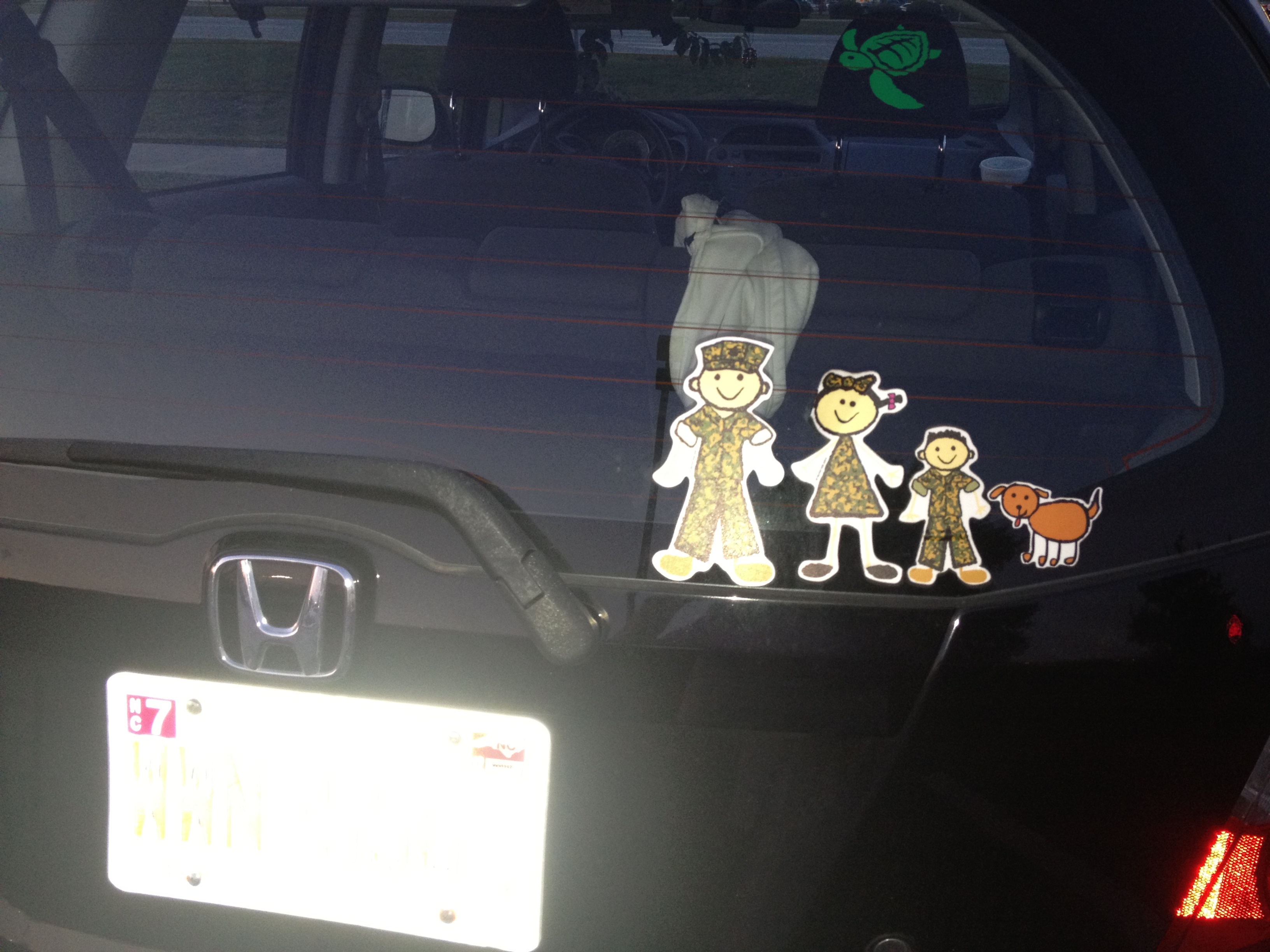
A car in Jacksonville
“No Meg, don’t hope it was a dream. I don’t understand it any more than you do, but one thing I’ve learned is that you don’t have to understand things for them to be.” – from A Wrinkle in Time by Madeleine L’Engle.
Jacksonville feels like a stain. It looks as dirty and tired as a bar after last call. We are staying in an extended stay hotel on Western Boulevard, the main business route, which is an aggregate of Old Navys and Olive Gardens, Walmarts and Wendy’s. The air smells like fried chicken and cigarette smoke and the sunlight bounces off all that asphalt. At night, shadowy packs of boys walk along the strip, their jeans low on their hips. Yesterday, I went to the grocery store and a man in a wife beater and flip flops leered at me. He parked his cart by the shelves of raw chicken thighs and made comments at women who walked by him. I turned sharply into the aisle with the detergent and held a box of Downey sheets up to my nose wondering how I ever could have complained about Washington, DC.
We will probably be staying at the Hilton Home2 until the beginning of August, when a house will be available for us on base. On the first floor of the hotel, a fitness center with a television is adjacent to a laundry room. Twice, I let the boys watch Disney Junior while I used the elliptical machine and slipped quarters into the washing machine. On Thursday, I struck up a conversation with another mother of two boys who is staying at the hotel because her house burned down last month. Marines in camouflage come out of other rooms on our floor, and from behind closed doors, I hear Southern accents and babies crying. I smell food being microwaved and Ramen noodles cooking. The night we arrived here, I had a quiet meltdown – conscious of the thin walls and my sleeping boys – thinking that at 39, I am too old to be living in a place that smells like someone else’s dinner. What was the point of the college degrees and all that striving? I thought back to another hotel room eight years ago in San Francisco. I was up all night helping the president of my company write her presentation and at five in the morning, I staggered off to Kinkos with it, thinking that finally, I was on my way. I would never in a million years have believed that I was on my way here to a town overflowing with soldiers.
Each place I have lived during the last six years has taught me something. In Philadelphia, Oliver was born, ironically, two hours from the town I drove 3000 miles away from when I was 21. In San Diego, I learned how to be an adult, a mother, and a wife. In Ventura, I was taught how to trust my heart and to believe in goodness. Washington DC taught me how to be alone and then how to be with people. I spent a year with this guy:

With Rolf Gates at my Yoga Teacher Training Graduation
And despite being so lonely for my first year there, things like this began to happen:

With Scott and friends at the Cherry Blossom Festival “Yoga on the Mall.”
Tonight I went for a walk along Western Boulevard, a four-lane highway with sidewalks but no crosswalks. After a while, my walk began to feel like a game of chicken with the pickup trucks and I started back to the hotel. I passed by Ruby Tuesday and the House of Pain tattoo parlor, Food Lion, and a dilapidated barber shop. Even though it was nine at night, a couple with a small child was going into Hooters. I wondered briefly if I should be afraid and then decided I shouldn’t. I figured I could outrun an attacker, and if I couldn’t, I would put up a good fight.
Coming towards me was a group of young Marines. Maybe I wasn’t as different from them as I thought. I too am the kind of person who would fight to the death to protect myself, and as they approached, I realized I am ashamed of this. The boys looked so innocent as they walked by me, so young. I wondered if they signed up to serve and protect and if they were surprised when they found out what was asked of them. Or maybe they weren’t. When I looked up, one of them said hello with a smile that lit up his face. And then they all looked at me for an instant, their faces lovely with youth.
I thought about how complicated it is to serve, how the word protect sometimes also means kill and how much that bothers me. I thought that some of those young boys might be headed off to a war I despise while others might build a school somewhere or save a child. They would all be trained to shoot and a few might have to pull the trigger when it counted. I thought about how much I hate being part of the military, how paying the cashier at the market sometimes feels like handing over blood money. And I thought of how proud I am that my gentle husband is a part of the same organization I hate, because he has watched over his own share of young men with such devotion. How contradictory it is to protect a freedom, how much freedom is taken away to accomplish that, how the choice to serve takes away so many other choices.
And then I thought about the first Power Yoga class I took at Downdog Yoga in Georgetown. For the last six months, that studio has served and protected me, which I never would have thought possible after that initial class, which I wasn’t sure I could even finish. On that morning, last July 4th, as we celebrated freedom, I was trapped in my own thoughts of how thirsty and tired and miserable I was. “I’m so hot,” my mind kept saying. ImsohotImsohotImsohot.
Gradually – and despite my best efforts not to – I fell in love with Power Yoga and began to practice at the Downdog studio four times a week, at least. On my second to last class there only six days ago, Kelly, who was teaching, told us that if we were uncomfortable, then we were in the right place. “That’s what you’ve come for,” she said. “To be uncomfortable and to see what’s underneath.”
As I finished my walk under the streetlights on a sidewalk that was still hot, I felt the same way I did in that first yoga class in Georgetown. I don’t want to know what’s underneath. I don’t want to see how I judge, how I hate, how I break every yogic value I strive for. I want to know why I am here in this strange town near the ocean. I want meaning and reason. I want validation that I am in the right place.
But the night gives me nothing other than the smell of fried chicken and hot concrete, the sound of my own sharp panic and stale discomfort. And maybe this is why I am here: to be uncomfortable. To crack off another layer. To cleanse myself here, in this city that looks toxic and not a single bit lovely in the dark.
Falls (And Giveaway!)
May 28, 2012 § 15 Comments

Niagara Falls
I was entering. I was leaving. California streamed behind me like a long silk veil. I didn’t feel like a big fat idiot anymore. And I didn’t feel like a hard-ass motherfucking Amazonian queen. I felt fierce and humble and gathered up inside, like I was safe in this world too. – from Wild, by Cheryl Strayed
I haven’t been here in a while. I haven’t been writing anything other than my bi-monthly column about chefs, mostly because of all the work that goes into moving to another state and trying to find a place to live given that it may be four weeks or four months until a home on the Camp Lejeune Marine base is ready for us. There is the packing of course, but there is also the getting rid of things, the collection of school and doctor and dentist records, the phone calls to turn off the power and the water, the endless calls to see if that home is still for rent, if that apartment is furnished, if we can sign a lease for fewer than three months. There is also the way the anxiety of moving turns my brain into static, and if I am honest, I have have been avoiding writing because of the way it forces me to face what is really going on.
At Oliver’s kindergarten drop-off, the other moms are very nice to me. “You look so great,” they say, “So relaxed,” and I laugh and lie and say, Thank you, it’s all going well.
This afternoon in yoga, while we held downward facing dog for what felt like way too long, Kelly, who was teaching, told us to press our thigh muscles onto our femur bones and I rebelled. I didn’t want to engage my legs, which is another way of saying I didn’t want to be there. I didn’t want to be in the present moment which is always right here. I wanted to roll up my mat and flee. I wanted to bolt from the 98-degree room and into the 90-degree day outside. I wanted to disappear into the crowded streets of Georgetown. I wanted to run into the air-conditioned haven of Dean & Deluca, to look for a new pair of shorts in J.Crew, to climb fully-clothed into the claw foot bathtubs in Waterworks.
Last Thursday, Oliver and my mom and I made the day-long drive up to Grand Island, New York, which is about a mile away from Niagara Falls. My cousin Jeremy and his wife graciously hosted us and Oliver was able to visit with his cousins and his godmother – Sister Mary Judith – who married Scott and I almost seven years ago, near a rocky beach just south of San Francisco. Sister Mary Judith is my father’s cousin and is in her mid-seventies, but she looks much younger. Before she became a Catholic nun, she was Homecoming Queen, and to me, she still has a sense of royalty about her. On our trip last weekend, she told me stories about when she helped run a school for African-American children in South Carolina in the late 1950’s. She told me about the time she spent in Africa, prior to that, and about my grandparents and aunts and uncles, whose own parents came over from Ireland and landed in Queens and Buffalo, New York.
On Friday, Jeremy took the day off from work and took us all to Niagara Falls. I was surprised by how accessible Niagara Falls is with the free parking in the state park and the easy walk in, just a few blocks from downtown Buffalo. It was a beautiful, sparkling day with bright sun and a cool breeze and we walked down from the parking lot onto a wooded trail which hugged the river. The river was so calm and quiet that I would never have guessed that it was about to jump off a cliff. The kids played on the wide, flat rocks at the edge of the river and they ran over the foot bridges that led us out to Goat Island. There was a small piling up of whitewater as the wide river bubbled around the boulders and the bank and you could tell the water was running fast, but there was a stillness at the surface that belied the drop up ahead.
Moving is kind of like that. You get word and then you wait, your life staying pretty much the same except for that static under the surface, which feels an awful lot like panic. The waiting itself becomes a kind of current, your life becoming flooded with the possibility that you are leaving it, until one day you look up and realize you are completely submerged in the leaving, so tired of the waiting that you just want it to be over already so your new life can start. According to some scholars, the name “Niagara” comes from the name of an Iroquois town called “Ongniaahra,” meaning “point of land cut in two.”
I used to think of surrender as a kind of ease. I used to think that I would be able to surrender once I was a different kind of person: once I meditated more or had more time, or became more wise. But standing there, looking at the falls, feeling the cold mist on my face and listening to the rush of that water, hearing the rush of my own blood through my ears, I thought that maybe surrender wasn’t a matter of ease but of courage. I watched that water, as it moved steadily, unhindered by what was in its path until finally, the Niagara River pulled its knees into its chest and leapt, the water gathering up and then falling from that sharp, dolomite ledge.
After we left the Falls we were hungry and tired and Sister Mary Judith and my mom and I headed to a grocery store to get some snacks for our return drive back to D.C. I told her my thoughts on surrender and she nodded. “Surrender is an act of courage,” she said, simply, and I rested in that, confident in her half-century of spiritual commitment.
This afternoon, as I held downward facing dog, while I was wishing I was anywhere but in my legs, Kelly said, “We think we can find ease by relaxing into something, but really, it’s the pushing out of something that creates the ease.” She told us to press our palms into the floor, to squeeze our thighs back to lift our hips and I thought of those falls – their height, their majesty, their courage. I took a deep breath and pressed down and back, feeling an ache in my legs and also a tiny bit of ease in my heart. I felt an infinitesimal opening as if maybe there was a place for me after all, despite the fact that I am a moving target, despite the fact that as soon as I begin to get comfortable, it’s time to press on and move out again. I pressed back into the pain and the cracking open and the fear and called those falls back to me, those daring wonders with their willingness to drop their history and their loves and their beliefs about where they should be, and instead, press onward and over the edge.
In honor of moving, I am having a month of giveaways. This week, I am giving away 2 copies of Bruce Dolin’s wonderful book, “Privilege of Parenting.” Kristen wrote such a wonderful review of the book that I won’t even try to duplicate her efforts and you can read her review of the book here. Bruce writes compassionately and wisely about how to hold our children by holding onto ourselves first, by breathing through our own fear and shame and sadness in order to put an end to the karma we don’t want our children to carry. Unlike some parenting books, which give generic and unlikely scenarios, Bruce helps us deal with life’s messiness, and like yoga, shows us that the messiness is part of the beauty. Just enter a comment below and I’ll draw a name at Random on Friday, June 1.
War
April 22, 2012 § 26 Comments

When the soldier arrives,
bleeding in the doorway,
can you recognize him as yourself
and let him in?
– From Yoga Heart, Lines on the Six Perfections, by Leza Lowitz
There is something so strange about walking around inside someone else’s house and trying to decide if you want to live there or not. We do this every two years, each time we move, and I am always unsettled by the experience of being a voyeur as well as what people tend to tell you while you are peering behind their shower curtains.
We have never lived on a military base. As a single officer, Scott could always get a much nicer place off-base than on, and when he married me, I had absolutely no desire to live on a military installation. I am embarrassed to admit this, but after years of protesting wars, of voting for Gore and Kerry and Obama, being married to a soldier feels a bit like going to the dark side. The fact that my yoga classes and my children’s organic yogurts are paid for by the same money that funds the war in Afghanistan is a little too messy for me. So I avoid these feelings by living off-base, by pretending that I am not really a Navy Wife.
When we went to North Carolina last week, we assumed we would live in town, but what surprised me was that in Jacksonville, there doesn’t seem to be an “off-base.” Camp Lejeune only has housing for 25 percent of the soldiers who work there, so most people live outside the base in homes that were put together too quickly or in the apartment complexes that surround the gate.
Amy* opens the door of the first house for rent on our list.”Come on in,” she says in her delicate southern drawl. Her tanned feet are bare and she is wearing a bohemian tunic and a dark skirt. She looks like a shorter and younger Julia Roberts, her thick hair twisted on top of her head. Her home is immaculate and candles are burning in the dining room. There are flowers in the space above the fireplace where a TV would go, and Amy tells us that her children don’t watch television. She shows us the granite countertops and the hardwood floors and the walk-in closets, but all I can think of is the neighborhood, which looks vaguely apocalyptic. Coldwell Banker started building the subdivision in the middle of a field but then abandoned it partway through, perhaps because they ran out of money. All the pine trees have been cut down, but there are still flags marking lots that have not been sold and most of the homes have For Sale signs in front of them.
Amy then leads us up to the bonus room, which takes up half of the second story and she tells us about her 15-year-old son, Max, what a great kid he is and how the two of them were alone for years while her husband was deployed three times to Iraq and Afghanistan. Then, she tells us about her six-year old daughter whose birth took place while her husband was deployed. She explains that her labor came on so quickly that when her friend came to pick up Max, she told Amy to get into the car too so she could take her to the hospital. When they were halfway there, her friend had to call 911 and the paramedics delivered Amy’s baby in the back of their EMS truck in the Wal-Mart parking lot. “You know,” Amy says, “The big one on the road into Jacksonville?” She laughs and smiles. “I kept asking for something for the pain. Just a Tylenol or something but they kept telling me it was too late.”
Her daughter runs into the house then and asks for a bag. “What will you be wanting that for?” Amy asks, laughing again.
“For my pet butterfly.” Emma says.
Amy hands Emma a plastic sandwich bag and rolls her eyes at us. “You know what it’s like,” she says to me and I smile.
A second later, Emma is back. “Mommy, I need a spoon!”
Amy hands her the spoon and asks her why she needs it.
“The butterfly is dead,” Emma says and Amy’s mouth forms a silent, “Oh.”
The second house we look at is next door which is awkward, but I have already spoken to Penelope on the phone and she is expecting us. We are greeted by an enormous yellow lab and then Penelope comes to the door and says hello. The dog barks at me and I jump. “Oh, he’s all talk,” she says looking down at the dog, who now has his hackles raised.
In Penelope’s house, the place above the fireplace does have a TV and Cartoon Network is blaring even though no one is watching. Penelope’s husband is in the kitchen. He’s still in his combat boots and his camouflage pants. He is staring at us with his arms folded in front of his chest, and he takes the big dog from Penelope and holds him by the collar. Even though it’s cool in the house, I am sweating. Penelope is wearing a pair of blue scrubs with a stain on the front and a photo ID badge, which says she works in the lab. They chose linoleum and carpet for their home instead of hardwood and granite and someone has left a blue duffel bag on top of the stove.
Penelope tells me they have to move to San Diego and she looks as though she might cry. “I can’t find a place to rent there,” she says. “Every place I call has 100 people looking at it. Well, not really but you know what I mean.” I tell her about Carlsbad and Scripps Ranch and she nods. “We really want a place in Poway,” she says, “So I can sign my son up for football there. I hear the school is good.”
I nod and ask her if she’s been to San Diego before and she smiles. “Just once,” she says, “Right after Matt graduated. I drove out to Miramar to see him and then we drove back to Ohio together. I had just turned eighteen and all I cared about was being with him.” There is silence for a moment as a one-eyed tortoiseshell cat wanders into the room. Penelope tells me that she and her husband have been married for sixteen years now but it doesn’t feel that long. “We were going to retire in Jacksonville,” she says. “But then Matt called me from Afghanistan and said, ‘How do you feel about California?’ I thought he was joking. I said, ‘get out of here.'”
We tell them we’ll be in touch and we go outside to our car parked on the street. A man with a short, short haircut is driving an old Willys Jeep around the development. Because there are no trees, we can see him the entire way around and he waves to us.
Scott tells me that we can also live on base, that it might actually be nicer there and after he says that, it feels like someone is grabbing my stomach and squeezing it as hard as they can. We drove on base earlier that afternoon and it was nothing like the Navy bases we lived near in San Diego and Ventura. As we drove onto Camp Lejeune, a convoy of tanks was driving out. Marines with helmets and goggles were manning the guns and staring straight ahead. We had to stop at a cross walk while another group of soldiers ran across the street. One of them stepped out in front of our car, his feet wide apart and his hands clasped behind his back. He stared at us, expressionless until his group was safely on the other side.
That night, we meet one of Scott’s Marine friends for dinner. Jeff is a company captain in his early thirties and when Scott was stationed in Ventura, Jeff worked for him for a little while. In passing, Jeff mentions coming back from Afghanistan last August and I ask him what it’s like over there. “How do you go from fighting a war to this?” I ask, gesturing at the restaurant, which overlooks the water, and to the people who are eating fish tacos or sautéed grouper.
Jeff smiles as if I’ve said something funny. “The first time I came back from Iraq, I stayed drunk for 6 months.”
I ask him what happened after that, and he tells me that he heard Tony Robbins one day on a TED Talk and that changed him. “For my 30th birthday I went to Fiji to do Tony’s workshop.” He completed Tony’s workshops twice more, including once in Australia.
I tell Jeff that I have made Tony Robbins’ green soup before in my Vita Mix. Jeff nods. “Yeah, Healing Soup. During one workshop I did Tony’s cleanse for a week.”
“Did you walk on the hot coals?” I ask.
Jeff nods. “Three times,” he says. “I kept thinking cool moss. Cool moss.”
I ask him what he did the last time he was in Afghanistan and he tells me that he was in charge of about 250 men who were fighting there. I ask him if his soldiers are scared when they go out into battle and Jeff shakes his head. “They’ve been trained to kill for 7 months so it’s like we let them out of a cage. They want to fight. The trouble happens when they come back home. They don’t know how to not do that any more.” Jeff tells me that the perfect soldier is between 18 and 24 years old. “What was that Michael Moore movie called?” he asks and none of us remember. “Moore got some of it wrong. He filmed a kid in a tank in Iraq listening to “Fire Water Burn” as loud as it can go and shooting people like it was a bad thing. Well who else do you want defending you?”
Jeff tells us that sometimes, after they get back, he has to help soldiers stay out of trouble. “One guy,” he said, “It took 6 months before he stopped fighting in bars because they’re so used to that.” Jeff explains that the programs that try to help soldiers when they are home are more of a bureauocratic nightmare than a help. He tells us that he comes up with his own programs for helping his troops. “I try to find ways to set goals for them and motivate them. I try to help them move forward because they can’t go back.”
“What people don’t get,” he continues, “Is that when a Marine is in a company, for the first time in his life, he’s with a group of guys who won’t let him down. No matter what. Then he comes back from Afghanistan after a year and his girlfriend’s cheated on him and his buddies don’t show up and all he wants to do is go back to his company. But he can’t because the company doesn’t exist any more. It’s all different when he comes home.”
Later that night, back at the Swansboro Hampton Inn, where we are staying, I start to cry and I have trouble breathing. My heart starts to race and it feels like I have no skin so I climb into the bathtub, where things seem a little bit better. I stare up through the shower curtain at the stacked white towels and the extra rolls of toilet paper and then down at my left hand, where during graduation from my 200 hour yoga teacher training, another graduate wound a purple thread around my wrist and then tied it. We did this to symbolize something we wanted to bring into our lives, and when it was my turn, I said, “Faith.”
It occurs to me then that it is hypocritical of me to believe I am a spiritual person when everything is going my way, and then to shake my fist at the sky when things get scary. I wonder if maybe the reason I am sitting in a bathtub trying to breathe has less to do with living on a Marine base and more to do with the fact that I am now having to face the part of myself I have avoided since becoming a Navy Wife.
Before I had anything to do with the military, I went to an Ivy-League school and was cross-country captain. I met Scott when he was going to grad school at Stanford and for a while we lived in Palo Alto and spent too much money on Thai food on Saturday nights just because we could. For most of my life, I put all my faith in being special, which may just be another way of saying I think I am better than everyone else. Even my yoga teacher training was another exercise in being special, in becoming more spiritual. But it’s one thing to think we’re all one while chanting Om and wearing Lululemon and it’s another thing entirely to think I am one with the 18-year old soldier who is shooting the hajis and with the enemy who is shooting back, with the man in the combat boots and the dog who is all talk. Maybe I was sitting in a bathtub because I was having to face the part of me that doesn’t want to recognize the soldier as myself.
The next day I tell Scott I’m ready to check out some of the homes on base so we drive out to the end of Camp Lejeune by Bogue Sound. It’s mostly pine forest and salt water rivers. I think in North Carolina, they call it low country. “Wow,” Scott says, “This is nice.”
I have to agree. A bike path winds next to the road and the neighborhood has sidewalks. “This looks more off-base than off-base does,” I tell him.
We are visiting our friends Chris and Paige. Scott will be taking over Chris’s job as the officer in charge of construction on base and we drive through their neighborhood, which is quiet and faces the water. The homes are two-story Cape Cods with blue shutters and sunrooms on the side. When we arrive, Paige is outside under a tree, reading with her 7-year old son. After we say hello, she gives me a tour of their home with the refinished oak floors and the curving staircase that leads to the big bedrooms upstairs. She tells me that by living on-base, Scott won’t have to go through the traffic to get through the gate, which sometimes can take over an hour. “But it’s stressful here too,” she continues. “The Marines come back from Afghanistan and their lifestyle is a little bit different if you know what I mean.” As if on cue, a police car drives into her neighbor’s driveway and Paige sighs.
We go back downstairs and I follow Paige to the kitchen where she makes a smoothie for her son, Sam, and then leads me outside to the backyard. “Sam’s tutor’s husband was on the Osprey that went down in Morocco,” she says quietly so no one will hear. “You see a lot here. You see guys with service dogs because of their PTSD and then you see the men walking around without an arm or a leg and it hits you.”
I tell Paige a bit about what I have seen over the past couple of days and how sheltered I have been from the fighting and the training and the deployments over the past decade. I think of how I tried to pretend that I wasn’t a Navy Wife as if it were possible to repudiate a war. I told myself that I wasn’t responsible for the war because I never voted for it, but really I am culpable if only because I live in the United States, because I expect there to not be a sniper at the end of my street, and because when I flip the switch, I expect the light to turn on. I am responsible for the war because these expectations necessitate a military that is ruthless and unflinching. They necessitate a service that trains 18 to 24 year olds how to fight so that I don’t have to carry a gun.
In the neighbor’s driveway, the police car is still there. We stare at it for a moment and then Paige shakes her head. “The war is right here,” she says. “It’s right here.”
*Some names have been changed
Pratyahara
April 6, 2012 § 14 Comments
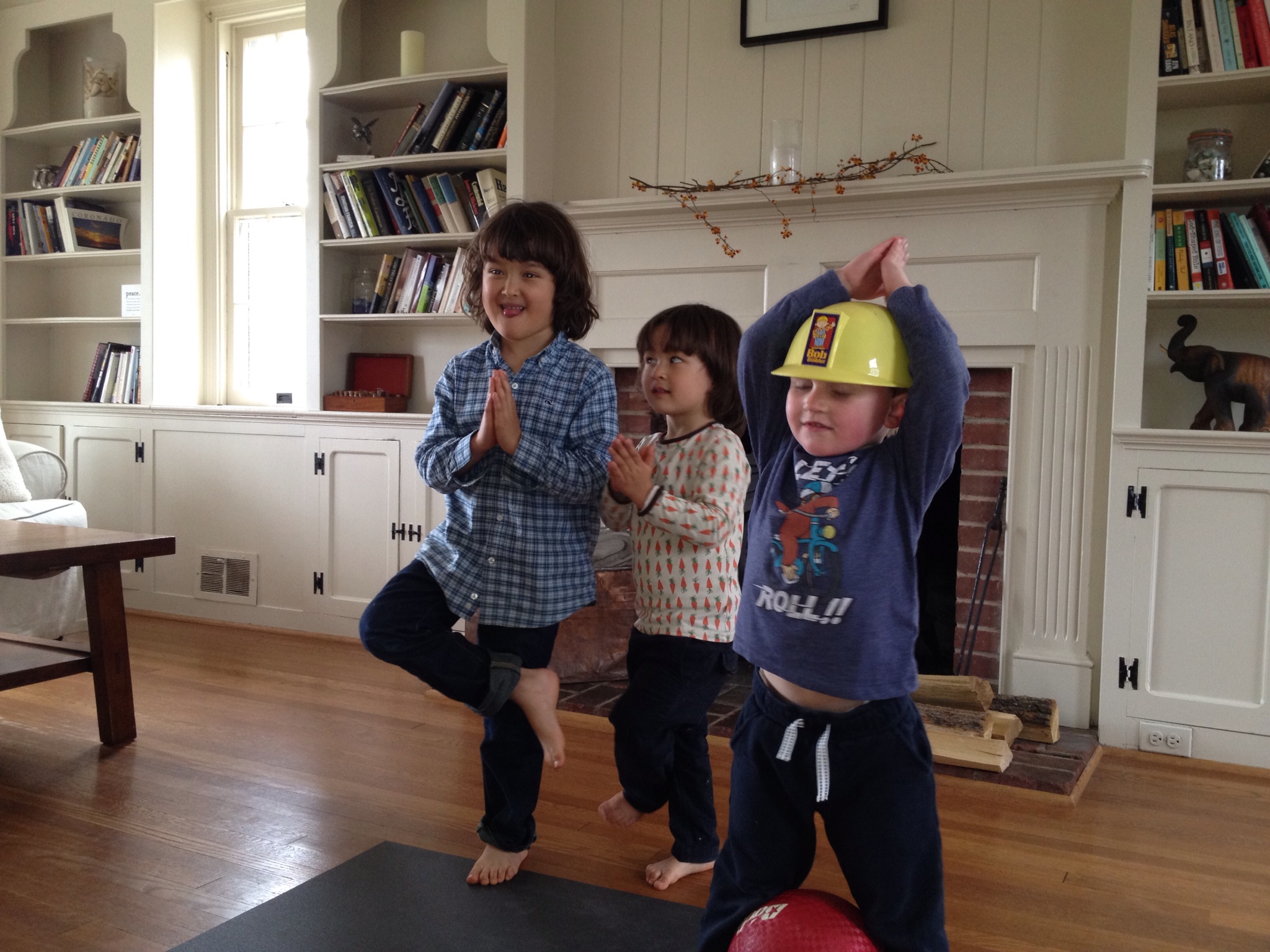
Playdate Tree Pose
“Yoga is the practice of tolerating the consequences of being yourself.” – Bhagavad Gita
“Where can you run to escape from yourself?
Where you gonna go?
Where you gonna go?
Salvation is here.” – Switchfoot
A few weeks ago, on a cold, rainy, Saturday, I was cleaning the bathrooms and washing our wood floors. Much has been written lately about the virtues of cleaning, but I am not convinced that these aren’t written by people with maids. By the time I was halfway through I was cranky, and I stopped in front of the upstairs window that looks out into our steep backyard to see if it was still raining. I watched the drizzle for a minute and was about to pick up the paper towels again but noticed two bright blue jays perched on a bare branch below. It’s not that blue jays are rare, exactly, but still, I don’t see them very often, especially not two, their wings too bright for this day, their bodies too fat for the thin branch they were bobbing on. As I stood, I saw a third jay perched high up in the sapling, and then, while I was still marveling at my luck, another one landed, its square wings folding under him. Despite the day and the chore and the remaining bathroom, I felt delight flutter in my throat. It felt like more than I was allowed to have.
Winter always drives me a little bit crazy. There is something about the gray and the cold and the onerous task of putting on coats and scarves that makes me feel suffocated and a bit desperate at the same time. By the time the forsythias bloom, their brightness isn’t even a consolation. I want to hurry them along. I want to usher in the daffodils and the cherry blossoms and then the tulips. I want to bypass spring altogether and get to the fat, fleshy leaves of summer. If I had a mantra, it would be hurry up. It would be get here already.
I signed up for a cleanse a few weeks ago. At the time, I signed up just to feel better. I am a pretty sensitive person, but then I go and forget this. I drink too many mugs of coffee and glasses of wine because it seems like this is what you do when you’re an adult. It’s comforting to hold something in your hand like a talisman. Some mornings, I carry my coffee from room to room like a sword. “En garde,” I want to say to the tedious tasks of brushing two foamy mouths, getting two squirming boys into coats, listening to the gossip in the school parking lot.
For the first few days, I was terrified of The Cleanse. What would happen when I took away the coffee and the sugar and the alcohol? And more importantly, what if I didn’t like what remained? Because really, it’s not about the caffeine or the chocolate, and that’s why cleanses can be such a bitch. It’s never about what you’re giving up, but about what you’ve already lost.
For over a month now, I have been reading Maya Stein’s luminous poem, “you will know (for T)”. The line: “Listen. The birds will teach you everything you need to know about flight,” has been reverberating inside my head and heart. I have been trying to fly through the drizzle with my own winter body. I have been trying to soar but something keeps pulling me back. I went to yoga one night, when I was particularly exhausted, thinking it would help, even though I know that’s not the point. I usually love Bakasana (crow pose), but that night, during the jump-back, I fell flat on my face. In Garudasana (eagle pose), I felt dizzy and nauseous, and by the time we got to Vrksasana (tree pose) I gave up completely. I bent down into Balasana (child’s pose) and felt my racing heart beat against my mat. It occurred to me then that maybe the problem wasn’t that I didn’t know how to fly, but that I hadn’t yet learned how to land.
After a 3-day headache and bone-crushing exhaustion, what I discovered was that being on a cleanse was easier than my normal life. There was something about a weekly call and a payment sent, a secret Facebook group and a recipe for kitchari that gave me license to take care of myself, to take an extra five minutes to apply Ayurvedic oil and make lemon tea. During the first week, Laura sent us an email about Pratyahara, which is one of the limbs on the eight-limbed yogic path. Pratyahara literally means “to turn inward.” In her email, Laura wrote: “Pratyhara is an invitation to drop into your heart, to come home to yourself.”
I have been spending so much time trying to soar that I have forgotten to come back to earth. So much of my life has been spent trying to prove myself, trying to earn a seat at the table. I waste so much energy trying to be twice as good in order to be considered as good as. I have been so busy plumbing the depths of what is expected of me that I have forgotten to listen to what I already know to be true.
In my yoga teacher training, we studied the ways a yoga class sequence follows both the chakras and the eight-limb path of yoga. Vrksasana (tree pose) is the part of our practice that corresponds to both the heart chakra and Pratyahara. It is the moment we leave the oceanic flow of the Sun Salutations and turn inward. We engage our core in order to open our heart. We begin to surrender our will and listen to the rush of blood in our ears. We balance our bodies on a single ankle bone and trust that it will hold.
If the birds will teach us everything we need to know about flight, then surely they can also teach us how to land. And what is landing if not forgiveness? What is turning inward if not an act of trust? One morning after I started the cleanse, as I awoke before dawn to do my Sun Salutations, I thought of those plump blue jays, landing on that skinny branch. I inhaled my arms high in my dark living room and bent my creaky body over my knees. I felt my feet on the cold wood floor. “I forgive L,” I thought and felt a tidal wave of sadness sweep me under and catch in my chest. I stepped back into downward facing dog and looked back at my knees. “I forgive myself,” I thought and felt myself land – wobbling, haltingly, shakily – on the thin branch of a new tree, not entirely trusting that it would hold, but wanting it to, more than anything.
Maya Stein’s full poem is below:
you will know (for T) – by Maya Stein
Receive (Moving Part II)
March 11, 2012 § 17 Comments

To receive is to accept, not to get. It is impossible not to have, but it is possible not to know you have.
A Course In Miracles
Lately, I have been consumed with thoughts of moving from northern Virginia to North Carolina, which we will be doing in early June. It’s not like it’s a surprise of course. Because my husband is in the Navy, we move every two years, like clockwork. And yet, each time we think about packing up, I am shocked by how attached I am to the place I am living. Even if I don’t like it all that much.
I am insanely great at complaining about moving. Honestly, I should get some kind of award. “You did know I was in the Navy before you married me?” my husband sometimes asks me, “Right?”
Scott will have a great job on Camp Lejeune, which is the biggest marine base in the country. It will be nice to be close to the ocean again and I am looking forward to leaving the fast pace of DC. But still, all I can think of are the public schools and the fact that there aren’t any yoga studios down there. I keep thinking of all that I am not going to have.
When I went to Kripalu for 3 days at the end of December for a yoga workshop with Rolf Gates, I knew it was too big to understand right away. It was wonderful and difficult. It was nurturing and confronting. It felt like home and it felt like the middle of nowhere. In a small way, it reminded me of what it’s like to be me, always on the go, always looking ahead, preparing to leave while we are still unpacking the boxes.
On the first day of our workshop, Rolf had us do an exercise I have done with him before a few times. “Spend the next 5 minutes,” he told us, “Writing about who you want to be and what you want that experience to be like.” I remember the first time I did it during the first week of my yoga teacher training with Rolf last April. Then, I had picked up my pen and paper with a sense of panic. Who do I want to be? Yikes.
What eventually made it onto paper that first time was that I wanted to teach yoga to military wives, like me. This idea had been in the back of my mind for a while, but seeing it on paper for the first time made my hands shake a little. It seemed like more than I was allowed to ask for. Most likely, I would not be up to the task.
As I prepared to do the exercise for a third time on that cold December day at Kripalu, I thought I knew who I wanted to be. I still wanted to teach yoga on a military base. What else was there to say? I paused, with my pen in the air and looked out the floor to ceiling window. Brown leaves sailed against the colorless sky and I thought about how wonderful it was at Kripalu and how far it was from North Carolina.
And then I sat up and felt a rush of something like lightning fill my insides. “Holy shit,” I thought. “I got exactly what I wanted.” Here I was, complaining about moving to Camp Lejeune in North Carolina, to the biggest marine base in the country, and yet, what had I asked for six months earlier? Who do I want to be? What do I want that experience to be like?
My heart was pounding and I looked around the room at so many heads bent over notebooks. There was the huge purple wall of the studio. There was the bare winter day outside. And then there was me on my mat, feeling as though I had just won the lottery. I felt my face turn up into a grin and tried to stop it. Eventually I gave in and just allowed myself to be happy, to be a little bit ecstatic, to believe if only for a little while that miracles happen, that sometimes, you get exactly what you ask for.
When I returned from Kripalu, I went online and found the web site for the gym on the Camp Lejeune base. In true military fashion, it took 12 phone calls to finally get in touch with the group exercise instructor and I had to leave a message. She called me back right away and I told her I was interested in teaching yoga.
“When are you moving?” she asked.
“In June.”
“Well, that’s perfect timing,” she said. “We’re opening up a mind body studio in July with a big yoga studio on base and we’re going to need instructors.”
What’s been so interesting to me over the past few months is how I keep refusing to receive what I am given, even it it’s exactly what I wanted. What’s almost comical is how my mind keeps turning to fear rather than gratitude, how it keeps spinning towards panic rather than joy.
Even now, after 21 months of despising Washington DC, I am thinking of all that I am going to miss here: the amazing, bigger than life yoga scene, the Baptiste-style power yoga studio I found in Georgetown, right along the canal, the Dean & Deluca micro-ground chai tea I have become addicted to, the mountain bike trails and the museums and how just when you think winter is never going to end, you wake up and see that the cherry blossoms are already pink against the cold sky.
On my way to yoga yesterday, my usual route around the Pentagon was closed and to get to the Key Bridge, I had to take the George Washington Parkway, and then zip up past Arlington Cemetery. I drove by the back side of the Iwo Jima Memorial, which is probably my favorite landmark in the city. This strikes me as odd as I am usually not a fan of anything war-related, but there is something about all those men leaning in to put that flag in the ground. Driving the way I did, I had a clear view of the only man not touching the flag, the one reaching with outstretched fingers, the one whose hands never touch the flag, who is forever holding onto the air.
Seeing that man always brings tears to my eyes, and yesterday I realized it might be because he reminds me so much of myself. I wish I could just relax into all the good things in my life, but I have never stopped being the girl who is always waiting for something bad to happen. I keep thinking that if I win, I’ll be safe, but what happens when I win is that I immediately begin to fear losing.
My word this winter was “Soften,” (which I stole from Claudia Cummins, whose blogs First Sip and Inside Out I am obsessed with and read almost as soon as I get up in the morning.).
A few weeks after repeating “Soften” like a mantra, I stopped making my bed before leaving the house. (This was a teeny bit difficult as I am a compulsive bed-maker).The boys and I spent so many cold and decadent afternoons huddled under our fleece sheets and down blankets reading books. Gus and I fell asleep sometimes while Oliver slipped out to play, and once or twice, in the evening, instead of going to yoga, I went back under those covers. It was delicious. It felt like more than I was allowed to have, and yet, it had been there all along.
Now that spring has arrived and the daffodils are coming up everywhere, I am trying to let go of my habit of reaching with my fingers outstretched. I want to enjoy what I have already received, which turns out to be a lot.
Yesterday, Gus and I went to Whole Foods to get a slice of vegan pizza (again, not likely to be available on Camp Lejeune) and in the parking lot, he stopped by a pothole filled with white confetti and pointed to it. “What is all of this Mommy?” he asked and my first reaction was to try to swoop him away. “It’s trash Gus,” I said, “Don’t touch that.”
But then I looked again and saw that the pothole wasn’t filled with trash at all. It was overflowing with cherry blossoms.
PS In my quest to “lighten up” I am participating in a 21-day cleanse with Laura Plumb, my yoga teacher in San Diego. She and her husband are amazing and together they founded the Deep Yoga School of Healing Arts. Laura will be leading the cleanse which will be completely supported with 3 group phone calls, emails, recipes, and if you choose, a care package full of Laura’s Ayurvedic spices, jam, and kitchari mix. The food-based cleanse (so you won’t be starving and eat half a cake by your third day) begins on March 20th, so if you would like to join me click here. There are 3 very affordable options.
Moving
February 15, 2012 § 23 Comments

The student asks the master: “What work will I do as I seek enlightenment?” The master replies “Chop wood, carry water.” “And what work will I do once I achieve enlightenment?” asks the student. “Chop wood, carry water,” replies the master.
The summer after my sophomore year in college, I received a marine biology internship at the University of North Carolina Marine Lab in Morehead City, North Carolina. I remember boarding the plane in Ithaca, desperate to leave it behind as quickly as I could. That April, I qualified for the Olympic Trials in the 5000 meter run and then the next month, I came in last place in the NCAA championships in Austin, Texas. Of course this was only a single race, and in the grand scheme of things, it wasn’t a big deal, but at the time, it felt like Disaster. Until that point, I thought I could be a runner for the rest of my life, or at least until I turned 30. But stumbling off that burning hot Texas track in May, a wet sponge in my hand, I knew then that I wasn’t among the greats. Even now, it is still one of my biggest memories of failure.
My internship that summer offered me an escape. For two months, I would be working with a team of scientists along North Carolina’s barrier islands, researching endangered sea scallop populations. We would be sailing around the same islands that sank Blackbeard’s ship, which seemed fitting. The head of the lab was a grand professor who only visited once a month, and my boss was a cranky lab tech named Hal, who was afraid of the water. Most days, I hopped on the boat with a grad student named Hunter, who had just returned from studying penguins in Antarctica and another named Thea, from Greece, who was as beautiful as her name. We rode around in a motor boat the university purchased at auction, that used to belong to drug runners. Every couple of weeks Hunter would toss our research logs and sunscreen from the console and reach his big hand in there, feeling around for a secret panel. “Don’t you think they would have hidden a stash of something in here?” he would ask about the drug runners. “Wouldn’t it be great if we found something they left behind?”
Before I left Ithaca, I had started dating a sweet engineering student who was on the cross-country ski team, and who is now the godfather of my youngest son. He made me a mix tape before I left and all summer long he sent me 5-page letters and brown cardboard boxes full of banana muffins he baked from scratch. Instead of answering his letters, I spent many of those summer nights on the back of a motorcycle with a boy named Wilson, a grad student at the Duke Marine Lab. One rainy night, Wilson showed up at the door of the horrible house I shared with the other interns with a helmet in his hands. “This is for you,” he said in his southern accent and as we rode away, he yelled back to me that it was really easy to crash a bike in the rain. I thought he was the most dangerous boy I had ever met.
If I believed I had failed on that Texas track, then my summer in North Carolina was research into the other side of failure, into what happens when you no longer care about the consequences. I drank beer on the front lawn with my other underage roommates late at night, Jimmy Buffet blaring on someone’s boom box. Karen, one of the roommates, came out of the closet that summer, and every time I washed my dishes, she tried to give me a massage. I went running late in the evening and the marines from Camp Lejeune drove by in their pickup trucks and sometimes threw bottles at me, their Semper Fi bumper stickers bright in the glow of their tail lights. I hated those marines with their short hair cuts and their tattoos. By the time August rolled around I hated the fleas and the roaches too. I was sick of the heat and a bit tired of Wilson and his Yamaha. I wanted to go back to Ithaca and be myself again. I was homesick for my roommates on Catherine Street and for my old life. Before I boarded the airplane bound for Ithaca, I kissed Wilson goodbye, grateful that it would be the last time, confident that I would never see North Carolina again, that it was a random chapter, a couple of months of bad decisions, a fluke, just like that day on the track.
***
Late this October, I removed the mosquito netting from the sand box, thinking that even in DC, mosquitoes didn’t hang around this long, but I was wrong. Even though the sun had already set, I saw three mosquitoes land on Gus’ cheek by the glow of the citronella candles. As I was swatting away, Scott came home from work and ran out to meet us. “Well,” he said breathlessly as the boys drove their trucks in the sand, “I know where we are moving to next.”
I held my own breath for a second. “Where?” I asked, hoping he would tell me that we were heading back to California.
“You’re never going to believe this,” he said. “North Carolina. I got the CO job. I’ll be in charge of the construction project on Camp Lejeune.”
***
A week ago we all went to Florida for a 5-day vacation. We spent a day at a nature center in Polk county, a day in Legoland, and 3 days with my parents in their rented condo on the ocean. The Spanish moss hanging from the trees made me feel as though the entire state was haunted. It made me think of ghosts. Moving every two years is a bit like being a ghost. You stay on the outside for a long time, watching what goes on in this new place. You hover at the edge of playgrounds and school yards, standing alone while old friends gather in tiny, intimate circles. You circle neighborhoods, trying to remember which street you live on now, you take exit ramps often, because you have gone too far. Three times now, we have moved back to places I used to live as if I am haunted by my own Ghost of Lifetimes Past.
This spring or summer we will do that again. I will once again return to North Carolina, to the scene of that crazy summer, Blackbeard’s wreck, those hot, hot barrier islands. Sometimes I wonder if that summer really happened, and then I look down at my left thumb, where a scar remains from where a blue crab got me, and I am reminded that it was real.
***
This winter, I have been crossing paths with a red fox. The first time, I was taking a walk at night, and something raced by me so fast I thought it was a ghost. I didn’t see it as much as I felt it. I heard the rush of it as it ran by me. I saw it again the other morning as we were going to school. It trotted across the street in front of our car, its red tail floating behind like a banner. I told Bruce at Privilege of Parenting about it as he is the ultimate resource for all things mythical and magical.
“It does seem the clever Trickster has arrived,” he wrote to me in an email, “And I imagine he has much to teach us.”
***
One noticeable thing about doing yoga is that I have begun to realize that most of my 30-some years before doing yoga were spent in a state of abject panic. What yoga has given me is a new voice, one that says, It’s going to be OK, and Take a deep breath, and Soften. Last week, I was on the phone with the head of Early Childhood Education of one of the schools in Jacksonville, North Carolina. Camp Lejeuene is three hours from the nearest Waldorf school, an hour away from a Quaker Friends school, 168 miles away from a Trader Joe’s and over 50 miles from a yoga studio. Trying to find a school for Oliver, who has only known Waldorf education is proving to be a daunting task.
The woman on the phone was lovely, and despite the fact that there are over 700 children in her elementary school, despite there being only one twenty minute recess each day and that the school lunches begin at 10 AM in order to accommodate all of the children, I liked her. And then she said, “Don’t be intimidated by all the tattoo parlors and used car dealerships you see as you drive through Jacksonville. It’s really a nice town once you get used to it.”
The yoga voice tells me to take a deep breath, that it’s all going to be OK. But still, that old voice pipes up. “Tattoo parlors?” It asks. “Used car dealerships? Are you out of your mind?”
***
I wonder now if knowledge of this move was the source for some of the anxiety I experienced this autumn. For twenty years I have blocked out that summer in 1992, and now pieces of it come back, as if it were something I dreamt. I remember Amanda, the intern who answered every question with “Boy Howdy.” I remember that Wilson and I sat on the edge of a dock in Beaufort while he told me about his traumatic childhood. I remember how sick the heat made me and way the air smelled on the beach while the pelicans flew in formation along the sunset.
One day this November, I needed to run so badly that I called a sitter to come for an hour. When she arrived, I pelted down our block and onto Russell Road, Coldplay’s Mylo Xyloto blasting in my ears. I ran as fast as I could until my lungs started to hurt and my legs began to ache and still I kept going until I hit King Street in Old Towne Alexandria where I leaned against a telephone pole.
As I turned back home, still thinking about North Carolina, a new voice appeared out of nowhere. Even over the music, it clearly said: “Your work will be there, waiting for you.”
Work? I thought. What work?
I thought of the work I do now, that of wiping noses and folding tee shirts with trucks on them, cutting peanut butter sandwiches in half. Reading Magic Treehouse Mystery books and feeling little boys curl into me with their signature scent of sweat and dirt and Johnson’s shampoo.
As my feet moved more slowly, towards home, I realized that this work might be enough, even in this strange new town, in this desolate outpost with its tattoo parlors and Piggly Wigglys. In the absence of organic tomatoes and coconut water and Lululemon reatail stores, there will still be this work of caring and cleaning and comforting. When we move, I will assuredly be a ghost again. I will get lost going to the grocery store and I will hover on the outside of conversations. I will take Oliver for a tour of his new school while he stays glued to my side and tells me that he doesn’t like this school, that he won’t go and I can’t make him. Afterwards we will find a place that sells ice cream cones and the next day, I will fold laundry and wipe counters. I will perform what seems like mundane tasks, but which are really my sustenance, my necessary work. Maybe this is what comforts me now, this notion that no matter where I go, there will be wood to chop and water to carry. That really, this is what we all do, every day, whether we want to or not, each of us stumbling towards enlightenment.
Subtraction
January 23, 2012 § 26 Comments

Watching the Snow
My yoga studio has a program twice a year called “Commit To It” in which you practice yoga and meditation for 40 days. The studio is a Baptiste-style power yoga studio and I am sure this program is inspired by Baron Baptiste, who claims that doing 40 days of yoga will transform your life. I am dubious of claims like this, probably because I don’t really like commitment very much. But early in December it seemed like everywhere I looked, people were doing “Challenges.” Even a book I was reading – Sacred Contracts, by Caroline Myss – had a section on how 40 days is the time necessary to manifest an intention.
I don’t really understand any of this. But because I am so crappy at commitment, I thought I would try out a 40 day yoga challenge of my own just to see what would happen. It was simple. From December 2 until January 9, I would do yoga. And since I really like yoga, I figured it wouldn’t be terribly difficult. Most of it, in fact, was quite easy. Leaving for yoga at 7 pm – when my kitchen counter is stacked with dirty dishes and the bath is filling and my kids are pretty much running on fumes – is not a difficult thing at all. Most days, I bolted, a smoothie in hand, my yoga mat riding shotgun as I peeled out of the driveway. Even when I was going to power yoga, which is new for me and pretty much kicks my ass every time, I was happy to flee, to run away from the messiest part of my day and allow my husband to do the dirty work.
But I had other days as well. There was the morning I woke at 5 am to do Rolf Gate’s video and was so stiff I could barely move. Halfway through, I saw my reflection in the windows against the pre-dawn sky, and I looked so horrible – so un-yogalike- that I burst into tears and went back to bed. Another afternoon, I was practicing at home while the boys had some quiet time, and I heard them arguing between their rooms. “BOYS!” I yelled up the stairs, “NO FIGHTING!!” I looked down for a moment, at my hands in prayer position over my heart, and I sighed, chagrined.
Ironically, the most difficult part of my 40 days was after my trip to Kripalu for New Year’s. As is always the case, I brought myself to Kripalu too, which was unfortunate. I balked at sharing a bathroom with twenty other people. I wanted to turn the heat down in the room but I couldn’t find the thermostat. I wanted a cup of coffee but had to wait in line behind a woman who decided that no one could move until she finished cutting up her apple. There was something so human about my New Year’s Eve weekend there, so bare and raw, that I have been feeling a bit unraveled ever since.
What most astounded me about Kripalu was the sense of camaraderie, maybe even equality. You might find yourself in the dining room scooping slices of lemon caper tempeh next to your teacher. You may see your classmates coming out of the shower. You might take a walk and find someone sitting on a bench, crying. For me, there was such a powerful sense that not a single one of us is better than another. At first, I was ecstatic and comforted by this idea. And then, I became depressed. If there wasn’t a perfect person out there, then who was going to save me?
A few days after I returned from Kripalu, Colin, one of my yoga teachers said. “Yoga is a process of subtraction. It is not a process of addition.”
I finished my 40 day challenge, but I pretty much staggered over the line. On Day 41, I didn’t go to yoga. Instead, I poured a glass of wine and was looking forward to eating a dinner that wasn’t a liquid. And then: “Mommy?” Oliver called from the top of the stairs, “I had a big leak in the bathroom and I can’t clean it up.”
I put down the wine and picked up the paper towels and the Mrs. Myers. “Mommy?” Oliver called again. “Gus has a stinky diaper and he won’t get out of my room.”
Afterwards, I remembered that earlier in the day, when Oliver had a friend over, I reached into the pantry-slash-broom-closet to grab a bag of pretzels for their snack and knocked a bottle of maple syrup onto the heavy mixer below. That evening, as I reluctantly opened the closet door and stared at the broken glass and syrup that lay before me, it hit me that nothing had changed. Nothing had been transformed. 40 days of yoga and I was still incredibly annoyed at the fact that some days, my biggest work is to clean up messes, to wipe noses and bums and clean pee off the floor. Fuck transformation, I thought. Fuck yoga. All those poses, all that sweat, all that holding reverse warrior for ten breaths while my thigh muscles tried not to explode.
As I scrubbed the mess in the broom closet, I realized how terrified I am of subtraction. I thought with embarrassment of how confidently I wrote about standing in my own emptiness, about creating a clean well-lighted place for myself. It was so easy to say those things in early December, before winter set in. It was so easy to say I would be as empty as the trees when it was still autumn, when the ground wasn’t covered in snow and ice and sleet. It’s easy to be confident before the storm hits and the power is lost. You think you’ll be so eighteen hundreds with your candles, but then the lights go out and you crack your shin on the coffee table.
The other night in yoga, Patty, the owner of the studio had us do one-legged planks and chaturangas (push-ups) for the first twelve minutes of class. A thought went through my head that I was going to die and then another that there was more than an hour to go. I was already shaking and in the 98 degree heat, rivers of sweat dripped from my forehead. From my position just over the floor, I saw Patty’s bare feet stop my me. No, I thought, Please God no, just before she rapped on my back, right behind my heart.
“Soften,” she commanded and I tensed up. “No,” she said firmly, “Soften. Right here.” The room was full, all 62 spaces holding a person on a mat. “Look,” Patty said, “Everyone around you is softening because they want it so badly for you.” I felt myself lighten. We had all paid to be here, in plank pose for what seemed like a million years, because each of us wanted to be stripped down, melted through the heat. We wanted the sculpture inside the stone and this is how we were going to find it.
There is something about subtraction that feels like losing. There is something about not wanting that feels like not having. There is something about letting go that feels a little too much like giving in. There is something about taking everything away that feels a lot like staring at a closet full of broken glass.
“Go,” Patty says after she asks for a second Eagle Pose. “You can write your story about the pose or you can just do the pose.”
“Fold,” Colin says as we move into Parsvottanasana and for some reason, I lose my balance even though both feet are on the floor. I see his bare feet next to me and again, I think No, go away. And then I feel his hands on my hips, steadying me, his palm on my back, right behind my heart.
Before my 40-day yoga challenge, I thought that yoga was going to fix me. Now instead of having that hope, I have my practice, which is kind of the opposite of hope. I have no idea what I learned during the 40 days between Thanksgiving and New Year’s.
I am guessing it’s somewhere between Go and Fold.
Gifts
January 5, 2012 § 27 Comments

Gus with his gifts.
The biggest, most persistent fear in my life is that there will not be enough for me. I worry that there won’t be enough money or time or luck. I worry that what I love has already been taken. I worry that I will have to keep proving myself worthy again and again and again.
Lately, my life has proven this fear to be absurd. If 2011 was the year of anything, it was The Year of Gifts.
While I have gone through my life thinking I never win anything, this fall I won a $100 bill during a random drawing and a few weeks ago, the Fairy Hobmother granted me a $50 Amazon gift card. This afternoon, my neighbors brought over the biggest stuffed dog I have ever seen. It’s bigger than Oliver and Gus put together and is now sitting on the couch in the funny back room of our house that is neither a porch or a sunroom. My neighbors are older and I am guessing that they have forgotten what Christmas is like with small children, when your house is strewn with new plastic toys and you keep running out of batteries. A giant stuffed dog is the very last thing I need and yet, it fits in perfectly amid the excess and the clutter. To me, it’s a sign of all I have. When they brought it over I imagined the universe laughing at me. You think there’s not enough? Well then get a load of this!
Gus birthday is January 3rd and pretty much the last thing anyone wants to do on that day is eat cake. And still, there I was, cracking eggs into a mixing bowl and melting heavy cream and chocolate for the frosting. So much sweetness, I thought as I poured in the vanilla.
The night before I made the cake, my mom and I drove to my house from the Berkshires, where we spent a New Year’s together at Kripalu. Another gift, getting to spend the end of 2011 with both my teacher, Rolf Gates and my mother. “Your mom is like another you,” Rolf told me after he had lunch with her. “You guys are like Thing One and Thing Two.”
The other big gift of Kripalu was getting to meet Katrina Kenison in person. Not only do I admire and love her writing, but her first book, Mitten Strings for God, literally changed my life. I bought the book from a library book sale when Oliver was nine months old. We were living in Coronado, a small island off the coast of San Diego, and I remember the August afternoon I opened the book. It was warm and sunny and I was rocking in the blue denim glider, nursing Oliver. When Oliver was born, I was not really prepared to become a mother and even after nine months I was still surprised by my position in life. Katrina’s book was both a lighthouse for me and a map. She showed me another way to do things. Reading her book, I discovered that motherhood wasn’t something to achieve or plow my way through. On page 72, she writes, “To begin, we need only create a “listening” space, tune in to the world around us, and have faith that our own inner storytellers will guide us.” To me at the time, this was a revelation. That I even had an inner storyteller was news to me.
The second day we were at Kripalu, my mom woke up with a stomach bug. Although my mother will tell you I overreacted drastically and was preparing to LifeFlight her out of the Berkshires, I was a little worried. My mom never gets sick and on the handful of times in her life she has been sick, it’s been serious enough to warrant a visit to the ER. Vertigo. Inner ear infection. Strep throat. In our tiny cinderblock room at Kripalu, I followed the advice of WebMD and waved my finger back and forth in front of her face. “Really,” my mom said, rolling her eyes at me. “I’m pretty sure I didn’t just have a stroke.”
The previous night, in Rolf’s yoga class, he asked us, “Where in your life do you draw the line between good and bad? Right and wrong? Okay and not okay?” I thought of my own line, the thick black thread that grants a tiny space for Okay and an infinite depth for Not Okay. I thought of how my own body becomes a line sometimes, tense and rigid when things don’t go the way I want them to. “What if,” Rolf continued, “There was no line?”
After I was pretty sure I didn’t have to rush my mom to the hospital, I thought about Rolf’s words. If there was no line, then falling out of tree pose didn’t mean that my yoga class was ruined. If there was no line, then my mistakes in life didn’t automatically qualify me as a failure. If there was no line, then my mom having a stomach bug wasn’t going to ruin her trip to Kripalu. Such relief.
The relief was instantly followed with terror. If there was no line, then I couldn’t pack all the moments I labeled as Wrong into garbage bags the way I took old toys to Good Will. If there was no line, then I would need to allow everything in. I would have to feel it all.
On the night of January 3rd, after we were home, after Gus’ birthday cake was eaten and the candles blown out and the presents opened, I went out for a run. Usually, I am a morning runner, shuffling down the sidewalk before the sun comes up, but on Tuesday night, I was restless, sick to death of cake, and floating in a sea of Too Much. Sometimes, only a run will do, no matter that it’s bedtime and twenty-one degrees out.
I headed down my favorite route along Russell Road where the bright streetlights lead to the King Street Metro in Old Town Alexandria. On my way, I passed a creche that was still up and it was so beautiful that I stopped right there, my breath steaming in the frigid air. A baby was in the manger and two wooden figures covered with beautiful cloth were kneeling beside it. In the wind, the figures were rocking, almost as if they were weeping.
Because it is early January, I have been thinking about the birth of Jesus for weeks, but never once did I think of Mary going through the labor of birth. I never thought of her as having those searing contractions or going through the moment of transition, when the world heaves and rolls itself upside down. Standing there in the cold under three layers of lycra and fleece, I thought of the night Gus was born. I made Scott walk with me, up and down the bike path near our townhouse in Ventura. I had to keep stopping, and I leaned against the eucalyptus trees that lined the path and inhaled their scent. When my own transition came, five minutes after we got to the hospital, I thought for a moment that the reflection of the lights on the linoleum floor was really the night sky. “I can’t do it,” I told the nurse, “I want the drugs after all,” but she shook her head. “You’re doing it,” she said. “You’ve already done it.”
I thought that the gift of January 3, 2009, was the birth of my second son, whole and healthy, swaddled in his pink and blue blanket. But maybe the pain of labor was also the gift. I thought that the gift on the first Christmas night was that Jesus was born and was lying in a manger. But of course his death was the gift as well.
I have no resolution this year, only the usual questions and worries and wonders. The gifts I received in 2011 are piled too high for me to wish for anything for this year. My two boys. My husband. Our home. My friends who live everywhere and my loneliness in this city. My yoga practice and all the suffering that brought me to my mat in the first place. The joy and the pain. The light and the shadows, all of them gifts, equal in measure.
My wish for you in 2012 is that your year be filled with gifts. Even more, I wish that everything you receive be a gift, if not at first, then someday. “I always say that things will work out,” Rolf told me, “And that’s only because they always do.”
If you wish to be visited by the Fairy Hobmother, leave a comment here and she may bestow her gifts on you as well. And, I am giving my own gift of Mitten Strings for God to two people. If you read Mitten Strings for God, then I’ll send The Gift of an Ordinary Day. If you’ve read that, then I’ll send Meditations from the Mat (written by Katrina Kenison and Rolf Gates). And if you’ve read all of Katrina’s books, then you are a very lucky person.
Happy New Year!
Darkness
December 17, 2011 § 22 Comments

“Someone I loved once gave me a box full of darkness. It took me years to understand that this too, was a gift.”
― Mary Oliver
Gopi read us this quote before a yoga class this October during an unseasonable cold snap. I didn’t really want to be a yoga that night as I was fighting a cold and I was feeling tired and maybe a little depressed that already it was beginning to feel like winter. On that October night, Gopi explained that she was in the midst of celebrating the feast Duwali, or the Hindu festival of lights, which involves lighting oil lamps to signify the triumph of good over evil.
I have been wanting to write this post for a while, but in the last few months, my writing has been stuck. Although I started this blog as a way to write freely, my tendency towards perfectionism is even creeping into these hallowed grounds. This morning, I had the humongous pleasure of getting to meet Jena Strong of Bullseye Baby. We went for a run from Old Town (Alexandria) and finished with omelettes at Pain Quotidian. “Just give yourself permission to write and don’t even reread it,” she told me. “Liberate yourself from wanting it to be good.”
Last winter, I decided I wanted to explore my own darkness, which, let me tell you, is not something I advise. It’s like asking for patience. Or tolerance. Ask for those things and you are guaranteed to have a difficult day. And last winter was difficult. The most vivid memory from last winter is of the grey view from my kitchen window as I stood there, waiting for the water to boil, watching the clock crawl from 2:23 to 2:24, hoping that the boys could play together without shrieking before I finished measuring the tea. Last winter was interminable. Picking my way through my own darkness was like turning the knob of a closet that hadn’t been opened in 38 years. It wasn’t pretty.
But then again, the monsters that I expected never appeared. I was afraid I would find a nest of beady-eyed rats or a never ending abyss of blackness, but all that was there was dust. There were cobwebs and a view of the world that was no longer accurate. There were old stories and beliefs about myself that had never been true to begin with.
This October, when Gopi read Mary Oliver’s words, I realized that what I had given myself last winter was a gift. When you sweep out the closets, you discover what you packed away in boxes so many years ago. I had to get my hands dirty but it is clear to me now that an excavation took place. What I discovered last winter was that the darkness in my life was of my own making, and if it was of my own making, it could be of my own dismantling as well.
I wish I could say that what rushed in to fill the void darkness left was golden light thick as honey, but that was not the case. Instead, what stood in the closet of my heart was emptiness. Space. A clean sense of nothing, which turned out to be as scary as the blackness.
This October, I suffered from a rather acute case of anxiety, strong enough that Scott gently suggested I go to the doctor. Instead, I called up Laura Plumb, my former yoga teacher in San Diego and an Ayurvedic practitioner. I told Laura that I constantly felt the need to outrun whatever was chasing me, that I woke up at 4:30 in the morning with a racing heart, that I was afraid of something that had no name.
Laura explained that this was a very autumnal feeling, that October was a season of falling away and of letting go of what not longer serves us.
“It’s clear,” I told her, “That my anxiety is no longer serving me, but I don’t know how to be without it.”
“Well,” Laura said, in her voice, which always reminds me of bells ringing, “We can let go and know there doesn’t need to be the next thing yet. We can stand in our own emptiness.”
I get through each day by trying hard: to be a good mother, to keep the house clean, to keep up my spiritual practice, to nurture those around me. It’s as though I believe that things happen because I exert enough force. It’s as though I believe if I worry enough, the disasters will stay away. My anxiety is my talisman, warding away the suckerpunch that will inevitably happen as soon as I let my guard down.
I don’t know how to stand in my own emptiness. My existential fear of emptiness is perhaps what underlies all of my fears: If I let go, the next thing will never come. If I stand still, I will be left behind.
Laura reminded me of the trees. “They lose all their leaves,” she told me, “They stand bare all winter and trust that spring will come.”
This winter, I have no need to explore the darkness. This winter, I am standing in what Hemingway called, “the clean well-lighted place” (there are shadows of the leaves). I am going to practice trusting that the next thing will come: that the next word will appear, that the next idea will organically arise, that the earth will keep spinning even though I have stopped swatting at it with my hand. This winter I am lighting a clay lamp and admiring how clean the emptiness is, how ready it is for something beautiful. This winter, I will see what it means to belong to myself completely and have faith in my own human heart. In the words of Jena, I am liberating myself from wanting it to be good, I am liberating myself from wanting it to be anything other than what it is: this barren landscape, these empty trees, this waiting space.
As an aside I just want to mention what a fabulous time it was to meet Jena, whom I have only previously known here, in this alternative online universe. She emailed me yesterday to ask if I could bring an extra fleece for her to run in as she packed light. When she rummaged through the bag of clothes I brought for her this morning, she said, “Ooohh, I LOVE your wardrobe.” Ahhh, I thought, someone who appreciates my workout clothes: the jewels of my closet. We had such a fun run on this cold grey day, where the sun barely made it over the hills, except for one slim ray that pierced the Potomac. We had such a luxuriously long breakfast and I learned so much from this beautiful, wise woman. At Pain Quotidian, we ran into someone I know from the yoga studio and he assumed we were old college buds. This warmed my heart. Because while my tenure in DC has been lonely, this space here has been rich. To know that the people I meet here translate into friends in real life is the best Christmas gift I could receive. I am so grateful to this space and to my new, real-life friend Jena. Check out her blog at Bullseye Baby.
 Walking on My Hands